Results by title
141 books match the query 'Turkey' and 6 start with f

Floating Power
Energy, Infrastructure, and South-South RelationsGökçe Günel
Duke University Press, 2026
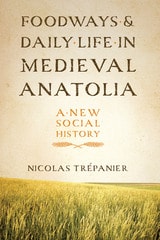
Foodways and Daily Life in Medieval Anatolia
A New Social HistoryBy Nicolas Trépanier
University of Texas Press, 2014
Byzantine rule over Anatolia ended in the eleventh century, leaving the population and its Turkish rulers to build social and economic institutions throughout the region. The emerging Anatolian society comprised a highly heterogeneous population of Christians and Muslims whose literati produced legal documents in Arabic, literary texts in Persian, and some of the earliest written works in the Turkish language. Yet the cultural landscape that emerged as a result has received very little attention—until now.
Investigating daily life in Anatolia during the fourteenth century, Foodways and Daily Life in Medieval Anatolia draws on a creative array of sources, including hagiographies, archaeological evidence, Sufi poetry, and endowment deeds, to present an accessible portrait of a severely under-documented period. Grounded in the many ways food enters the human experience, Nicolas Trépanier’s comprehensive study delves into the Anatolian preparation of meals and the social interactions that mealtime entails—from a villager’s family supper to an elaborately arranged banquet—as well as the production activities of peasants and gardeners; the marketplace exchanges of food between commoners, merchants, and political rulers; and the religious landscape that unfolded around food-related beliefs and practices. Brimming with enlightening details on such diverse topics as agriculture, nomadism, pastoralism, medicine, hospitality, and festival rituals, Foodways and Daily Life in Medieval Anatolia presents a new understanding of communities that lived at a key juncture of world history.
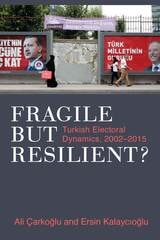
Fragile but Resilient?
Turkish Electoral Dynamics, 2002-2015Ali Çarkoglu and Ersin Kalaycioglu
University of Michigan Press, 2021
Ersin Kalaycıoğlu and Ali Çarkoğlu, who conducted surveys comparable to the American National Election Survey for the 2002 and 2015 national elections in Turkey, chart the dynamics that brought the pro-Islamist conservative Justice and Development Party (Adalet ve Kalkınma Partisi-AKP) to power in 2002, and that continue to influence electoral politics. The authors trace the uneven course of democratization in Turkey, as revealed through elections, since the first competitive, multi-party elections in 1950. Since the market liberalization reforms of 1980, Turkey has been rapidly evolving from a closed, agricultural, comparatively underdeveloped polity into an open and industrial state primarily integrated with the global economy. Kalaycıoğlu and Çarkoğlu analyze different dimensions of five elections surveys in 2002-2015 period to show how the consequent socio-economic changes and traditional socio-cultural divisions have affected elections, political parties, and individual voters. The authors conclude that the historical-cultural divide between rural, peripheral, conservative groups and more urban, centrist, and modernized groups not only persists but shapes elections more than ever. This book not only provides an original comprehensive and critical evaluation of the Turkish electoral and party politics, it also offers a case study of voting behavior in a state undergoing both democratization and market liberalization in a rapidly changing and volatile international environment.

Fragments of Culture
The Everyday of Modern TurkeyKandiyoti, Deniz
Rutgers University Press, 2002
In this volume, some of the most innovative scholars of post 1980s Turkey address the complex ways that suburbanization and the growth of a globalized middle class have altered gender and class relations, and how Turkish society is being shaped and redefined through consumption. They also explore the increasingly polarized cultural politics between secularists and Islamists, and the ways that previously repressed Islamic elements have reemerged to complicate the idea of an "authentic" Turkish identity. Contributors examine a range of issues from the adjustments to religious identity as the Islamic veil becomes marketed as a fashion item, to the media's increased attention in Turkish transsexual lifestyle, to the role of folk dance as a ritualized part of public life. Fragments of Culture shows how attention to the minutiae of daily life can successfully unravel the complexities of a shifting society. This book makes a significant contribution to both modern Turkish studies and the scholarship on cross-cultural perspectives in Middle Eastern studies.
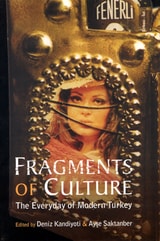
Fragments of Culture
The Everyday of Modern TurkeyKandiyoti, Deniz
Rutgers University Press, 2002
In this volume, some of the most innovative scholars of post 1980s Turkey address the complex ways that suburbanization and the growth of a globalized middle class have altered gender and class relations, and how Turkish society is being shaped and redefined through consumption. They also explore the increasingly polarized cultural politics between secularists and Islamists, and the ways that previously repressed Islamic elements have reemerged to complicate the idea of an "authentic" Turkish identity. Contributors examine a range of issues from the adjustments to religious identity as the Islamic veil becomes marketed as a fashion item, to the media's increased attention in Turkish transsexual lifestyle, to the role of folk dance as a ritualized part of public life. Fragments of Culture shows how attention to the minutiae of daily life can successfully unravel the complexities of a shifting society. This book makes a significant contribution to both modern Turkish studies and the scholarship on cross-cultural perspectives in Middle Eastern studies.
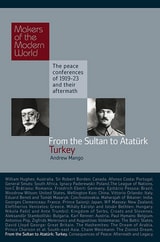
From the Sultan to Atatürk
TurkeyAndrew Mango
Haus Publishing, 2009