109 books match the query 'United States. Army' and 9 start with f
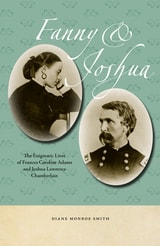
cover of Fanny & Joshua: The Enigmatic Lives of Frances Caroline Adams and Joshua Lawrence Chamberlain

Fanny & Joshua

The Enigmatic Lives of Frances Caroline Adams and Joshua Lawrence Chamberlain

Diane Monroe Smith

University Press of New England, 2013
Joshua Chamberlain has fascinated historians and readers ever since his service in the Civil War caused his commanding officers to sit up and take notice when the young professor was on the field. What makes a man a gifted soldier and natural leader? In this compelling book, Diane Monroe Smith argues that finding the answer requires a consideration of Chamberlain’s entire life, not just his few years on the battlefield. Truly understanding Chamberlain is impossible, Smith maintains, without exploring the life of Joshua’s soul mate and wife of almost fifty years, Fanny. In this dual biography, Fanny emerges as a bright, talented woman who kept Professor, General, and then Governor Chamberlain on his toes. But you don’t have to take Smith’s word for it. Liberally quoting from years of correspondence, the author invites you to judge for yourself.
[more]
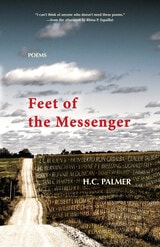
cover of Feet of the Messenger: poems

Feet of the Messenger

poems

H. C. Palmer

BkMk Press, 2017

Winner, Kansas Notable Book
Balcones Poetry Prize Finalist

Feet of the Messenger explores H.C. Palmer’s experiences as a medical doctor, especially as an army surgeon in the Vietnam War, and his feelings for and memories of his native Kansas, especially the Flint Hills. Although he has only been writing poetry for ten years, Palmer’s work reflects decades of discovering how the war kept coming back to him, even on the prairie.
[more]
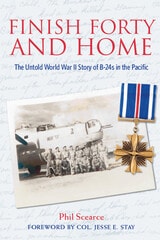
cover of Finish Forty and Home: The Untold World War II Story of B-24s in the Pacific

Finish Forty and Home

The Untold World War II Story of B-24s in the Pacific

Phil Scearce

University of North Texas Press, 2011
[more]
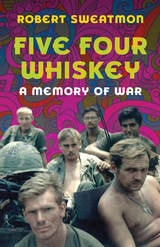
cover of Five Four Whiskey: A Memory of War

Five Four Whiskey

A Memory of War

Robert Sweatmon

Westholme Publishing, 2014

A Personal Reflection of a Frontline Soldier in Vietnam and Cambodia During the Cultural Maelstrom of the 1960s  
In late 1969, twenty-year-old Robert Sweatmon received a letter informing him that he had ten days to report to the United States Army. Like thousands of others, he had been drafted. Assigned as a rifleman with a mechanized unit, the author began a year-long odyssey in the Southeast Asian wilderness that would change his and his fellow soldiers’ lives forever.
Taking its title from the nighttime radio code call and response between base camp and those on ambush patrol, Five Four Whiskey: A Memory of War is a moving account of life as a combat soldier in the Vietnam War. Set mostly in the sprawling woods and rubber plantations northwest of Saigon, the author explains what his unit was asked to do and what obstacles they faced, including an elusive but deadly enemy, multiple kinds of booby traps, and antitank mines. The author, a notable television personality following the war, does not sensationalize his account; rather, his book allows a new generation to understand the emotional and physical pressures of the times. Coming of age in the maelstrom of civil rights and the free love culture, the author and his fellow soldiers saw their idealism quickly vaporize in the face of the grim realities of war. Here they learned to compartmentalize their lives as a way to survive, but it was their strong bonds that ultimately kept them from succumbing to the madness that surrounded them. Kept in the field for almost the entire time of his tour, the author was in a unit selected to conduct a clandestine reconnaissance in Cambodia and then lead the 1970 invasion, where he was wounded. Following his convalescence, he was sent to Nui Ba Den, the fabled ghost mountain haunted by the spirit of a Vietnamese princess, until he received his papers that he had completed his combat service. At that moment, his year-long mental wall between soldier and civilian fell away as he counted the last terrifying hours before he was safely out of Vietnam. A tour-de-force of military memoir, written in an objective and often literary prose, Five Four Whiskey perfectly captures how ordinary civilian-soldiers survived an ordeal set in one of the most turbulent times in American history.
[more]
cover of Five Stars: Missouri's Most Famous Generals

Five Stars

Missouri's Most Famous Generals

James F. Muench

University of Missouri Press, 2006

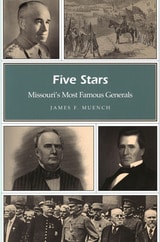
Missouri’s history is replete with strong and adventurous leaders, from Lewis and Clark to Harry S. Truman. It is no surprise, then, that the Show-Me State has produced a great number of military men and women, including thirty who attained the rank of general. In this clearly written and richly illustrated book, James F. Muench has profiled five of the best-known figures: Alexander William Doniphan, Sterling Price, Ulysses S. Grant, John J. Pershing, and Omar Bradley. These men represent a number of historical eras–from the Mexican-American War through World War II–and a variety of social and cultural backgrounds.
            Doniphan, who served in the Mexican-American War, and Price, who served in the Civil War on the Confederate side, were citizen soldiers who rose through the ranks of their local militias. Grant, who served in the Civil War on the Union side; Pershing, who served in World War I; and Bradley, who served in World War II, were professional soldiers who represented the trend in the modern army as general as manager and graduated from the United States Military Academy at West Point. While noting the diversity among the generals, Muench also is careful to emphasize the connections and commonalities among them.
            Five Stars: Missouri’s Most Famous Generals dedicates one chapter to each general. With lively, clear language, Muench gives readers an effective and entertaining primer on the lives and times of Missouri’s celebrated generals and their roles in American history, focusing in particular on their battlefield exploits. This book is sure to appeal to anyone interested in Missouri history, as well as those interested in military leadership.
[more]
cover of For You, Lili Marlene: A Memoir Of World War II

For You, Lili Marlene

A Memoir Of World War II

Robert Peters

University of Wisconsin Press, 1996
[more]
cover of Freedom's Witness: The Civil War Correspondence of Henry McNeal Turner

Freedom's Witness

The Civil War Correspondence of Henry McNeal Turner

Jean Lee Cole

West Virginia University Press, 2013
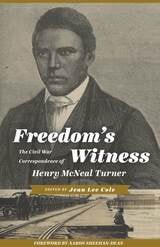
In a series of columns published in the African American newspaper The Christian Recorder, the young, charismatic preacher Henry McNeal Turner described his experience of the Civil War, first from the perspective of a civilian observer in Washington, D.C., and later, as one of the Union army’s first black chaplains.
 
In the halls of Congress, Turner witnessed the debates surrounding emancipation and black enlistment. As army chaplain, Turner dodged “grape” and cannon, comforted the sick and wounded, and settled disputes between white southerners and their former slaves. He was dismayed by the destruction left by Sherman’s army in the Carolinas, but buoyed by the bravery displayed by black soldiers in battle. After the war ended, he helped establish churches and schools for the freedmen, who previously had been prohibited from attending either.
 
Throughout his columns, Turner evinces his firm belief in the absolute equality of blacks with whites, and insists on civil rights for all black citizens. In vivid, detailed prose, laced with a combination of trenchant commentary and self-deprecating humor, Turner established himself as more than an observer: he became a distinctive and authoritative voice for the black community, and a leader in the African Methodist Episcopal church. After Reconstruction failed, Turner became disillusioned with the American dream and became a vocal advocate of black emigration to Africa, prefiguring black nationalists such as Marcus Garvey and Malcolm X. Here, however, we see Turner’s youthful exuberance and optimism, and his open-eyed wonder at the momentous changes taking place in American society.
 
Well-known in his day, Turner has been relegated to the fringes of African American history, in large part because neither his views nor the forms in which he expressed them were recognized by either the black or white elite. With an introduction by Jean Lee Cole and a foreword by Aaron Sheehan-Dean, Freedom’s Witness: The Civil War Correspondence of Henry McNeal Turner restores this important figure to the historical and literary record.

[more]
cover of From Conciliation to Conquest: The Sack of Athens and the Court-Martial of Colonel John B. Turchin

From Conciliation to Conquest

The Sack of Athens and the Court-Martial of Colonel John B. Turchin

George C. Bradley and Richard L. Dahlen

University of Alabama Press, 2006

In the summer of 1862, the U.S. Army court martialed Colonel John B. Turchin, a Russian-born Union officer, for "outrages" committed by his troops in Athens, Alabama

In the summer of 1862, the U.S. Army court martialed Colonel John B. Turchin, a Russian-born Union officer, for offenses committed by his troops in Athens, Alabama, including looting, safe cracking, the vandalization of homes, and the rape of young black women. The pillage of Athens violated a government policy of conciliation; it was hoped that if Southern civilians were treated gently as citizens of the United States, they would soon return their allegiance to the federal government.
 
By examining the volunteers who made up Turchin’s force, the colonel's trial, his subsequent promotion, the policy debate surrounding the incident and the public reaction to the outcome, the authors further illuminate one of the most provocative questions in Civil War studies: how did the policy set forth by President Lincoln evolve from one of conciliation to one far more modern in nature, placing the burden of war on the civilian population of the South?
[more]
cover of From Home Guards to Heroes: The 87th Pennsylvania and Its Civil War Community

From Home Guards to Heroes

The 87th Pennsylvania and Its Civil War Community

Dennis W. Brandt

University of Missouri Press, 2007

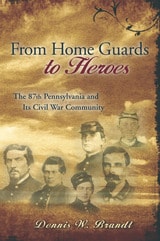
The soldiers of the 87th Pennsylvania Infantry fought in the Overland campaign under Grant and in the Shenandoah valley under Sheridan, notably at the Battle of Monocacy. But as Dennis Brandt reveals in From Home Guards to Heroes, their real story takes place beyond the battlefield. The 87th drew its men from the Scotch-Irish and German populations of York and Adams counties in south-central Pennsylvania—a region with closer ties to Baltimore than to Philadelphia—where some citizens shared Marylanders’ southern views on race while others aided the Underground Railroad.
Brandt’s unique regimental history investigates why these “boys from York” enlisted and why some deserted, the ways in which soldiers reflected their home communities, and the area’s attitudes toward the war both before and after hostilities broke out. Brandt takes a humanistic approach to the Civil War, revealing the more personal aspects of the struggle in a book that focuses on the soldiers themselves.
Using their own words to describe action both on and off the battlefield, he sheds light on the lives of ordinary men: the comparative values of farm and city boys, their motives and concerns, the effect of battle on soldiers and their families, and the suffering that veterans took to the grave. Brandt also looks at soldiers’ racial views, illuminating their deepest worries about the war, and at community politics and problems of discipline surrounding this ideologically divided unit.
Grounded in more than a decade of research into nearly two thousand military records, this is one of the few regimental histories based on more than one thousand pension records for the entire regiment, plus nearly eight hundred additional record sets for other area soldiers. Brandt tapped regional newspapers and a cache of unpublished letters and diaries—some from private collections not previously known—to provide an invaluable account of Civil War sensibilities in a northern area bordering a slave state.
From Home Guards to Heroes is a book about war in which humanity rather than troop movement takes center stage. Engagingly written for a wide audience and meticulously researched, it offers a distinctive image of a community and the intimate lives of the men it sent off to fight—and a story that will intrigue any Civil War aficionado.
[more]