Results by title
1566 books match the query 'Christianity' and 58 start with f
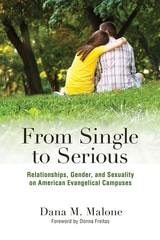
From Single to Serious
Relationships, Gender, and Sexuality on American Evangelical CampusesMalone, Dana M.
Rutgers University Press, 2018
College students hook up and have sex. That is what many students expect to happen during their time at university—it is part of growing up and navigating the relationship scene on most American campuses today. But what do you do when you’re a student at an evangelical university? Students at these schools must negotiate a barrage of religiously imbued undercurrents that impact how they think about relationships, in addition to how they experience and evaluate them. As they work to form successful unions, students at evangelical colleges balance sacred ideologies of purity, holiness, and godliness, while also dealing with more mainstream notions of popularity, the online world, and the appeal of sexual intimacy.
In From Single to Serious, Dana M. Malone shines a light on friendship, dating, and, sexuality, in both the ideals and the practical experiences of heterosexual students at U. S. evangelical colleges. She examines the struggles they have in balancing their gendered and religious presentations of self, the expectations of their campus community, and their desire to find meaningful romantic relationships.
In From Single to Serious, Dana M. Malone shines a light on friendship, dating, and, sexuality, in both the ideals and the practical experiences of heterosexual students at U. S. evangelical colleges. She examines the struggles they have in balancing their gendered and religious presentations of self, the expectations of their campus community, and their desire to find meaningful romantic relationships.
[more]
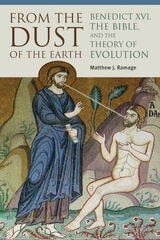
From the Dust of the Earth
Benedict XVI, the Bible , and the Theory of EvolutionMatthew J. Ramage
Catholic University of America Press, 2022
The claim that evolution undermines Christianity is standard fare in our culture. Indeed, many today have the impression that the two are mutually exclusive and that a choice must be made between faith and reason—rejecting Christianity on the one hand or evolutionary theory on the other. Is there a way to square advances in this field of study with the Bible and Church teaching?
In this book—his fourth dedicated to applying Joseph Ratzinger/Benedict XVI’s wisdom to pressing theological difficulties—Matthew Ramage answers this question decidedly in the affirmative. Distinguishing between evolutionary theory properly speaking and the materialist attitude that is often conflated with it, Ramage’s work meets the challenge of evolutionary science to Catholic teaching on human origins, guided by Ratzinger’s conviction that faith and evolutionary theory mutually enrich one another.
Pope Benedict gifted the Church with many pivotal yet often-overlooked resources for engaging evolution in the light of faith, especially in those instances where he addressed the topic in connection with the Book of Genesis. Ramage highlights these contributions and also makes his own by applying Ratzinger’s principles to such issues as the meaning of man’s special creation, the relationship between sin and death, and the implications of evolution for eschatology. Notably, Ramage shows that many apparent conflicts between Christianity and evolutionary theory lose their force when we interpret creation in light of the Paschal Mystery and fix our gaze on Jesus, the New Adam who reveals man to himself.
Readers of this text will find that it does more than merely help to resolve apparent contradictions between faith and modern science. Ramage’s work shows that discoveries in evolutionary biology are not merely difficulties to be overcome but indeed gifts that yield precious insight into the mystery of God’s saving plan in Christ.
[more]
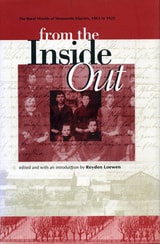
From the Inside Out
The Rural Worlds of Mennonite DiaristsRoyden Loewen
University of Manitoba Press, 1999
Historian Royden Loewen has brought together selections from diaries kept by 21 Mennonites in Canada between 1863 and 1929, some translated from German for the first time. By skillfully comparing and contrasting a wide cross-section of lives, Loewen shows how these diaries often turn the hidden contours of household and community "inside out." The writers featured were ordinary rural people: young women and grandmothers, rural preachers and landless householders. They include a teenaged boy who immigrated from Russia to Manitoba in 1875 as well as a successful merchant, a traveling evangelist, and a devout, conservative church elder. An elderly grandfather recounted the daily circuit of his children's homes, while 19-year-old Marie Schoeder wrote of her literary aspirations, her "secret hope" that some day she would "write things that have a real worth, things that are worth printing, and things that other folks would love to read and pay for." From the Inside Out also contrasts diaries from two distinct Mennonite communities in Canada. The Swiss-American Mennonites in Waterloo County, Ontario, faced rapid urbanization, while the Dutch-Russian Mennonites in southern Manitoba maintained their more rural environment. The diaries mirror their writers' preoccupations with work and weather, but they also reveal a communityís social structure and round of activities such as weddings, funerals, and worship services. In the process of diary-keeping, the writers sought to make sense of a dynamic and often unpredictable world. Reading what they chose to record is to learn much about their culture. Their writings provide glimpses of their lives, their collective mindset, and their history as a people.
[more]
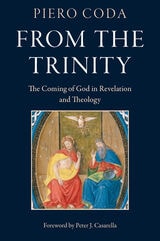
From the Trinity
The Coming of God in Revelation and TheologyPiero Coda
Catholic University of America Press, 2020
From the Trinity provides an overall view of the history and the philosophical and theological significance of God the Trinity, not only from a religious point of view but from an anthropological and socio-cultural view as well. The perspective is that of Christian doctrine, specifically Catholic, in dialogue with the cultural sensitivity of our times and with the religious pluralism that characterizes it.
Following the generative-progressive method proposed by Vatican II, the book begins with a phenomenological reading of the signs of the times, with special focus upon the performative aspect of the announcement and the doctrine of faith. In particular, constant attention to the contribution made by the mystics and great charisms (from Augustine of Hippo to Francis of Assisi and Theresa of Avila up until Therese of Lisieux, Edith Stein and Chaira Lubich) toward a deeper understanding of the Trinitarian truth.
From the Trinity is unique in what it offers not only for Trinitarian theology, but also for other theological disciplines (Christology, Pneumatology, Anthropology, Ecclesiology, etc.) – in which the Trinity shines forth as the central and enlightening truth – as well as for philosophy, the humanities and the natural sciences. This perspective is especially developed in terms of a Trinitarian ontology (see Part V) by which reality is understood in light of the revelation of the Trinity. The implications of the incarnation of the Son of God and the gift of the Holy Spirit are taken seriously in studying the truth of all things as they are perceived in the space created by living and thinking “in” Jesus, united to the Father in the Spirit, as suggested by the title of the book, looking upon reality “From the Trinity.”
[more]

Frozen Embryos
A Catholic Moral Evaluation of Embryo Adoption, Cryopreservation, Rehydration & Artifical WombsIrene Alexander
Catholic University of America Press, 2027
In the decades following the rise of in vitro fertilization, hundreds of thousands of human embryos have been cryopreserved and ultimately abandoned, raising urgent and largely unresolved ethical questions. What moral responsibilities are owed to these embryonic human lives, and what courses of action remain open to those seeking to act with integrity in the face of this technological legacy?
In this work, Irene Alexander offers a careful and rigorous examination of the ethical possibilities surrounding abandoned frozen embryos. Drawing on philosophical reasoning, theological insight, and contemporary bioethical debate, she evaluates a range of proposed responses, including embryo adoption, indefinite cryopreservation, thawing without transfer, and the emerging prospect of artificial wombs. Each option is assessed not only for its practical implications but also for its coherence with a robust account of human dignity and moral responsibility.
Rather than offering simplistic solutions, Alexander clarifies the moral principles at stake, illuminating the tensions between compassion, justice, and the limits of technological intervention. She situates the problem within a broader cultural and scientific context, showing how developments in reproductive technology have outpaced the ethical frameworks needed to guide them.
Accessible to educated readers while grounded in serious scholarship, this book provides a much-needed framework for thinking clearly about one of the most complex bioethical dilemmas of our time. It will be of particular interest to scholars, students, and practitioners in bioethics, theology, philosophy, and medicine, as well as to anyone seeking to understand the moral contours of life in an age of unprecedented technological power.
[more]
Fundamental Soteriology
On the Fullness of LifeMichal Paluch
Catholic University of America Press, 2026
Fullness of Life is a basic introduction to the Catholic understanding of salvation. It begins with a presentation of the background against which the teaching on salvation must be situated (the contemporary context of the question of salvation, the positions of other religions, the teaching of the magisterium) (chapter one), and a concise sketch on the history of soteriology (chapter two). The following chapters are a discussion of models for interpreting salvation relating to Christ's death on the cross (chapter three) and the totality of His life (chapter four). These considerations are concluded with a presentation of St. Thomas Aquinas' interpretative proposal (chapter five), which proves to be an apt way to synthesize the discussions presented earlier. The model of salvific mediation eventually turns out to be a higher-order model that allows to close the entire presentation (chapter six). The body of the text is supplemented by appendices that discuss a chosen set of particular problems related to the reflections in the corpus, that is, the “scapegoat” as a figure of Christ, the salvific function of other religions, substitution in Aquinas, and salutary suffering. The entire text ends with a selection of relevant sources.
With the help of such a structure, the book proposes a basic explanation of (sometimes distorted) interpretations of sacrifice, substitution, satisfaction, divinization. It helps to bring readers from their first steps of soteriological reflection to Aquinas’ synthesis and to help them to discover that – taking into account the contemporary discussions and problems – Aquinas’ account can still offer a very convincing way for synthesizing soteriology.
The book is addressed primarily to students of theology. However, it has been written in such a way that any Christian properly motivated to deepen their faith can benefit from reading it. And since it may serve as an aid in learning how to interpret the whole of soteriology, professional theologians may also find themselves inspired by it.
[more]
Fundamental Theology
Guy Mansini, OSB
Catholic University of America Press, 2018
Fundamental Theology examines the light by which the mysteries of Christ and the Church, the Trinity and the Sacraments, are revealed to us. That light we call "revelation," and fundamental theology examines in the first place what this light shows about itself, and how it is sustained in the world. Or again, fundamental theology considers what the word of God has to say both about itself and what it has to say about where in the world it is to be heard. So, first it is a theology of Revelation (chapter 1), and second, a theology of the transmission of Revelation in Tradition, Scripture, and the Church (chapters 2, 3, and 4). Why must Revelation have the shape it does, and why must it be constituted by both word and event? Why is Tradition prior to Scripture, why must the word of God be written down, and why must Scripture come to us in two testaments? And why must the message conveyed in Tradition and Scripture have a living interpreter in the Church?
Since no word is spoken unless it is heard, fundamental theology also investigates the conditions of hearing the word of God, the very hearing itself in the assent of faith, and a necessary consequence of this hearing. The remote conditions of hearing are also what theology calls our ability to come to the knowledge of the preambula fidei- the things about God than can be known by the natural light (chapter 5). The immediate condition of hearing is the credibility of the word (chapter 6). Hearing is faith (chapter 7). And true hearing gives the hearer to recapitulate what is heard in his own wondering and thankful voice in theology (chapter 8). The introduction to theology in the last chapter is by way of considering the history of Catholic theology in the 20th century.
Since no word is spoken unless it is heard, fundamental theology also investigates the conditions of hearing the word of God, the very hearing itself in the assent of faith, and a necessary consequence of this hearing. The remote conditions of hearing are also what theology calls our ability to come to the knowledge of the preambula fidei- the things about God than can be known by the natural light (chapter 5). The immediate condition of hearing is the credibility of the word (chapter 6). Hearing is faith (chapter 7). And true hearing gives the hearer to recapitulate what is heard in his own wondering and thankful voice in theology (chapter 8). The introduction to theology in the last chapter is by way of considering the history of Catholic theology in the 20th century.
[more]
Fundamental Theology According to Newman
The Principles of ChristianityFernando Maria Cavaller
Catholic University of America Press, 2026
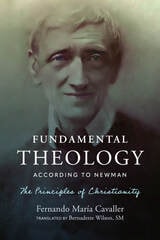
Although Newman certainly did not write the Essay on the Development of Christian Doctrine with the intention to do systematic theology, his ten principles serve as a framework for ordering the content of the essay with reference to Newman's other works. The result in this present book is a systematic analysis of the theological themes considered by Newman throughout his writing career.
Newman’s writings were circumstantial in nature, written in response to controversies or needs of the moment. Nevertheless, he was able to shed light on those specific situations by appealing to timeless theological insights. The originality of this book consists in placing these insights in a systematic context. The arrangement is structured as a fundamental theology, following the usual discourse on God's revelation and faith as a response, with a brief intermediate exposition of fundamental Christology and ecclesiology.
In order to give it Newman's own imprint, the author has provided only brief introductions or comments, as well as references to other authors, giving priority to Newman's own texts. In this way the work serves as an introduction to the thought and even to the life of John Henry Newman, whose literary style denotes the union of theological questions with a living faith.
[more]