Results by title
2728 books match the query 'Education' and 80 start with f
Four Point Listening and Speaking 2, Second Ed., Supplemental Audiofiles
Audio DownloadBetsy Parrish
University of Michigan Press, 2014
This audio download product is NOT an audio reproduction of all the content in the accompanying textbook (Four Point: Listening & Speaking 2, Second Edition).
The Four Point series is designed for English language learners whose primary goal is to succeed in an academic setting.The series covers the four academic skills of reading, writing, listening, and speaking while providing reinforcement and systematic recycling of key vocabulary and further exposure to grammar issues. In order to participate in academic settings, English learners need focused activities to develop and then maintain their use of vocabulary and grammar. Each book in the series focuses heavily on vocabulary in particular, highlighting between 125-150 key vocabulary items including individual words, compound words, phrasal verbs, short phrases, idioms, metaphors, collocations, and longer set lexical phrases.
Four Point Listening and Speaking 2, Second Edition (No Audio)
English for Academic PurposesBetsy Parrish
University of Michigan Press, 2018
This version has the same content as 978-0-472-03535-9; it just is not packaged with the audio. The audio (MP3) files, available for download, must be purchased separately: 978-0-472-00362-4.
This product replaces 978-0-472-03535-9.
The Four Point series is designed for English language learners whose primary goal is to succeed in an academic setting.The series covers the four academic skills of reading, writing, listening, and speaking while providing reinforcement and systematic recycling of key vocabulary and further exposure to grammar issues. In order to participate in academic settings, English learners need focused activities to develop and then maintain their use of vocabulary and grammar. Each book in the series focuses heavily on vocabulary in particular, highlighting between 125-150 key vocabulary items including individual words, compound words, phrasal verbs, short phrases, idioms, metaphors, collocations, and longer set lexical phrases.
The 2nd Edition of Listening-Speaking 2 contains six lectures on the topic within a field of academic study: applied linguistics, geology, economics, history, health sciences, and engineering. The lectures range in length from 11 to 16 minutes in length. Audio files are sold separately. The exercises practice an array of important academic listening and speaking skills, including making presentations, and also reinforce vocabulary and reading and writing skills. Each unit includes activities based on the in-class interactions students will encounter in academic settings—including making impromptu and prepared presentations, debating, participating in group discussions. Toward this end, video scenes (available on the companion website) for each unit model student behavior when working in groups and incorporate key words and phrases typically used when working in groups. By addressing the breadth and depth of listening and speaking tasks required in academic settings, students will grow confident in areas that build the fluencies needed to succeed in their academic endeavors.
Fourth Genre
Twenty-Five Essays from Our First Twenty-Five YearsJoey Franklin
Michigan State University Press, 2025
Fragments of Truth
Residential Schools and the Challenge of Reconciliation in CanadaNaomi Angel. Edited by Dylan Robinson and Jamie Berthe.
Duke University Press, 2022
Framing Identities
Autobiography and the Politics of PedagogyWendy S. Hesford
University of Minnesota Press, 1999
A trenchant examination of the political dynamics of autobiography in education.
How do historically marginalized groups expose the partiality and presumptions of educational institutions through autobiographical acts? How are the stories we tell used to justify resistance to change or institutional complacency? These are the questions Wendy S. Hesford asks as she considers the uses of autobiography in educational settings. This book demonstrates how autobiographical acts-oral, written, performative, and visual-play out in vexed and contradictory ways and how in the academy they can become sites of cultural struggle over multicultural education, sexual harassment, institutional racism, hate speech, student activism, and commemorative practices.
Within the context of Oberlin, a small liberal arts college in Ohio, and beginning with a speak-out organized by Asian American students in 1995, this book looks at the uses of autobiographical practices in empowering groups traditionally marginalized in academic settings. Investigating the process of self-representation and the social, spatial, and discursive frames within which academic bodies and identities are constituted, Framing Identities explores the use of autobiographical acts in terms of power, influence, risks involved, and effectiveness. Hesford does not endorse autobiography as an unequivocal source of empowerment, however. Instead, she illustrates how autobiographical practices in the academy can mobilize competing and often irreconcilable interests. Hesford argues that by integrating self-reflection into cultural, rhetorical, and material analyses-and encouraging students to do the same-teachers not only will largely justify attention to the personal in the classroom, they will help their communities move beyond a naive identity politics. Framing Identities provides a model for teacher-researchers across the disciplines (education, English, composition, cultural studies, women’s studies, to name a few) to investigate the contradictory uses and consequences of autobiography at their own institutions, and to carve out new pedagogical spaces from which they and their students can emerge as social, political, and intellectual subjects.
Fraud and Misconduct in Research
Detection, Investigation, and Organizational ResponseNachman Ben-Yehuda and Amalya Oliver-Lumerman
University of Michigan Press, 2017

Freaks of History
Two Performance TextsJames MacDonald
Intellect Books, 2017
MacDonald, who is cerebral palsied, recognizes that disability narratives are rarely written by and for disabled people. Therefore his plays, accompanied by critical essays and director’s notes, are a welcome addition to the emerging discourse of Crip theory, and essential reading for disability students and academics alike.
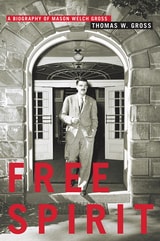
Free Spirit
A Biography of Mason Welch GrossThomas W. Gross
Rutgers University Press, 2022
Free Spirit explores how Gross helped reshape Rutgers from a sleepy college into a world-renowned public research university. It also reveals how he steered the university through the tumult of the Red Scare, civil rights era, and the Vietnam War by taking principled stands in favor of both racial equality and academic freedom. This biography tells the story of how, from an early age, Gross came to believe in the importance of doing what was right, even when the backlash took a toll on his own health.
Written by his youngest son Thomas, this book offers a uniquely well-rounded portrait of Gross as both a public figure and a private person. Covering everything from his service in World War II to his stints as a game-show personality, Free Spirit introduces the reader to a remarkable academic leader.

Freedom Through Education
Lotus Coffman
University of Minnesota Press, 1939
From Child Art to Visual Language of Youth
New Models and Tools for Assessment of Learning and Creation in Art EducationEdited by Andrea Kárpáti and Emil Gaul
Intellect Books, 2013
From Class to Identity
The politics of education reforms in former YugoslaviaJana Bacevic
Central European University Press, 2014
From Expectation to Experience
Essays on Law and Legal EducationJames Boyd White
University of Michigan Press, 2000
The essays here are united by two basic themes. First, the essays suggest that law can usefully be regarded not only as a set of rules designed to produce results in the material world, as it usually is regarded, but also as an imaginative and intellectual activity that has as its end the claim of meaning for human experience, both individual and collective. Second, they argue that education, including in the law, works by the constant modification of expectation by experience.
White claims that as we grow, whether as individuals or as a community, we constantly shape our expectations to our experiences. This happens with particular force and clarity in the law, which seeks to create both a certain set of expectations--this is how it works as a system of regulation--and a series of occasions and methods for their revision. White's interest is in the way these understandings can affect legal teaching, practice, and criticism.
The essays in this book examine such topics as the nature of legal education; the possibilities for writing in the law for both judges and lawyers; the relation between the practice of making and claiming meaning as it works in the law and in literatures more usually though of as imaginative, such as poetry or drama; the ways in which the law talks, and ought to talk, about business corporations, religion, and individual judgments; and the ethical possibilities of the practice of law when it is conceived of as a field for the making of meaning.
From Expectation to Experience will be of interest to lawyers, legal scholars, as well as students of law, law and literature, and ethics and literature.
James Boyd White is Hart Wright Professor of Law, Professor of English, and Adjunct Professor of Classical Studies, University of Michigan.
From High School to College
Gender, Immigrant Generation, and Race-EthnicityCharles Hirschman
Russell Sage Foundation, 2016
Today, over 75 percent of high school seniors aspire to graduate from college. However, only one-third of Americans hold a bachelor’s degree, and college graduation rates vary significantly by race/ethnicity and parental socioeconomic status. If most young adults aspire to obtain a college degree, why are these disparities so great? In From High School to College, Charles Hirschman analyzes the period between leaving high school and completing college for nearly 10,000 public and private school students across the Pacific Northwest.
Hirschman finds that although there are few gender, racial, or immigration-related disparities in students’ aspirations to attend and complete college, certain groups succeed at the highest rates. For example, he finds that women achieve better high school grades and report receiving more support and encouragement from family, peers, and educators. They tend to outperform men in terms of preparing for college, enrolling in college within a year of finishing high school, and completing a degree. Similarly, second-generation immigrants are better prepared for college than first-generation immigrants, in part because they do not have to face language barriers or learn how to navigate the American educational system.
Hirschman also documents that racial disparities in college graduation rates remain stark. In his sample, 35 percent of white students graduated from college within seven years of completing high school, compared to only 19 percent of black students and 18 percent of Hispanic students. Students’ socioeconomic origins—including parental education and employment, home ownership, and family structure—account for most of the college graduation gap between disadvantaged minorities and white students. Further, while a few Asian ethnic groups have achieved college completion rates on par with whites, such as Chinese and Koreans, others, whose socioeconomic origins more resemble those of black and Hispanic students, such as Filipinos and Cambodians, also lag behind in preparedness, enrollment, and graduation from college.
With a growing number of young adults seeking college degrees, understanding the barriers that different students encounter provides vital information for social scientists and educators. From High School to College illuminates how gender, immigration, and ethnicity influence the path to college graduation.
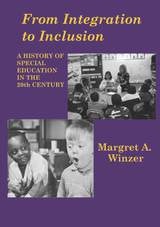
From Integration to Inclusion
A History of Special Education in the 20th CenturyMargret A. Winzer
Gallaudet University Press, 2009
Since Margret A. Winzer wrote her landmark work The History of Special Education, much has transpired in this field, which she again has captured in a remarkable display of scholarship. Winzer’s new study From Integration to Inclusion: A History of Special Education in the 20th Century focuses chiefly on the significant events of the twentieth and early twenty-first centuries in the United States and Canada. Its key dynamics consist of a retrospective overview of the paradigms that emerged from and shaped special education; a critical assessment of past progress and reform, including failures and disappointments; and an analysis of the theoretical diversity within the discipline.
In this stand-alone volume, Winzer juxtaposes the historical study of disability and of special schooling and service provision with reference to broader social systems, protocols, and practices. She documents how prevailing emotional and intellectual climates influence disability and schooling, and also takes into account the social, political, and ideological factors that affect educational theory and practice. Winzer recognizes that reform has been the Zeitgeist of the history of special education. Crucial problems such as defining exceptional conditions and separating them from one another were formulated in contexts organized along moral, theological, legislative, medical, and social dimensions. Many of these reforms failed for various reasons, which Winzer thoroughly explains in her study. Most of these reforms evolved from the long and honorable pedigree that the field of special education has possessed since its earliest antecedents, now admirably brought up to date by this outstanding work.
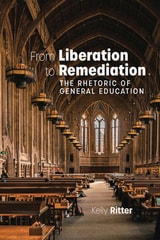
From Liberation to Remediation
The Rhetoric of General EducationKelly Ritter
Utah State University Press, 2026
Kelly Ritter addresses how lawmakers, for-profit testing companies, and even universities fuel public misconceptions of what Gen Ed can provide for our democracy and the role that a broad-based college education plays in social uplift. Tracing the history of the public rhetoric that persuades parents and students to see these courses as a set of interchangeable precollege credits to gain (or game) by any means necessary, she examines how positive and negative public responses to the curricula affected the position of core subjects in US universities, focusing on first-year writing. She also explores the role local, state, and organizational politics played in Gen Ed’s positioning, including decisions related to race, social class, and educational attainment; the impact credit-by-exemption and seamless transfer had on the quality and import of Gen Ed programming in both high schools and colleges; and the perceived use-value of the courses themselves in the face of rising college costs. Finally, she considers which student populations have benefited from the denigration of Gen Ed’s value and which have been left behind.
Drawing on archival research and case studies, From Liberation to Remediation raises important questions about equity, access, and the role of General Education in US higher education’s future and demonstrates that recovering the original post-war democratizing principles and practices of Gen Ed is critical to the continuance of a literate, empathetic, and civic-minded democracy for the twenty-first century.
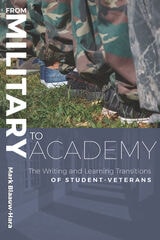
From Military to Academy
The Writing and Learning Transitions of Student-VeteransMark Blaauw-Hara
Utah State University Press, 2021
From Military to Academy is a detailed picture of how student-veterans may experience the shift to the college experience and academic writing. Grounding his research in the experiences of student-veterans at a community college, Blaauw-Hara integrates adult learning theory, threshold concepts, genre analysis, and student-veteran scholarship to help readers understand the challenges student-veterans experience and the strengths they bring as they enter the academic writing environment. Each chapter takes a different theoretical approach to frame student-veterans’ experiences, and Blaauw-Hara ends each chapter with specific, actionable pedagogical suggestions.
Composition studies scholars especially have demonstrated an ongoing interest in and commitment to understanding the experiences of student-veterans from military service to postsecondary education. From Military to Academy helps college writing faculty and writing program administrators understand and support the growing numbers of student-veterans who are making the transition to higher education.
From Parent to Child
Intrahousehold Allocations and Intergenerational Relations in the United StatesJere R. Behrman, Robert A. Pollak, and Paul Taubman
University of Chicago Press, 1995
The analyses in From Parent to Child explore these questions by developing and testing a model in which the earnings of children with different genetic endowments respond differently to investments in human capital. Behrman, Pollak, and Taubman use this model to investigate issues such as parental bias in resource allocations based on gender or birth order; the extent of intergenerational mobility in income, earnings, and schooling in the United States; the relative importance of environmental and genetic factors in determining variations in schooling; and whether parents' distributions offset the intended effects of government programs designed to subsidize children. In allocating scarce resources, parents face a trade-off between equity and efficiency, between the competing desires to equalize the wealth of their children and to maximize the sum of their earnings.
Building on the seminal work of Gary Becker, From Parent to Child integrates careful modeling of household behavior with systematic empirical testing, and will appeal to anyone interested in the economics of the family.
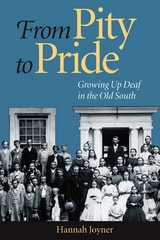
From Pity to Pride
Growing Up Deaf in the Old SouthHannah Joyner
Gallaudet University Press, 2004
The antebellum South’s economic dependence on slavery engendered a rigid social order in which a small number of privileged white men dominated African Americans, poor whites, women, and many people with disabilities. From Pity to Pride examines the experiences of a group of wealthy young men raised in the old South who also would have ruled over this closely regimented world had they not been deaf. Instead, the promise of status was gone, replaced by pity, as described by one deaf scion, “I sometimes fancy some people to treat me as they would a child to whom they were kind.”
In this unique and fascinating history, Hannah Joyner depicts in striking detail the circumstances of these so-called victims of a terrible “misfortune.” Joyner makes clear that Deaf people in the North also endured prejudice. She also explains how the cultural rhetoric of paternalism and dependency in the South codified a stringent system of oppression and hierarchy that left little room for self-determination for Deaf southerners. From Pity to Pride reveals how some of these elite Deaf people rejected their family’s and society’s belief that being deaf was a permanent liability. Rather, they viewed themselves as competent and complete. As they came to adulthood, they joined together with other Deaf Americans, both southern and northern, to form communities of understanding, self-worth, and independence.
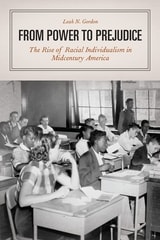
From Power to Prejudice
The Rise of Racial Individualism in Midcentury AmericaLeah N. Gordon
University of Chicago Press, 2015
To answer these questions, From Power to Prejudice examines American academia—both black and white—in the 1940s and ’50s. Gordon presents four competing visions of “the race problem” and documents how an individualistic paradigm, which presented white attitudes as the source of racial injustice, gained traction. A number of factors, Gordon shows, explain racial individualism’s postwar influence: individuals were easier to measure than social forces; psychology was well funded; studying political economy was difficult amid McCarthyism; and individualism was useful in legal attacks on segregation. Highlighting vigorous midcentury debate over the meanings of racial justice and equality, From Power to Prejudice reveals how one particular vision of social justice won out among many contenders.
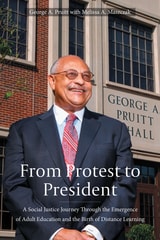
From Protest to President
A Social Justice Journey through the Emergence of Adult Education and the Birth of Distance LearningGeorge A Pruitt
Rutgers University Press, 2023
From barbershop encounters with Malcolm X to death threats at Illinois State University and gunfire at Towson State, Pruitt provides a powerful narrative poised at the intersection of social justice, higher education and politics. He recounts leadership experiences at HBCUs and public universities across the country, as he advocated for autonomy at Morgan State and fought to preserve Tennessee State University.
His steadfast activism, integrity and courage led to groundbreaking work in providing access to higher education for working adults and the military.
From his days as a student protester in high school and college to his appearances on Capitol Hill, Pruitt has earned the reputation as a candid and influential leader in higher education.

From Single to Serious
Relationships, Gender, and Sexuality on American Evangelical CampusesMalone, Dana M.
Rutgers University Press, 2018
In From Single to Serious, Dana M. Malone shines a light on friendship, dating, and, sexuality, in both the ideals and the practical experiences of heterosexual students at U. S. evangelical colleges. She examines the struggles they have in balancing their gendered and religious presentations of self, the expectations of their campus community, and their desire to find meaningful romantic relationships.
From Skepticism to Competence
How American Psychiatrists Learn PsychotherapyMariana Craciun
University of Chicago Press, 2024
While many medical professionals can physically examine the body to identify and understand its troubles—a cardiologist can take a scan of the heart, an endocrinologist can measure hormone levels, an oncologist can locate a tumor—psychiatrists have a much harder time unlocking the inner workings of the brain or its metaphysical counterpart, the mind.
In From Skepticism to Competence, sociologist Mariana Craciun delves into the radical uncertainty of psychiatric work by following medical residents in the field as they learn about psychotherapeutic methods. Most are skeptical at the start. While they are well equipped to treat brain diseases through prescription drugs, they must set their expectations aside and learn how to navigate their patients’ minds. Their instructors, experienced psychotherapists, help the budding psychiatrists navigate this new professional terrain by revealing the inner workings of talk and behavioral interventions and stressing their utility in a world dominated by pharmaceutical treatments. In the process, the residents examine their own doctoring assumptions and develop new competencies in psychotherapy. Exploring the world of contemporary psychiatric training, Craciun illuminates novice physicians’ struggles to understand the nature and meaning of mental illness and, with it, their own growing medical expertise.

From Socrates to Software
The Teacher as Text and the Text as TeacherEdited by Philip W. Jackson and Sophie Haroutunian-Gordon
University of Chicago Press, 1989
From Vermont to Michigan
Correspondence of James Burrill Angell: 1869-1871Edited by Wilfred B. Shaw
University of Michigan Press, 1936
From the Capitol to the Classroom
Standards-Based Reform in the StatesEdited by Susan Fuhrman
University of Chicago Press, 2001
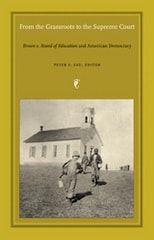
From the Grassroots to the Supreme Court
Brown v. Board of Education and American DemocracyPeter F. Lau, ed.
Duke University Press, 2004
The contributors illuminate the breadth of developments that led to Brown, from the parallel struggles for social justice among African Americans in the South and Mexican, Asian, and Native Americans in the West during the late nineteenth century to the political and legal strategies implemented by the National Association for the Advancement of Colored People (naacp) in the twentieth century. Describing the decision’s impact on local communities, essayists explore the conflict among African Americans over the implementation of Brown in Atlanta’s public schools as well as understandings of the ruling and its relevance among Puerto Rican migrants in New York City. Assessing the legacy of Brown today, contributors analyze its influence on contemporary law, African American thought, and educational opportunities for minority children.
Contributors
Tomiko Brown-Nagin
Davison M. Douglas
Raymond Gavins
Laurie B. Green
Christina Greene
Blair L. M. Kelley
Michael J. Klarman
Peter F. Lau
Madeleine E. Lopez
Waldo E. Martin Jr.
Vicki L. Ruiz
Christopher Schmidt
Larissa M. Smith
Patricia Sullivan
Kara Miles Turner
Mark V. Tushnet
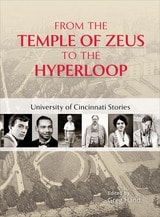
From the Temple of Zeus to the Hyperloop
University of Cincinnati StoriesEdited by Greg Hand
University of Minnesota Press, 2018
Former Ohio Governor Bob Taft remembers his law school days in a building named for his great-grandfather. Broadway star Faith Prince recalls her musical theater start at UC’s College-Conservatory of Music. More than thirty-five contributors provide their own unique perceptions of this extraordinary urban university. Some are well-known names like Taft and Prince, while others are current students and alumni whose education and futures were profoundly shaped by memorable experiences connected to UC. Clark Beck recounts the struggles he initially faced upon coming to UC and offers readers an inspiring story of perseverance and tenacity. Sid Thatham gives a captivating tale of his move from India and the home base he made in Cincinnati with UC graduate students. Other contributors celebrate the relationships, such as that between the strong-willed duo of Jack Rouse and Helen Laird, that give UC its storied past.
In From the Temple of Zeus to the Hyperloop, anyone can find a person, whether it be the trailblazing Lucy Braun or the celebrated Carl Blegen, or a place, be it the changing landscape of Ludlow Avenue or the new frontier for the DAAP College, to which he or she can relate. Such figures, places, and stories present a sampling of the UC experience. From the Temple of Zeus to the Hyperloop offers readers an inside look at the many lives that have influenced UC and the opportunity to envision how their own stories can be a part of its future.
Just as Hand titles his introduction, “a dedicated crew of bearcats assembled this book,” the University of Cincinnati and its story continue to be a community effort, deeply intertwined with the lives of the people who have made up the university and its two-hundred years.
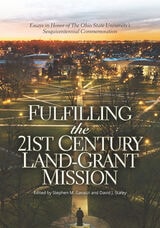
Fulfilling the 21st Century Land-Grant Mission
Essays in Honor of The Ohio State University’s Sesquicentennial CommemorationEdited by Stephen M. Gavazzi and David J. Staley
The Ohio State University Press, 2020
Gathered in honor of The Ohio State University’s sesquicentennial celebration, this collection of essays highlights the significant contributions that Ohio State continues to make as part of its twenty-first-century land-grant mission. Authors from across the university—representing fields as various as agriculture, dance, English, engineering, family science, geography, medicine, social work, and veterinary science—provide contributions that highlight the preeminent status of The Ohio State University. In addition, the perspectives of alumni, staff members, and senior administrators (both present and former) round out the picture of Ohio State as the first among equals regarding its land-grant peers. Overall, contributors draw on rich and varied institutional backgrounds to offer invaluable insights for higher education administrators and scholars across the US.
Fundamentals of Curriculum Planning, Development, Implementation, and Evaluation in English Language Teaching
Eman Elturki
University of Michigan Press, 2026
This book offers a systematic guide to navigating the different phases of the curriculum, from its inception to its evaluation. Part I explores the conceptual and theoretical foundations that shape curriculum and instruction. Part II provides practical knowledge and guidelines that programs and individual teachers can adopt or adapt to their specific educational contexts with the goal is to optimize the teaching and learning experience. Elturki draws largely on knowledge from the field of education, particularly curriculum studies, to complement what we know about L2 teaching and learning from Applied Linguistics, Second Language Acquisition, and English Language Teaching. Each chapter begins with pre-reading questions to stimulate thinking and concludes with post-reading questions for reflection, encouraging readers to connect the material to their own context.
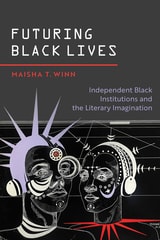
Futuring Black Lives
Independent Black Institutions and the Literary ImaginationMaisha T. Winn
Vanderbilt University Press, 2025
The rationale for establishing and valuing IBIs remains highly relevant, given the sociopolitical landscape of education today. In addition to persistent racial disparities in academic achievement and Black students’ highly disproportionate experiences of punishment and “discipline,” friction and legislation against critical examination of race, racism, and racist ideas in school settings are front and center, and children’s and young adult literature are under attack through censorship and outright book bans. Yet Black institution builders left useful maps of and for the educational future/s of Black children that remain available in journals, newspapers, pamphlets, and other ephemera. Author Maisha T. Winn demonstrates how and why the historiography-grounded futuring of Black education can and should inform current pursuits of equity, justice, and liberation through education.