Results by title
1832 books match the query 'Essays' and 74 start with f
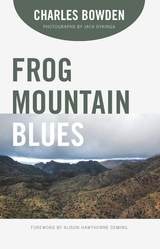
Frog Mountain Blues
Charles Bowden; Photographs by Jack Dykinga; Foreword by Alison Hawthorne Deming
University of Arizona Press, 2018
When it was first published in 1987, Frog Mountain Blues documented the creeping sprawl of new development up the Catalinas’ foothills. Today, that development is fully visible, but Charles Bowden’s prescience of the urgency to preserve and protect a sacred recreational space remains as vivid as ever. Accompanied by Jack W. Dykinga’s photographs from the original work, this book continues to convey the natural beauty of the Catalinas and warns readers that this unique wilderness could easily be lost.
As Alison Hawthorne Deming writes in the new foreword, “Frog Mountain Blues continues to be an important book for learning to read this place through the eyes of experience and history, and Bowden remains a sobering voice for facing our failures in protecting what we love in this time of global destruction, for taking seriously the power of language to set ourselves right again with the enormous task of living with purpose and presence and care on the land.”
From Black Sox to Three-Peats
A Century of Chicago's Best Sportswriting from the "Tribune," "Sun-Times," and Other NewspapersEdited by Ron Rapoport
University of Chicago Press, 2013
In From Black Sox to Three-Peats, veteran Chicago sports columnist Ron Rapoportassembles one hundred of the best columns and articles from the Tribune, Sun-Times, Daily News, Defender, and other papers to tell the unforgettable story of a century of Chicago sports. From Ring Lardner to Rick Telander, Westbrook Pegler to Bob Verdi, Mike Royko to Hugh Fullerton , Melissa Isaacson to Brent Musburger, and on and on, this collection reminds us that Chicago sports fans have enjoyed a wealth of talent not just on the field, but in the press box as well. Through their stories we relive the betrayal of the Black Sox, the cocksure power of the ’85 Bears, the assassin’s efficiency of Jordan’s Bulls, the Blackhawks’ stunning reclamation of the Stanley Cup, the Cubs’ century of futility—all as seen in the moment, described and interpreted on the spot by some of the most talented columnists ever to grace a sports page.
Sports are the most ephemeral of news events: once you know the outcome, the drama is gone. But every once in a while, there are those games, those teams, those players that make it into something more—and great writers can transform those fleeting moments into lasting stories that become part of the very identity of a city. From Black Sox to Three-Peats is Chicago history at its most exciting and celebratory. No sports fan should be without it.

From Broadway to The Bronx
New York City’s History through SongVeronika Keller and Sabrina Mittermeier
Intellect Books, 2026
From Broadway to the Bronx tells the history of New York City in song across a variety of different genres that the city has been home to and instrumental in developing, covering everything from early twentieth-century sheet music to Broadway’s musical theater, hip-hop, disco, punk, dancehall, but also contemporary metal, rock, and pop. It features an analysis of the work of artists with intimate connections to the city, like Billy Joel, Lin-Manuel Miranda, Debbie Harry, Shinehead, and the Wu-Tang Clan, as well as an exclusive interview with RENT original cast member Anthony Rapp. The collection includes essays from authors across the disciplines of cultural studies, media studies, cultural history, and musicology, resulting in a far-ranging treatment of the interconnection of the city space and its musical history.
From Child Art to Visual Language of Youth
New Models and Tools for Assessment of Learning and Creation in Art EducationEdited by Andrea Kárpáti and Emil Gaul
Intellect Books, 2013
From Expectation to Experience
Essays on Law and Legal EducationJames Boyd White
University of Michigan Press, 2000
The essays here are united by two basic themes. First, the essays suggest that law can usefully be regarded not only as a set of rules designed to produce results in the material world, as it usually is regarded, but also as an imaginative and intellectual activity that has as its end the claim of meaning for human experience, both individual and collective. Second, they argue that education, including in the law, works by the constant modification of expectation by experience.
White claims that as we grow, whether as individuals or as a community, we constantly shape our expectations to our experiences. This happens with particular force and clarity in the law, which seeks to create both a certain set of expectations--this is how it works as a system of regulation--and a series of occasions and methods for their revision. White's interest is in the way these understandings can affect legal teaching, practice, and criticism.
The essays in this book examine such topics as the nature of legal education; the possibilities for writing in the law for both judges and lawyers; the relation between the practice of making and claiming meaning as it works in the law and in literatures more usually though of as imaginative, such as poetry or drama; the ways in which the law talks, and ought to talk, about business corporations, religion, and individual judgments; and the ethical possibilities of the practice of law when it is conceived of as a field for the making of meaning.
From Expectation to Experience will be of interest to lawyers, legal scholars, as well as students of law, law and literature, and ethics and literature.
James Boyd White is Hart Wright Professor of Law, Professor of English, and Adjunct Professor of Classical Studies, University of Michigan.

From Here to Free Trade
Essays in Post-Uruguay Round Trade StrategyErnest H. Preeg
University of Chicago Press, 1998
The first essay assesses U.S. interests in economic globalization, the second examines recent steps toward free trade at the multilateral and regional levels, and the next three offer an in-depth critique of U.S. regional free trade objectives in the Americas, across the Pacific, and possibly with Europe. The final essay presents a multilateral/regional synthesis for going from here to free trade over the coming decade.
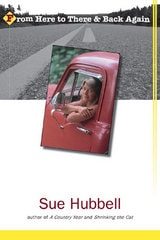
From Here to There and Back Again
Sue Hubbell
University of Michigan Press, 2004
"Sue Hubbell's From Here to There and Back Again is stylish and thought-provoking. As her brother I have long admired her mince pies and her ability to knit her own thermal underwear."
---Bil Gilbert
"The real masterwork that Sue Hubbell has created is her life."
---New York Times Book Review
"A latter-day Henry Thoreau with a sense of the absurd."
---Chicago Sun-Times
"Sue Hubbell writes splendidly."
---William Least Heat-Moon
"Prose as clear, languorous and beautiful as honey poured from a jar."
---People
From Here to There and Back Again is the much-anticipated collection of essays on an array of offbeat and engrossing subjects by magazine essayist and nature writer Sue Hubbell, author of A Country Year, Shrinking the Cat, and Waiting for Aphrodite.
Reading Sue Hubbell is like embarking on a journey of discovery with a close friend. Her writing is witty, learned yet unassuming, intensely personal, and pointedly honest as she ranges far and wide on such topics as after-hours truck stops, the country's best pie restaurants, bowling shoes, Costa Rica's blue morpho butterfly, earthquakes, and the honey trade. Several of her pieces take place in Michigan locales as well, including Elvis sightings in Vicksburg and the magicians' convention in Colon. In the end you'll return from these travels refreshed, enlightened-and wiser.
From Kant and Royce to Heidegger
Essays in Modern PhilosophyCharles Sherover
Catholic University of America Press, 2019
From Liberal Values to Democratic Transition
Essays in Honor of Janos KisRonald Dworkin
Central European University Press, 2004
From Page to Performance
Essays in Early English DramaJohn A. Alford
Michigan State University Press, 1995
From Renaissance to Baroque
Essays on Literature and ArtLouis L. Martz
University of Missouri Press, 1991
Distinguished critic and scholar Louis L. Martz refreshingly addresses some of the central concerns in current studies of English poetry from the sixteenth and seventeenth centuries, exploring the context of religious controversy within which this poetry developed and the relationship of poetry to the visual arts.
From Text to Action
Essays in Hermeneutics, IIPaul Ricoeur
Northwestern University Press, 1991
From Text to Action
Essays in Hermeneutics, IIPaul Ricoeur, Translated from the French by Kathleen Blamey and John B. Thompson, Foreword to the new edition by Richard Kearney
Northwestern University Press, 2007
From Text to Action is an essential companion to the classic The Conflict of Interpretations. Here, Ricoeur continues and extends his project of constructing a general theory of interpretation, positioning his work in relation to its philosophical background: Hegel, Husserl, Gadamer, and Weber. He also responds to contemporary figures like K. O. Apel and Jürgen Habermas, connecting his own theorization of ideology to their critique of ideology.
This new edition includes a foreword by Richard Kearney. It and other new editions of Ricoeur's texts published by Northwestern University Press have joined the canon of contemporary continental philosophy and continue to contribute to emergent discussions in the twenty-first century.
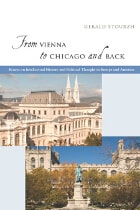
From Vienna to Chicago and Back
Essays on Intellectual History and Political Thought in Europe and AmericaGerald Stourzh
University of Chicago Press, 2007
Spanning both the history of the modern West and his own five-decade journey as a historian, Gerald Stourzh’s sweeping new essay collection covers the same breadth of topics that has characterized his career—from Benjamin Franklin to Gustav Mahler, from Alexis de Tocqueville to Charles Beard, from the notion of constitution in seventeenth-century England to the concept of neutrality in twentieth-century Austria.
This storied career brought him in the 1950s from the University of Vienna to the University of Chicago—of which he draws a brilliant picture—and later took him to Berlin and eventually back to Austria. One of the few prominent scholars equally at home with U.S. history and the history of central Europe, Stourzh has informed these geographically diverse experiences and subjects with the overarching themes of his scholarly achievement: the comparative study of liberal constitutionalism and the struggle for equal rights at the core of Western notions of free government. Composed between 1953 and 2005 and including a new autobiographical essay written especially for this volume, From Vienna to Chicago and Back will delight Stourzh fans, attract new admirers, and make an important contribution to transatlantic history.
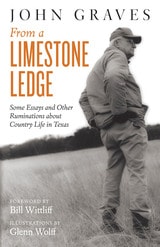
From a Limestone Ledge
Some Essays and Other Ruminations about Country Life in TexasBy John Graves<br>Foreword by Bill Wittliff<br>Illustrations by Glenn Wolff
University of Texas Press, 2016
“Another fine, reflective, anecdotal look at rural Texas.” —New Yorker
“Graves writes eloquently about a countryman’s concerns. There's not a false note in the book.” —Boston Globe
“Like the unmortared stone fences of Graves’s native hill country, From a Limestone Ledge is constructed of bits and pieces never designed to fit together, yet made to achieve a unity that is more enduring than the sum of its individual parts by the hands of a master craftsman.” —Southwestern Historical Quarterly
“The beauty of his work endures, and there is a greater pride in Texans’ hearts for their home, I think, than there would be if he hadn’t written the books he did.” —Rick Bass, Garden & Gun
“In describing the particulars of his surroundings, Graves often was describing the world in microcosm and the place and plight of humankind in it.” —Bryan Woolley, Dallas Morning News
From the Top
Brief Transmissions from Tent Show RadioMichael Perry
Wisconsin Historical Society Press, 2013
“Bottom line is, I’m the kind of guy who’s happy to go to the opera, but I should like to be allowed to wear steel-toed boots with my evening suit. I like to read Harper’s with a chaser of Varmint Hunter Magazine. Maybe that’s why I enjoy a good show under canvas. Here we sit, brain-deep in arts and culture, but we’re also just people hanging out in a tent, some of us wearing boots, a few of us wearing Birkenstocks, but best of all we’re breathing free fresh air filled with music.”
From Scandihoovian Spanglish to snickering chickens, New York Times bestselling author and humorist Michael Perry navigates a wide range of topics in this collection of brief essays drawn from his weekly appearances on the nationally syndicated Tent Show Radio program. Fatherhood, dumpster therapy, dangerous wedding rings, Christmas trees, used cars, why you should have bacon in your stock portfolio, loggers in clogs—whatever the subject, Perry has a rare ability to touch both the funny bone and the heart.
From the Valley of Bronze Camels
A Primer, Some Lectures, & A Boondoggle on PoetryJane Miller
University of Michigan Press, 2022
Jane Miller loves poetry. In these provocative and deeply insightful essays, she unpacks the work of giants like Adrienne Rich, Paul Celan, Marina Tsvetaeva, Osip Mandelstam, and Federico García Lorca alongside painters such as Caravaggio and Paul Klee, as well as ancient Chinese music and techniques of the contemporary poem. Miller explores the use of the question mark in the history of poetry and its function as a revelation of poetic voice. She considers the positive and negative aspects of surrealism on the contemporary poem, its anti-feminist origins in France, its contemporary usage, and the benefits of super-real images. Miller examines how identity politics might affect the imagination. She describes ancient Chinese musical instruments to show how their sounds resonate off/in American poems and on the aural integrity of the lyric poem. She interrogates the political implications of language and the degeneration and regeneration of words. Finally, in an essay about what she dares not say about poetry, she comes out against forms of surrealism, narrative, jargon, rhetoric, irony, and appropriation. This masterful work can be read as advice to a young writer, but it also invites us into the mind of a writer who has developed her craft through the course of a lifetime of writing, reading, and exploring the world, showing not only the ideas that influenced her—feminist, lesbian, and international works—but also how Miller has, in turn, influenced ideas.
From the Valley of Making
Essays on the Craft of PoetryDavid Wojahn
University of Michigan Press, 2015
Frontinus' Legacy
Essays on Frontinus' de aquis urbis RomaeDeane R. Blackman and A. Trevor Hodge, Editors
University of Michigan Press, 2001
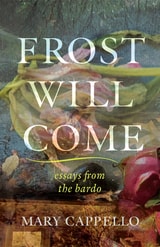
Frost Will Come
Essays from the BardoMary Cappello
University of Wisconsin Press, 2026
When her octogenarian poet mother was diagnosed with terminal ovarian cancer, Mary Cappello and her wife moved into the living room of Rosemary’s one-bedroom apartment in Philadelphia to help fulfill her wish to live out her life at home. A memoir in the form of lyric essays—with her mother’s own writing interspersed—Frost Will Come is a daughter’s tribute to her mother’s months-long transition from a deeply lived life to a difficult, beautiful, and uneasy death.
Cappello renders an immersive and emotionally honest portrait of modern caregiving in a prose style that is the very definition of candor. While paying homage to expert caregivers and medical professionals, Cappello also brings her signature razor-sharp analysis to all the things that fall outside the realm of (medical) knowledge—from platitudes around the time death takes to the defiance of a “peaceful death” as a sign of a moral failing. More than a memoir of grief, Frost Will Come is a rare reckoning with the very fundamentals of existence: how we come into being, how we care, and how we die.
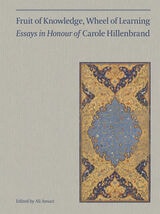
Fruit of Knowledge, Wheel of Learning (Vol I)
Essays in Honour of Professor Carole HillenbrandEdited by Ali M. Ansari
Gingko, 2021
Carole and Robert Hillenbrand are legendary British professors, both of whom have made immense contributions to the fields of Islamic history and art history, and they are highly respected and beloved by the academic community. For these two volumes, editors Melanie Gibson and Ali Ansari have gathered an eclectic mix of scholarly contributions by colleagues and by some of their most recent students who now occupy positions in universities worldwide. The eleven articles in the volume dedicated to Carole Hillenbrand include research on a range of topics, including the elusive Fatimid caliph al-Zafir, a crusader raid on Mecca, and the Persian bureaucrat Mirza Saleh Shirazi’s history of England. In Robert Hillenbrand's volume, the thirteen articles include studies of a rare eighth-century metal dish with Nilotic scenes, Chinese Qur’ans, the process of image-making in both theory and practice, and a shrine in Mosul destroyed by ISIS.
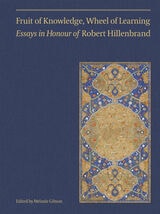
Fruit of Knowledge, Wheel of Learning (Vol II)
Essays in Honour of Professor Robert HillenbrandEdited by Melanie Gibson
Gingko, 2021
Carole and Robert Hillenbrand are legendary British professors, both of whom have made immense contributions to the fields of Islamic history and art history, and they are highly respected and beloved by the academic community. For these two volumes, editors Melanie Gibson and Ali Ansari have gathered an eclectic mix of scholarly contributions by colleagues and by some of their most recent students who now occupy positions in universities worldwide. The eleven articles in the volume dedicated to Carole Hillenbrand include research on a range of topics, including the elusive Fatimid caliph al-Zafir, a crusader raid on Mecca, and the Persian bureaucrat Mirza Saleh Shirazi’s history of England. In Robert Hillenbrand's volume, the thirteen articles include studies of a rare eighth-century metal dish with Nilotic scenes, Chinese Qur’ans, the process of image-making in both theory and practice, and a shrine in Mosul destroyed by ISIS.
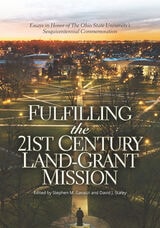
Fulfilling the 21st Century Land-Grant Mission
Essays in Honor of The Ohio State University’s Sesquicentennial CommemorationEdited by Stephen M. Gavazzi and David J. Staley
The Ohio State University Press, 2020
Gathered in honor of The Ohio State University’s sesquicentennial celebration, this collection of essays highlights the significant contributions that Ohio State continues to make as part of its twenty-first-century land-grant mission. Authors from across the university—representing fields as various as agriculture, dance, English, engineering, family science, geography, medicine, social work, and veterinary science—provide contributions that highlight the preeminent status of The Ohio State University. In addition, the perspectives of alumni, staff members, and senior administrators (both present and former) round out the picture of Ohio State as the first among equals regarding its land-grant peers. Overall, contributors draw on rich and varied institutional backgrounds to offer invaluable insights for higher education administrators and scholars across the US.
Functionalism Historicized
Essays on British Social AnthopologyEdited by George W. Stocking, Jr.
University of Wisconsin Press, 1988
" This volume is likely to prove indispensable to historians of anthropology in general and of British anthropology in particular. There are a wide range of historical skills on display, from traditional textual analysis to historical sociology of the most sophisticated sort, and there is a more or less thorough chronological coverage from the era of classical evolutionism virtually up to the present. One can only hope that historicizing anthropologists will sample some of these wares."—Journal of the History of the Behavioral Sciences