Results by title
1947 books match the query 'Music' and 62 start with f
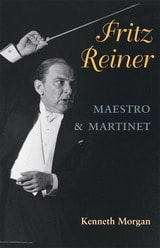
Fritz Reiner, Maestro and Martinet
Kenneth Morgan
University of Illinois Press, 2010
This award-winning book, now available in paperback, is the first solid appraisal of the legendary career of the eminent Hungarian-born conductor Fritz Reiner (1888-1963). Personally enigmatic and often described as difficult to work with, he was nevertheless renowned for the dynamic galvanization of the orchestras he led, a nearly unrivaled technical ability, and high professional standards. Reiner's influence in the United States began in the early 1920s and lasted until his death. Reiner was also deeply committed to serious music in American life, especially through the promotion of new scores. In Fritz Reiner, Maestro and Martinet, Kenneth Morgan paints a very real portrait of a man who was both his own worst enemy and one of the true titans of his profession.
Fritz Reiner
A BiographyPhilip Hart
Northwestern University Press, 1996

From Broadway to The Bronx
New York City’s History through SongVeronika Keller and Sabrina Mittermeier
Intellect Books, 2026
From Broadway to the Bronx tells the history of New York City in song across a variety of different genres that the city has been home to and instrumental in developing, covering everything from early twentieth-century sheet music to Broadway’s musical theater, hip-hop, disco, punk, dancehall, but also contemporary metal, rock, and pop. It features an analysis of the work of artists with intimate connections to the city, like Billy Joel, Lin-Manuel Miranda, Debbie Harry, Shinehead, and the Wu-Tang Clan, as well as an exclusive interview with RENT original cast member Anthony Rapp. The collection includes essays from authors across the disciplines of cultural studies, media studies, cultural history, and musicology, resulting in a far-ranging treatment of the interconnection of the city space and its musical history.
From Dixie to Rocky Top
Music and Meaning in Southeastern Conference FootballCarrie Tipton
Vanderbilt University Press, 2023
The first book to explore the history of college fight songs as a culturally important phenomenon, From Dixie to Rocky Top zeroes in on the US South, where college football has forged a powerful, quasi-religious sense of meaning and identity throughout the region.
Tracing the story of Southeastern Conference (SEC) fight songs from the late nineteenth to the early twenty-first century, author Carrie Tipton places this popular repertory within the broader commercial music industry and uses fight songs to explore themes of authorship and copyright; the commodification of school spirit; and the construction of race, gender, and regional identity in Southern football culture.
This book unearths the history embedded in SEC football’s music traditions, drawing from the archives of the seventeen universities currently or formerly in the conference. Alongside rich primary sources, Tipton incorporates approaches and literature from sports history, Southern and American history, Southern and American studies, and musicology.
Chronicling iconic Southern fight songs’ origins, dissemination, meanings, and cultural reception over a turbulent century, From Dixie to Rocky Top weaves a compelling narrative around a virtually unstudied body of popular music.
From Jim Crow to Jay-Z
Race, Rap, and the Performance of MasculinityMiles White
University of Illinois Press, 2011
From Jim Crow to Jay-Z traces black male representations to chattel slavery and American minstrelsy as early examples of fetishization and commodification of black male subjectivity. Continuing with diverse discussions including black action films, heavyweight prizefighting, Elvis Presley's performance of blackness, and white rappers such as Vanilla Ice and Eminem, White establishes a sophisticated framework for interpreting and critiquing black masculinity in hip-hop music and culture. Arguing that black music has undeniably shaped American popular culture and that hip-hop tropes have exerted a defining influence on young male aspirations and behavior, White draws a critical link between the body, musical sound, and the construction of identity.
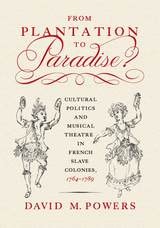
From Plantation to Paradise?
Cultural Politics and Musical Theatre in French Slave Colonies, 1764–1789David M. Powers
Michigan State University Press, 2014
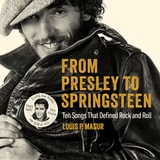
From Presley to Springsteen
Ten Songs That Defined Rock and RollLouis P. Masur
Rutgers University Press, 2027
The first decades of the rock and roll era changed popular music forever and introduced songs that remain beloved standards over a half-century later. But what did it feel like in the rooms where those songs were being written, recorded, and mixed? What creative alchemy and happy accidents transpired to turn these records into classics?
This book examines ten of the rock era’s most iconic songs, including Chuck Berry’s “Johnny B. Goode” and Bruce Springsteen’s “Born to Run.” Along the way, it reveals how singers like Elvis Presley and Aretha Franklin reimagined “Hound Dog” and “Respect” through their sheer force of personality. It also takes you inside the studio to see how producers George Martin, Phil Spector, and Brian Wilson created a symphony of sounds. Other chapters explore how the lyrics of “Satisfaction,” “Like a Rolling Stone,” and “What’s Going On” gave voice to the feelings of a new generation. Writing with a historian’s careful attention to detail and a fan’s love for music, Louis Masur invites us to hear these enduring songs anew.
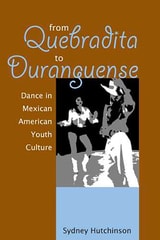
From Quebradita to Duranguense
Dance in Mexican American Youth CultureSydney Hutchinson
University of Arizona Press, 2007
Quebradita, meaning “little break,” is a modern Mexican American dance style that became hugely popular in Los Angeles and across the southwestern United States during the early to mid 1990s. Over the decade of its popularity, this dance craze offered insights into the social and cultural experience of Mexican American youth. Accompanied by banda, an energetic brass band music style, quebradita is recognizable by its western clothing, hat tricks, and daring flips. The dance’s combination of Mexican, Anglo, and African American influences represented a new sensibility that appealed to thousands of young people. Hutchinson argues that, though short-lived, the dance filled political and sociocultural functions, emerging as it did in response to the anti-immigrant and English-only legislation that was then being enacted in California. Her fieldwork and interviews yield rich personal testimony as to the inner workings of the quebradita’s aesthetic development and social significance. The emergence of pasito duranguense, a related yet distinct style originating in Chicago, marks the evolution of the Mexican American youth dance scene.
Like the quebradita before it, pasito duranguense has picked up the task of demonstrating the relevance of regional Mexican music and dance within the U.S. context.
From Scratch
Writings in Music TheoryJames TenneyEdited by Larry Polansky, Lauren Pratt, Robert Wannamaker, and Michael Winter
University of Illinois Press, 2019
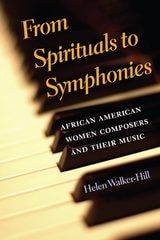
From Spirituals to Symphonies
African-American Women Composers and Their MusicHelen Walker-Hill
University of Illinois Press, 2006
Helen Walker-Hill's unique study provides a carefully researched examination of the history and scope of musical composition by African American women composers from the nineteenth and twentieth centuries. Focusing on the effect of race, gender, and class, From Spirituals to Symphonies notes the important role played by individual personalities and circumstances in shaping this underappreciated category of American art. The study also provides in-depth exploration of the backgrounds, experiences, and musical compositions of eight African American women including Margaret Bonds, Undine Smith Moore, and Julia Perry, who combined the techniques of Western art music with their own cultural traditions and individual gifts. Despite having gained national and international recognition during their lifetimes, the contributions of many of these women are today forgotten.
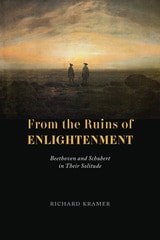
From the Ruins of Enlightenment
Beethoven and Schubert in Their SolitudeRichard Kramer
University of Chicago Press, 2023
Here is Vienna, hosting a congress in 1815 that would redraw national boundaries and reconfigure the European community for a full century. A snapshot captures two of its citizens, each seemingly oblivious to this momentous political environment: Franz Schubert, not yet twenty years old and in the midst of his most prolific year—some 140 songs, four operas, and much else; and Ludwig van Beethoven, struggling through a midlife crisis that would yield the song cycle An die ferne Geliebte, two strikingly original cello sonatas, and the two formidable sonatas for the “Hammerklavier,” opp. 101 and 106. In Richard Kramer’s compelling reading, each seemed to be composing “against”—Beethoven, against the Enlightenment; Schubert, against the looming presence of the older composer even as his own musical imagination took full flight.
From the Ruins of Enlightenment begins in 1815, with the discovery of two unique projects: Schubert’s settings of the poems of Ludwig Hölty in a fragmentary cycle and Beethoven’s engagement with a half dozen poems by Johann Gottfried Herder. From there, Kramer unearths previously undetected resonances and associations, illuminating the two composers in their “lonely and singular journeys” through the “rich solitude of their music.”
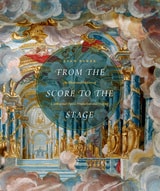
From the Score to the Stage
An Illustrated History of Continental Opera Production and StagingEvan Baker
University of Chicago Press, 2013