Results by title
3266 books match the query 'Performing arts' and 162 start with f
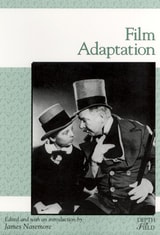
Film Adaptation
Naremore, James
Rutgers University Press, 2000
Some of the earliest feature films were derived from classic literature. Even today, most of the movies we see are adaptations of one kind or another. People who have never read Jane Austen can see her characters on the screen; but filmgoers can also see material taken from theater, television, comic books, and every other medium.
The essays in this volume, most of which have never before been published, raise fundamental questions about cinema and adaptation: what is the nature of the "literary" and the "cinematic"? Why do so many of the
films described as adaptions seem to derive from canonical literature rather than from other sources? How do the different media affect the ways stories are told?
Film Adaptation offers fresh approaches to the art, theory, and cultural politics of movie adaptations, even challenging what is meant by the term "adaptation" itself. Contributors examine the process of adaptation in both theory and practice, discussing a wide variety of films. James Naremore's introduction provides an accessible historical overview of the field and reveals the importance of adaptation study to the many different academic disciplines now attracted to the analysis of film as commodity, document, and cultural artifact.
(Contributors are André Bazin, Dudley Andrew, Robert B. Ray, Robert Stam, Richard Maltby, Guerric DeBona, O. M. B., Gilberto Perez, Michael Anderegg, Matthew Bernstein, Darlene J. Sadlier, Jonathan Rosenbaum, and Lesley Stern.)
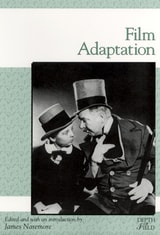
Film Adaptation
Naremore, James
Rutgers University Press, 2000
Some of the earliest feature films were derived from classic literature. Even today, most of the movies we see are adaptations of one kind or another. People who have never read Jane Austen can see her characters on the screen; but filmgoers can also see material taken from theater, television, comic books, and every other medium.
The essays in this volume, most of which have never before been published, raise fundamental questions about cinema and adaptation: what is the nature of the "literary" and the "cinematic"? Why do so many of the
films described as adaptions seem to derive from canonical literature rather than from other sources? How do the different media affect the ways stories are told?
Film Adaptation offers fresh approaches to the art, theory, and cultural politics of movie adaptations, even challenging what is meant by the term "adaptation" itself. Contributors examine the process of adaptation in both theory and practice, discussing a wide variety of films. James Naremore's introduction provides an accessible historical overview of the field and reveals the importance of adaptation study to the many different academic disciplines now attracted to the analysis of film as commodity, document, and cultural artifact.
(Contributors are André Bazin, Dudley Andrew, Robert B. Ray, Robert Stam, Richard Maltby, Guerric DeBona, O. M. B., Gilberto Perez, Michael Anderegg, Matthew Bernstein, Darlene J. Sadlier, Jonathan Rosenbaum, and Lesley Stern.)
Film Blackness
American Cinema and the Idea of Black FilmMichael Boyce Gillespie
Duke University Press, 2016
Film Criticism in the Digital Age
Frey, Mattias
Rutgers University Press, 2015
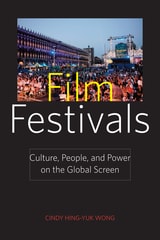
Film Festivals
Culture, People, and Power on the Global ScreenWong, Cindy H
Rutgers University Press, 2011
Movies, stars, auteurs, critics, and the sheer excitement of cinema come together in film festivals as quintessential constellations of art, business, and glamour. Yet, how well do we actually understand the forces and meanings that these events embody?
Film Festivals offers the first comprehensive overview of the history, people, films, and multiple functions of the festival world. From Sundance to Hong Kong, from the glitter of Cannes to edgier festivals that challenge boundaries or foster LGBTQ cultural production, film festivals celebrate art, promote business, bring cinema to diverse audiences, and raise key issues about how we see our world. Cindy Hing-Yuk Wong situates festivals within changing global practices of film, including their important ties to both Hollywood and independent cinema. She explores how these events have become central in the construction of cinema knowledge as well as the behind-the-scene mechanics of finance, distribution, and evaluation. By linking general structures and connections to specific films and auteurs, Wong addresses the components and creation of film festivals that continue to reshape filmmaking as art and business.
Film Genre Reader IV
Edited by Barry Keith Grant
University of Texas Press, 2012
From reviews of the third edition:
“Film Genre Reader III lives up to the high expectations set by its predecessors, providing an accessible and relatively comprehensive look at genre studies. The anthology’s consideration of the advantages and challenges of genre studies, as well as its inclusion of various film genres and methodological approaches, presents a pedagogically useful overview.” —Scope
Since 1986, Film Genre Reader has been the standard reference and classroom text for the study of genre in film, with more than 25,000 copies sold. Barry Keith Grant has again revised and updated the book to reflect the most recent developments in genre study. This fourth edition adds new essays on genre definition and cycles, action movies, science fiction, and heritage films, along with a comprehensive and updated bibliography. The volume includes more than thirty essays by some of film’s most distinguished critics and scholars of popular cinema, including Charles Ramírez Berg, John G. Cawelti, Celestino Deleyto, David Desser, Thomas Elsaesser, Steve Neale, Thomas Schatz, Paul Schrader, Vivian Sobchack, Janet Staiger, Linda Williams, and Robin Wood.

Film Hieroglyphs
Tom Conley
University of Minnesota Press, 2006
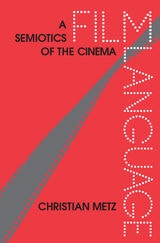
Film Language
A Semiotics of the CinemaChristian Metz
University of Chicago Press, 1990
"The semiology of film . . . can be held to date from the publication in 1964 of the famous essay by Christian Metz, 'Le cinéma: langue ou langage?'"—Geoffrey Nowell-Smith, Times Literary Supplement
"Modern film theory begins with Metz."—Constance Penley, coeditor of Camera Obscura
"Any consideration of semiology in relation to the particular field signifying practice of film passes inevitably through a reference to the work of Christian Metz. . . . The first book to be written in this field, [Film Language] is important not merely because of this primacy but also because of the issues it raises . . . issues that have become crucial to the contemporary argument."—Stephen Heath, Screen
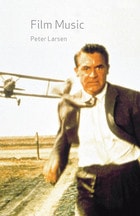
Film Music
Peter Larsen
Reaktion Books, 2005
Taking off from a variation of that question—whether music accompanies a film or a film illustrates the music—Peter Larsen probes the complex relationship between the two. He charts the history of music in film, exploring along the way the role that music plays in the narrative and psychological functions of film. Examining such classics and blockbusters as The Big Sleep, American Graffiti, North by Northwest, and Blade Runner,Larsen uses these case studies to demonstrate how scores and soundtracks can expose unexpected new facets of a film.
A wholly accessible examination, Film Music will be an essential read for music scholars and film buffs alike.
Film Nation
Hollywood Looks at U.S. HistoryRobert Burgoyne
University of Minnesota Press, 1997
Film Noir and the Arts of Lighting
Patrick Keating
Rutgers University Press, 2024
Film Noir and the Cinema of Paranoia
Dixon, Wheeler Winston
Rutgers University Press, 2009
Wheeler Winston Dixon's comprehensive work engages readers in an overview of noir and fatalist film from the mid-twentieth century to the present, ending with a discussion of television, the Internet, and dominant commercial cinema. Beginning with the 1940s classics, Film Noir and the Cinema of Paranoia moves to the "Red Scare" and other ominous expressions of the 1950s that contradicted an American split-level dream of safety and security. The dark cinema of the 1960s hosted films that reflected the tensions of a society facing a new and, to some, menacing era of social expression. From smaller studio work to the vibrating pulse of today's "click and kill" video games, Dixon boldly addresses the noir artistry that keeps audiences in an ever-consumptive stupor.
Film Remakes and Franchises
Herbert, Daniel
Rutgers University Press, 2017
Film Remakes and Franchises examines how remakes and sequels have been central to the film industry from its very inception, yet also considers how the recent trends toward reboots and transmedia franchises depart from those historical precedents. Film scholar Daniel Herbert not only analyzes the film industry’s increasing reliance on recycled product, but also asks why audiences are currently so drawn to such movies. In addition, he explores how contemporary filmmakers have used reboots and franchise movies to inject timely social commentary and diversity into established media properties. A lively and accessible overview that covers everything from You’ve Got Mail to The Force Awakens, Film Remakes and Franchises raises important questions about the intersection of business and creativity in Hollywood today.
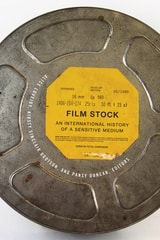
Film Stock
An International History of a Sensitive MediumAlice Lovejoy
University of Minnesota Press, 2027
A global collection exploring the vital significance of film’s materiality to the history of cinema
Made from animal bones, plant cellulose, and precious metals, photochemical film defined a century of cinema. Looking past Hollywood and beyond iconic companies like Eastman Kodak, Agfa, and Pathé, Film Stock travels to Argentina, India, Czechoslovakia, and other locales to offer a truly global history of the very material of film.
Engaging with cultural, political, economic, and environmental questions of significant contemporary concern, Film Stock shows the immense consequences of how film was made, handled, processed, destroyed, and archived. Individual essays explore how climate shaped film distribution in early twentieth-century Southeast Asia, unique film formats manufactured in China, early efforts to standardize the size of film stock in Hollywood, and how Eastman Kodak’s tropical research lab in Panama became a tool of cultural empire.
With a deep commitment to archival research and substantive engagement with primary materials, Film Stock is a major work that tells the international story of film’s physical life. Its innovative, groundbreaking essays make a compelling case for why, even in our digital age, motion picture film matters.
Retail e-book files for this title are screen-reader friendly with images accompanied by short alt text and/or extended descriptions.

Film Studies in China
Selected Writings from Contemporary CinemaEdited by Contemporary Cinema
Intellect Books, 2017
Film Talk
Directors at WorkDixon, Wheeler Winston
Rutgers University Press, 2007
The answers to these questions, along with many more little-known facts and insights, can be found in Film Talk, an in-depth, behind-the-scenes look at filmmaking from the 1940s to the present. In eleven intimate and revealing interviews, contemporary film directors speak frankly about their work-their successes and their disappointments, their personal aspirations, struggles, relationships, and the politics that affect the industry.
A medley of directors including those working in pop culture and documentary, as well as feminist filmmakers, social satirists, and Hollywood mavericks recount stories that have never before been published. Among them are Monte Hellman, the auteur of the minimalist masterpiece Two-Lane Blacktop; Albert Maysles, who with his late brother David, created some of the most important documentaries of the 1960s, including Salesman and The Beatles: What's Happening?; Robert Downey Sr., whose social satires Putney Swope and Greaser's Palace paved the way for a generation of filmmakers; Bennett Miller, whose film Capote won an Academy Award in 2005; and Jamie Babbit, a lesbian crossover director whose low-budget film But I'm a Cheerleader! became a mainstream hit.
The candid conversations, complimented by more than fifty photographs, including many that are rare, make this book essential reading for aspiring moviemakers, film scholars, and everyone interested in the how movies are made and who the fascinating individuals are who make them.
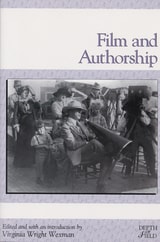
Film and Authorship
Wexman, Virginia W
Rutgers University Press, 2003
During the 1960s, when cinema first entered the academy as a serious object of study, the primary focus was on auteurism, or on films authorship. Burgeoning cinema studies courses demonstrated how directors were the authors of work that undermined (or succeeded in spite of) all the constraints that Hollywood threw at them. New critical methods were introduced as the field matured, and studies of the author/director, for the most part, were considered obsolete.
Virginia Wright Wexman has pulled together some of the freshest writing available on the topic of film authorship. Spanning approaches including poststructuralism, feminism, queer theory, postcolonialism, and cultural studies, the contributors ask, what does auteurship look like today in light of all these developments? The contents of the volume are divided into three major sections: Theoretical Statements, Historical and Institutional Contexts, and Case Studies. Wexmans comprehensive introduction contextualizes the selections and summarizes the scholarly methods through which auteurism has been addressed in the past; it also provides a sketch of the history of media authorship. An extensive bibliography rounds off the volume.

Film and Everyday Resistance
Marguerite La Caze
Northwestern University Press, 2024
A philosophical exploration of how modern global cinema represents everyday means of resisting authoritarianism and totalitarianism
Václav Havel’s concept of “living within the truth” in an authoritarian regime frames Marguerite La Caze’s readings of international cinema, highlighting forms of resistance in which seemingly pre- or nonpolitical aspects of life—such as professional labor, exile, and truth telling—can be recognized as political when seen against a backdrop of general acquiescence. La Caze’s case studies cross genres, historical eras, and national contexts: the apartheid regime in South Africa, in A Dry White Season; post-Suharto Indonesia, in The Look of Silence; 1980s East Germany, in Barbara; the Chilean military dictatorship, in No; contemporary Iran, in A Separation; and current-day Saudi Arabia, in Wadjda. This book explores the films’ use of image, sound, narrative, and character in dialogue with the work of Simone de Beauvoir, Aimé Cesaire, Hannah Arendt, Sara Ahmed, and W. E. B. Du Bois to reveal how cinema depicts ordinary people enacting their own philosophies of defiance.
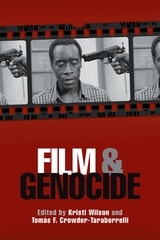
Film and Genocide
Kristi M. Wilson
University of Wisconsin Press, 2011
Film and Genocide brings together scholars of film and of genocide to discuss film representations, both fictional and documentary, of the Holocaust, the Armenian genocide, and genocides in Chile, Australia, Rwanda, and the United States. Since 1955, when Alain Resnais created his experimental documentary Night and Fog about the Nazis’ mass killings of Jews and other ostracized groups, filmmakers have struggled with using this medium to tell such difficult stories, to re-create the sociopolitical contexts of genocide, and to urge awareness and action among viewers. This volume looks at such issues as realism versus fiction, the challenge of depicting atrocities in a manner palatable to spectators and film distributors, the Holocaust film as a model for films about other genocides, and the role of new technologies in disseminating films about genocide.
Film and Genocide also includes interviews with three film directors, who discuss their experiences in working with deeply disturbing images and bringing hidden stories to life: Irek Dobrowolski, director of The Portraitist (2005) a documentary about Wilhelm Brasse, an Auschwitz-Birkenau prisoner ordered to take more than 40,000 photos at the camp; Nick Hughes, director of 100 Days (2005) a dramatic film about the Rwandan mass killings; and Greg Barker, director of Ghosts of Rwanda (2004), a television documentary for Frontline.
Film and Nationalism
Williams, Alan
Rutgers University Press, 2002
Film and Nationalism examines the ways in which cinema has been considered an arena of conflict and interaction between nations and nationhood. Each section of this volume explores a crucial aspect of the discussion. Is film an effective form of national propaganda? Are films losing the very notion of nationhood, in favor of a generalized, "global" cinematographic culture? What is films influence over "national character"? In addition, the volume explores the cultural and economic interactions between developed and underdeveloped countries. How have third world nations defined themselves in relation to hegemonic first world cultures, and how have their relations been changed through the dissemination of Western films? Throughout, Alan Williams chooses essays that enhance our understanding of how films help shape our sense of nationhood and self.
Film and Television After 9/11
Edited by Wheeler Winston Dixon
Southern Illinois University Press, 2004
In Film and Television After 9/11, editor Wheeler Winston Dixon and eleven other distinguished film scholars discuss the production, reception, and distribution of Hollywood and foreign films after the terrorist attacks of September 11, 2001, and examine how moviemaking has changed to reflect the new world climate.
While some contemporary films offer escapism, much of mainstream American cinema since 9/11 is centered on the desire for a “just war” in which military reprisals and escalation of warfare appear to be both inevitable and justified. Films of 2002 such as Black Hawk Down, Collateral Damage, and We Were Soldiers demonstrate a renewed audience appetite for narratives of conflict, reminiscent of the wave of filmmaking that surrounded American involvement in World War II.
The attacks on the World Trade Center and the Pentagon galvanized the American public initially, yet film critics wonder how this will play out over time. Film and Television After 9/11 is the first book to provide original insights into topics ranging from the international reception of post-9/11 American cinema, re-viewing films of our shared cinematic past in light of the attacks, and exploring parallels between post-9/11 cinema and World War II-era productions.
Film and the Anarchist Imagination
Expanded Second EditionRichard Porton
University of Illinois Press, 2020
Film and the German Left in the Weimar Republic
From Caligari to Kuhle WampeBy Bruce Murray
University of Texas Press, 1990
The Weimar Republic of Germany, covering the post-World War I period of civil and governmental strife, witnessed a great struggle among a variety of ideologies, a struggle for which the arts provided one important arena. Leftist individuals and organizations critiqued mainstream art production and attempted to counter what they perceived as its conservative-to-reactionary influence on public opinion. In this groundbreaking study, Bruce Murray focuses on the leftist counter-current in Weimar cinema, offering an alternative critical approach to the traditional one of close readings of the classical films.
Beginning with a brief review of pre-Weimar cinema (1896-1918), he analyzes the film activity of the Social Democratic Party, the German Communists, and independent leftists in the Weimar era. Leftist filmmakers, journalists, and commentators, who in many cases contributed significantly to marginal leftist as well as mainstream cinema, have, until now, received little scholarly attention. Drawing on exhaustive archival research and personal interviews, Murray shows how the plurality of aesthetic models represented in the work of individuals who participated in leftist experiments with cinema in the 1920S collapsed as Germany underwent the transition from parliamentary democracy to fascist dictatorship. He suggests that leftists shared responsibility for that collapse and asserts the value of such insights for those who contemplate alternatives to institutional forms of cinematic discourse today.
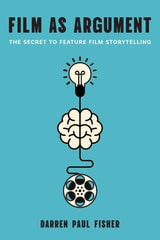
Film as Argument
The Secret to Feature Film StorytellingDarren Paul Fisher
Rutgers University Press, 2025
Is it to entertain? To move and audience? To tell a powerful story? For fame and fortune?
You may have answered yes to each, but those answers don’t account for the practice overall. Most books about screenwriting and directing are primarily concerned with craft and technique, but how can you truly understand filmmaking – or make the best films - unless you know what purpose it really serves.
So what’s the secret? As the title of this book suggests, making feature films is fundamentally the practice of making a very specific type of argument. To see how this works, we will deep-dive into how filmmakers are trained and taught to think about filmmaking, and what traditions they knowingly or unknowingly follow. We will look at hundreds of films and some major case studies, including Toy Story 3, Schindler’s List, Raiders of the Lost Ark, Amour, and mother!, to explore how and what films argue, and why knowing this can both unlock both a greater appreciation of the form, and improve the impact your films make.
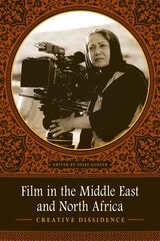
Film in the Middle East and North Africa
Creative DissidenceEdited by Josef Gugler
University of Texas Press, 2011
This is the first study to cover cinemas from Iran to Morocco. Nine essays present the region's major national cinemas, devoting special attention to the work of directors who have given image and voice to dissent from political regimes, from patriarchal customs, from fundamentalist movements, and from the West. These country essays are complemented by in-depth discussions of eighteen films that have been selected for both their excellence and their critical engagement with pressing current issues. The introduction provides a comprehensive overview of filmmaking throughout the region, including important films produced outside the national cinemas. The long history of Iranian cinema, its international renown, and the politics of directors confronting the state, earns it a special place in this volume. The other major emphasis is on the Israel/Palestine conflict, featuring films by Palestinian directors, Israelis, and an Egyptian working in Syria.
Nineteen authors collaborated on this book, among them Walter Armbrust, Roy Armes, Kevin Dwyer, Eric Egan, Nurith Gertz, Lina Khatib, Florence Martin, and Nadia Yaqub. About half of the contributors are film scholars; the others range across literary studies and the social sciences to two film directors and a novelist. Beyond differences in disciplinary orientation, there is considerable variation among contributors in the perspectives that inform their writing. They offer an illuminating range of approaches to the cinemas of the region.
The book is richly illustrated with posters of the featured films, photos of their directors at work, and stills illustrating critical arguments in the film essays.
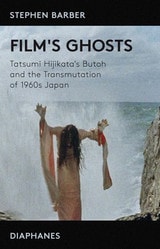
Film's Ghosts
Tatsumi Hijikata's Butoh and the Transmutation of 1960s JapanStephen Barber
Diaphanes, 2019
Film, Drama and the Break Up of Britain
Steve Blandford
Intellect Books, 1995
When the sun set on the British Empire, the resultant fragmentation of British identity emerged most tellingly in artistic works: cinematic works such as Howards End depicted a richly historical land steeped in tradition and tragedy, while the more modern Lock, Stock and Two Smoking Barrels revealed a brutal yet sharply humorous portrayal of contemporary English life. That relationship between nationalism, national identity, and postcolonialism remains central to many British dramatists’ works, and in Film, Drama and the Break Up of Britain, Steve Blandford explores how the “break up” of Britain has influenced contemporary British drama.
Breaking down the scholarly barriers between theater and film studies, Blandford examines British directors’ interpretations of their nation’s postcolonial age, tracing the various ways that auteurs have created dramatic narratives that explore the idea of being “British” and all its inherent complexity. From community-based theaters in Scotland and Wales to the blockbuster The Full Monty, Blandford probes the cultural impact of Britain’s struggle to form a new identity, making his book an essential read for all those interested in postcolonial studies and the history of British film.
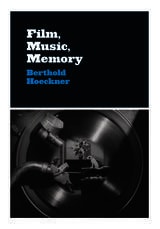
Film, Music, Memory
Berthold Hoeckner
University of Chicago Press, 2019
Hoeckner examines films that reflect directly on memory, whether by featuring an amnesic character, a traumatic event, or a surge of nostalgia. As the history of cinema unfolded, movies even began to recall their own history through quotations, remakes, and stories about how cinema contributed to the soundtrack of people’s lives. Ultimately, Film, Music, Memory demonstrates that music has transformed not only what we remember about the cinematic experience, but also how we relate to memory itself.
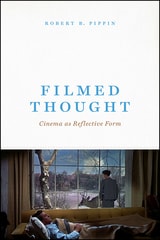
Filmed Thought
Cinema as Reflective FormRobert B. Pippin
University of Chicago Press, 2020
Filmed Thought examines questions of morality in Almodóvar’s Talk to Her, goodness and naïveté in Hitchcock’s Shadow of a Doubt, love and fantasy in Sirk’s All That Heaven Allows, politics and society in Polanski’s Chinatown and Malick’s The Thin Red Line, and self-understanding and understanding others in Nicholas Ray’s In a Lonely Place and in the Dardennes brothers' oeuvre. In each reading, Pippin pays close attention to what makes these films exceptional as technical works of art (paying special attention to the role of cinematic irony) and as intellectual and philosophical achievements. Throughout, he shows how films offer a view of basic problems of human agency from the inside and allow viewers to think with and through them. Captivating and insightful, Filmed Thought shows us what it means to take cinema seriously not just as art, but as thought, and how this medium provides a singular form of reflection on what it is to be human.
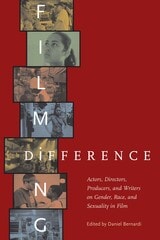
Filming Difference
Actors, Directors, Producers, and Writers on Gender, Race, and Sexuality in FilmEdited by Daniel Bernardi
University of Texas Press, 2009
Addressing representation and identity in a variety of production styles and genres, including experimental film and documentary, independent and mainstream film, and television drama, Filming Difference poses fundamental questions about the ways in which the art and craft of filmmaking force creative people to confront stereotypes and examine their own identities while representing the complexities of their subjects.
Selections range from C. A. Griffith's "Del Otro Lado: Border Crossings, Disappearing Souls, and Other Transgressions" and Celine Perreñas Shimizu's "Pain and Pleasure in the Flesh of Machiko Saito's Experimental Movies" to Christopher Bradley's "I Saw You Naked: 'Hard' Acting in 'Gay' Movies," along with Kevin Sandler's interview with Paris Barclay, Yuri Makino's interview with Chris Eyre, and many other perspectives on the implications of film production, writing, producing, and acting.
Technical aspects of the craft are considered as well, including how contributors to filmmaking plan and design films and episodic television that feature difference, and how the tools of cinema—such as cinematography and lighting—influence portrayals of gender, race, and sexuality. The struggle between economic pressures and the desire to produce thought-provoking, socially conscious stories forms another core issue raised in Filming Difference. Speaking with critical rigor and creative experience, the contributors to this collection communicate the power of their media.
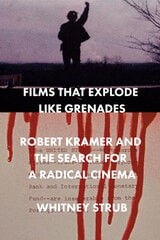
Films That Explode Like Grenades
Robert Kramer and the Search for a Radical CinemaWhitney Strub
University of Chicago Press, 2026
Robert Kramer (1939–99) was the emblematic filmmaker of the late-1960s New Left in the United States. Yet because most of his three dozen films have been out of circulation for decades, he has long been neglected by film historians and the Left. Kramer was the cofounder of the leftist documentary collective Newsreel and the director of underground films such as Ice (1970), Milestones (1975), and Route One/USA (1989). His films provide distinctive insights into how America’s political terrain has changed over time, capturing each era’s revolutionary ethos and its contradictions. Whitney Strub’s Films That Explode Like Grenades tracks the histories of leftist film and global revolutionary movements via Kramer’s life and travels. Moving among New York City, Chicago, North Vietnam, Paris, Portugal, Angola, and other crucial flashpoints, Kramer left a major and influential body of work in his wake that has fundamentally shaped the work of radical filmmakers across the globe.
For Strub, Kramer’s career is a key thread in an intimate history of the 1960s New Left, one that emphasizes the complexities of the movement’s internal tensions and its legacies. Drawing on visual analysis, extensive archival research across the United States and France, and myriad interviews with Kramer contemporaries, including Bernardine Dohrn, Tom Hayden, Jonas Mekas, and Kramer’s relatives, Strub transforms Kramer’s life story into a dynamic and engaging social history of 1960s radicalism and its generational legacies.
With detailed mapping of Robert Kramer’s many social and artistic contexts, Films That Explode Like Grenades restores him to a place of global importance in leftist cinema.
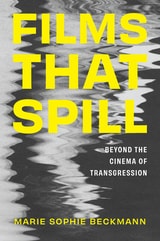
Films That Spill
Beyond the Cinema of TransgressionMarie Sophie Beckmann
Rutgers University Press, 2025
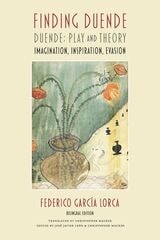
Finding Duende
Duende: Play and Theory | Imagination, Inspiration, EvasionFederico García Lorca
Swan Isle Press, 2023
For years, Federico García Lorca’s lecture on duende has been a source of insight for writers and performers, including Ted Hughes, Nick Cave, Patti Smith, and Amanda Gorman.
Duende: Play and Theory not only provides a path into Lorca’s poetics and the arts of Spain; it is one of the strangest, most compelling accounts of inspiration ever offered by a poet. Contrasting the demon called duende with the Angel and the Muse, Lorca describes a mysterious telluric, diabolical current, an irreducible “it,” that can draw the best from both performer and audience.
This new translation by Christopher Maurer, based on a thoroughly revised edition of the Spanish original of 1933, also included in this volume, offers a more accurate and fully annotated version of the lecture, with an introduction by eminent philologist José Javier León. Drawing on a deep knowledge of flamenco, and correcting decades of discussion about duende and its supposed origins in Spanish folklore and popular speech, León shows to what extent the concept of duende—understood as the imp of artistic inspiration—was the playful, yet deadly serious, invention of Lorca himself.
Lorca’s bravura performance of duende is foreshadowed here with a bilingual version—the most complete ever—of his other major text on inspiration, “Imagination, Inspiration, Evasion,” in which he calls for greater freedom in poetry as if searching for duende and its “constant baptism of newly created things.”
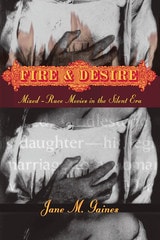
Fire and Desire
Mixed-Race Movies in the Silent EraJane M. Gaines
University of Chicago Press, 2001
Fire and Desire offers a penetrating look at the black independent film movement during the silent period. Gaines traces the profound influence that D. W. Griffith's racist epic The Birth of a Nation exerted on black filmmakers such as Oscar Micheaux, the director of the newly recovered Within Our Gates. Beginning with What Happened in the Tunnel, a movie that played with race and sex taboos by featuring the first interracial kiss in film, Gaines also explores the cinematic constitution of self and other through surprise encounters: James Baldwin sees himself in the face of Bette Davis, family resemblance is read in Richard S. Robert's portrait of an interracial family, and black film pioneer George P. Johnson looks back on Micheaux.
Given the impossibility of purity and the co-implication of white and black, Fire and Desire ultimately questions the category of "race movies" itself.
First Person Jewish
Alisa S. Lebow
University of Minnesota Press, 2008
Documentaries have increasingly used the first person, with a number of prominent filmmakers finding critical and commercial success with this intimate approach. Jewish filmmakers have particularly thrived in this genre, using it to explore disparate definitions of the self in relation to the larger groups of family and community.
In First Person Jewish, Alisa S. Lebow examines more than a dozen films from Jewish artists to reveal how the postmodern impulse to turn the lens inward intersects provocatively (and at times unwittingly) with historical tropes and stereotypes of the Jew. Focusing her efforts on Jewish filmmakers working on the margins, Lebow analyzes the work of Jonathan Caouette, Chantal Akerman, and Alan Berliner, among others, also including a discussion of her own first person film Treyf (1998), made with Cynthia Madansky. The filmmakers in this study, Lebow argues, are confronting a desire to both define and reimagine contemporary Jewishness.
Using a multidisciplinary approach to first person films, Lebow shows how this form of self-expression is challenging both autobiography and documentary and, in the process, changing the art of cinema and recording the cultural shifts of our time.
Alisa S. Lebow is a filmmaker and lecturer in film and TV studies at Brunel University.
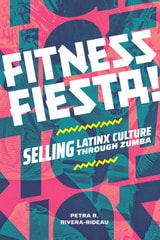
Fitness Fiesta!
Selling Latinx Culture through ZumbaPetra R. Rivera-Rideau
Duke University Press, 2024
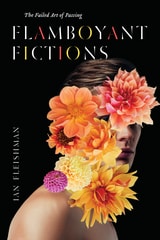
Flamboyant Fictions
The Failed Art of PassingIan Fleishman
Northwestern University Press, 2025
Exposes a stylistic tradition of flamboyantly failed passing in queer literature and film
This book posits formal experimentation as an index for evolving expressions of male homosexuality from literary modernism to the German New Wave and the present day. Ian Fleishman exposes a tradition of flamingly failed passing that is itself a surreptitious mode of passing: the flaunting of queer style as an intentionally unconvincing cover for queer content. Exploring a corpus of films and novels by André Gide, Jean Genet, Rainer Werner Fassbinder, Werner Schroeter, François Ozon, and Xavier Dolan, among others, Flamboyant Fictions: The Failed Art of Passing intervenes in trenchant debates about queer agency, visibility, negativity, and disidentification. Mapping queer strategies of storytelling onto queer practices of self-invention, Flamboyant Fictions wagers that it is precisely in instances of conflict between these auteurs and their inventions that narrative becomes a laboratory for testing the sovereignty and self-determination of queer identity.
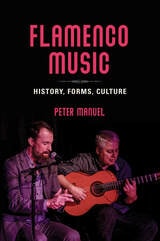
Flamenco Music
History, Forms, CulturePeter Manuel
University of Illinois Press, 2023
An iconic symbol of Spain, flamenco has become a global phenomenon. Peter Manuel offers English-language readers a rare portrait of the music’s history, styles, and cultural impact. Beginning with flamenco’s Moorish and Roma influences, Manuel follows the music’s evolution through its consolidation in the mid-1800s and on to the vibrant contemporary scene. An investigation of flamenco’s major song-types looks at rhythm and compás, guitar technique, and many other aspects of the music while Manuel’s description and analysis of the repertoire range from soleares and bulerías to tangos. His overview of contemporary flamenco culture provides insight into issues that surround the music, including globalization, gender dynamics, notions of ownership, and the ongoing debates on purity versus innovation and the relative roles played by Gitanos and non-Gitanos.
Multifaceted and entertaining, Flamenco Music is an in-depth study of the indelible art form that inspires enthusiasts and practitioners around the world.
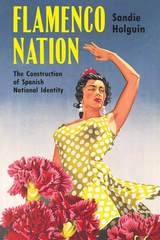
Flamenco Nation
The Construction of Spanish National IdentitySandie Holguín
University of Wisconsin Press, 2019
Holguín brings forth an important interplay between regional nationalists and image makers actively involved in building a tourist industry. Soon they realized flamenco performances could be turned into a folkloric attraction that could stimulate the economy. Tourists and Spaniards alike began to cultivate flamenco as a representation of the country's national identity. This study reveals not only how Spain designed and promoted its own symbol but also how this cultural form took on a life of its own.
Flickering Shadows
Cinema and Identity in Colonial ZimbabweJ. M. Burns
Ohio University Press, 2002
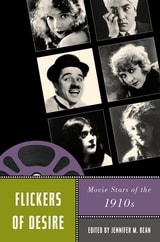
Flickers of Desire
Movie Stars of the 1910sBean, Jennifer M
Rutgers University Press, 2011
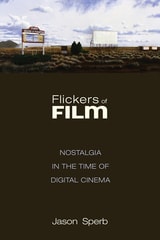
Flickers of Film
Nostalgia in the Time of Digital CinemaSperb, Jason
Rutgers University Press, 2015
In Flickers of Film, Jason Sperb offers nuanced and unexpected answers to these questions, examining the benefits of certain types of film nostalgia, while also critiquing how Hollywood’s nostalgic representations of old technologies obscure important aspects of their histories. He interprets this affection for the prehistory and infancy of digital technologies in relation to an industry-wide anxiety about how the digital has grown to dominate Hollywood, pushing it into an uncertain creative and economic future. Yet he also suggests that Hollywood’s nostalgia for old technologies ignores the professionals who once employed them, as well as the labor opportunities that have been lost through the computerization and outsourcing of film industry jobs.
Though it deals with nostalgia, Flickers of Film is strikingly cutting-edge, one of the first studies to critically examine Pixar’s role in the film industry, cinematic representations of videogames, and the economic effects of participatory culture. As he takes in everything from Terminator: Salvation to The Lego Movie, Sperb helps us see what’s distinct about this recent wave of self-aware nostalgic films—how Hollywood nostalgia today isn’t what it used to be.
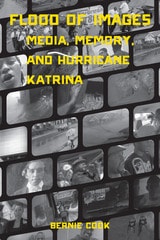
Flood of Images
Media, Memory, and Hurricane KatrinaBy Bernie Cook
University of Texas Press, 2015
Anyone who was not in New Orleans during Hurricane Katrina and the subsequent flooding of the city experienced the disaster as a media event, a flood of images pouring across television and computer screens. The twenty-four-hour news cycle created a surplus of representation that overwhelmed viewers and complicated understandings of the storm, the flood, and the aftermath. As time passed, documentary and fictional filmmakers took up the challenge of explaining what had happened in New Orleans, reaching beyond news reports to portray the lived experiences of survivors of Katrina. But while these narratives presented alternative understandings and more opportunities for empathy than TV news, Katrina remained a mediated experience.
In Flood of Images, Bernie Cook offers the most in-depth, wide-ranging, and carefully argued analysis of the mediation and meanings of Katrina. He engages in innovative, close, and comparative visual readings of news coverage on CNN, Fox News, and NBC; documentaries including Spike Lee’s When the Levees Broke and If God Is Willing and Da Creek Don’t Rise, Tia Lessin and Carl Deal’s Trouble the Water, and Dawn Logsdon and Lolis Elie’s Faubourg Treme; and the HBO drama Treme. Cook examines the production practices that shaped Katrina-as-media-event, exploring how those choices structured the possible memories and meanings of Katrina and how the media’s memory-making has been contested. In Flood of Images, Cook intervenes in the ongoing process of remembering and understanding Katrina.
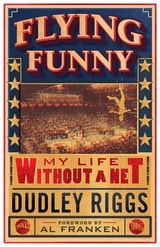
Flying Funny
My Life without a NetDudley Riggs
University of Minnesota Press, 2017
The unusual, gravity-defying first act of improvisational theater’s founding father—now in paperback
Dudley Riggs didn’t have to run away from home to join the circus: home was the circus. Son of the acclaimed aerial flyers Riggs and Riggs, he made his circus debut as a polar prince parading in a wagon pulled by a polar bear. At the age of five, he graduated to a risqué vaudeville act during the circus off- season; at eight, he outgrew his cutes (and his child stardom) and joined his high-flying parents on the trapeze. Eventually he had to learn to “fly funny” because he grew too tall to fly straight. In one way or another, Riggs has been flying ever since.
The rest, as they say, is history. And what a story it is. In Flying Funny, Riggs shares many highs and lows while describing circus life and the evolution of America’s popular entertainment during the twentieth century. From his early life in circus and vaudeville to his creation of the Brave New Workshop, we see how his show business experience and instincts helped him create in Minneapolis what became the “next wave” in American entertainment—improvisation.
As a young man, Riggs lost everything in a tornado, got an education on the fly, and sailed with the All American circus to post–war Japan. On a slow boat home and restless about his future, he developed the idea of Word Jazz—creating a script on stage as it is being performed—and shortly after he opened the Instant Theater in New York. Later, he moved to Minneapolis where he founded the Brave New Workshop, launching the careers of comic greats such as Penn and Teller, The Flying Karamazov Brothers, Louie Anderson, Peter Tolan, Pat Proft, Nancy Steen, Liz Winstead, Al Franken and many others. Today, the Brave New Workshop thrives as the longest running improvisational theater in America.
From flying funny on the trapeze to theater without a net, Dudley Riggs’s story is filled with hearty laughs and eyebrow-raising insights. With a wry sense of humor and infectious warmth, he shares the exhilaration of flying whether through the air or on the stage.
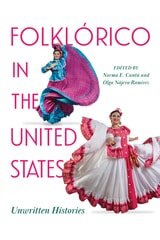
Folklórico in the United States
Unwritten HistoriesEdited by Norma E. Cantú and Olga Nájera-Ramírez
University of Illinois Press, 2027
Multidimensional and enlightening, Folklórico in the United States expands our knowledge of a powerful and creative dance tradition central to Mexican Americans’ sense of self and community.
Contributors: Erica Acevedo-Ontiveros, Jenna Cortez-Aguirre, Manuel R. Cuellar, Alma Ixchel Flores-Pérez, Guadalupe Friaz, Ennio García-Miera, Javier Sepúlveda Garibay, Jacquelyn Y. Guzmán, Aida Hurtado, Cándida F. Jácquez, Gabriela Mendoza-García, Mona Lisa Montgomery, Cassondra Montoya, Felisa Patiño-Longoria, Cindy Padilla, Russell C. Rodriguez, Gema Sandoval, Sarahí Lay Trigo
Following the Score
The Ravel TrilogyOliver Smith
Intellect Books, 2024
This book frames the playtexts of The Ravel Trilogy—Bolero (2014), Concerto (2016), and Solo (2018)—alongside a series of reflective essays and provocations on contemporary dramaturgy and musicology from academics and artists in drama, music, linguistics, and fine art. It contextualizes the themes and approaches of the trilogy and serves as a critical companion to a body of devised work, stimulating a debate about dramaturgy and composition and inviting discussion about post-dramatic theater's relationship to music.
This publication marks the culmination of the trilogy and its critical legacy, exploring the work through the dual lenses of postdramatic theater and research questions articulated and addressed by the practice-research undertaken by its co-creators. The dramaturgical context for The Ravel Trilogy and the reflective essays around it allow the editors to explore the relationship between theater and music, raising questions about practice-research and notions of creating playtexts from musical scores. In this volume, Michael Pinchbeck and Ollie Smith reflect on making and performing The Ravel Trilogy and the process of researching, devising, and presenting work inspired by music where score becomes script and dynamics become stage directions.
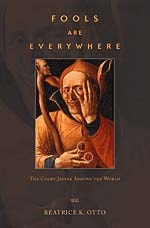
Fools Are Everywhere
The Court Jester Around the WorldBeatrice K. Otto
University of Chicago Press, 2001
Most of the work on the court jester has concentrated on Europe; Otto draws on previously untranslated classical Chinese writings and other sources to correct this bias and also looks at jesters in literature, mythology, and drama. Written with wit and humor, Fools Are Everywhere is the most comprehensive look at these roguish characters who risked their necks not only to mock and entertain but also to fulfill a deep and widespread human and social need.
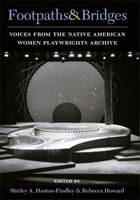
Footpaths and Bridges
Voices from the Native American Women Playwrights ArchiveEdited by Shirley A. Huston-Findley and Rebecca Howard
University of Michigan Press, 2011
Footpaths and Bridges celebrates the vitality and diversity of Native American women, collecting plays ranging from ETHNOSTRESS—a humorous take on art and identity politics—to the biographical musical Te Ata to a retelling of the Thanksgiving story from the Wampanoag perspective. The dramatic works are accompanied by critical commentary that illuminates Native American women’s theater practices and perspectives, highlighting the issues of heritage, identity, and changing lifestyles that the plays imaginatively tackle.
Featuring work from a wide array of tribes and geographic regions, the collection affords the artist, scholar, and general reader access to previously unheard voices that communicate the complexity and the diversity of the Native American experience. The far-ranging genres and content of the plays suggest the many possibilities for communicating the past and the present, the personal and the political, and the stunning kaleidoscope of Native American life and art.
“Often thoughtful provocateurs, Native American playwrights are frequently overlooked . . . eminently readable, and possibly performable, the plays [in this collection] examine colonization, generational differences, ‘ethnostress,’ and cultural identity.”
—Choice
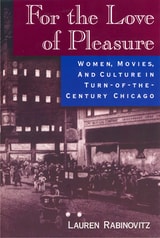
For the Love of Pleasure
Women, Movies, and Culture in Turn-of-the-Century ChicagoRabinovitz, Lauren
Rutgers University Press, 1998
--Gaylyn Studlar, atuhor of This Mad Masquerade: Stardom and Masculinity in the Jazz Age
The period from the 1880s until the 1920s saw the making of a consumer society, the inception of the technological, economic, and social landscape in which we currently live. Cinema played a key role in the changing urban landscape. For working-class women, it became a refuge from the factory. For middle-class women, it presented a new language of sexual danger and pleasure. Women found greater freedom in big cities, entering the workforce in record numbers and moving about unchaperoned in public spaces. Turn-of-the-century Chicago surpassed even New York as a proving ground for pleasure and education, attracting women workers at three times the national rate. Using Chicago as a model, Lauren Rabinovitz analyzes the rich interplay among demographic, visual, historical, and theoretical materials of the period. She skillfully links cinema theory and women's studies for a fuller understanding of cultural history. She also demonstrates how cinema dramatically affected social conventions, ultimately shaping modern codes of masculinity and feminity.
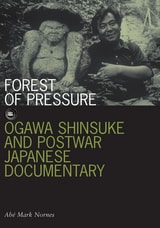
Forest of Pressure
Ogawa Shinsuke and Postwar Japanese DocumentaryAbe Mark Nornes
University of Minnesota Press, 2007
“Extraordinarily valuable, illuminating, and even entertaining, Forest of Pressure brims with the types of information that only a key insider can get his hands on.” —Mitsuhiro Yoshimoto, New York University
Ogawa Productions—known in Asia as Ogawa Pro—was an influential filmmaking collective that started in the 1960s under the direction of Ogawa Shinsuke (1936–1992). Between 1968 and the mid-1970s, Ogawa Pro electrified the Japanese student movement with its Sanrizuka documentary series—eight films chronicling the massive protests over the construction of the Narita airport—which has since become the standard against which documentaries are measured in Japan.
A critical biography of a collective, Forest of Pressure explores the emergence of socially committed documentary filmmaking in postwar Japan. Analyzing Ogawa Pro’s films and works by other Japanese filmmakers, Abé Mark Nornes addresses key issues in documentary theory and practice, including individual and collective cinema production modes and the relationship between subject and object. Benefiting from unprecedented access to Ogawa Pro’s archives and interviews with former members, Forest of Pressure is an innovative look at the fate of political filmmaking in the wake of the movement’s demise.
Abé Mark Nornes is associate professor of screen arts and cultures and Asian languages and cultures at the University of Michigan. He is a coordinator at the Yamagata International Documentary Film Festival and the author of Japanese Documentary Film: The Meiji Era through Hiroshima (Minnesota, 2003).