Results by title
3703 books match the query '19th century' and 164 start with f

From the Midwife's Bag to the Patient's File
Public Health in Eastern and Southeastern EuropeSara Bernasconi
Central European University Press, 2018

From the Ruins of Enlightenment
Beethoven and Schubert in Their SolitudeRichard Kramer
University of Chicago Press, 2023
Here is Vienna, hosting a congress in 1815 that would redraw national boundaries and reconfigure the European community for a full century. A snapshot captures two of its citizens, each seemingly oblivious to this momentous political environment: Franz Schubert, not yet twenty years old and in the midst of his most prolific year—some 140 songs, four operas, and much else; and Ludwig van Beethoven, struggling through a midlife crisis that would yield the song cycle An die ferne Geliebte, two strikingly original cello sonatas, and the two formidable sonatas for the “Hammerklavier,” opp. 101 and 106. In Richard Kramer’s compelling reading, each seemed to be composing “against”—Beethoven, against the Enlightenment; Schubert, against the looming presence of the older composer even as his own musical imagination took full flight.
From the Ruins of Enlightenment begins in 1815, with the discovery of two unique projects: Schubert’s settings of the poems of Ludwig Hölty in a fragmentary cycle and Beethoven’s engagement with a half dozen poems by Johann Gottfried Herder. From there, Kramer unearths previously undetected resonances and associations, illuminating the two composers in their “lonely and singular journeys” through the “rich solitude of their music.”

From the Shadow of Empire
Defining the Russian Nation through Cultural Mythology, 1855–1870Olga Maiorova
University of Wisconsin Press, 2010
From the Shadow of Empire traces how these nationalist writers refashioned key historical myths—the legend of the nation’s spiritual birth, the tale of the founding of Russia, stories of Cossack independence—to portray the Russian people as the ruling nationality, whose character would define the empire. In an effort to press the government to alter its traditional imperial policies, writers from across the political spectrum made the cult of military victories into the dominant form of national myth-making: in the absence of popular political participation, wars allowed for the people’s involvement in public affairs and conjured an image of unity between ruler and nation. With their increasing reliance on the war metaphor, Reform-era thinkers prepared the ground for the brutal Russification policies of the late nineteenth century and contributed to the aggressive character of twentieth-century Russian nationalism.
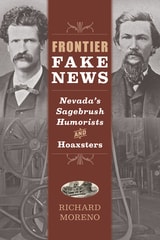
Frontier Fake News
Nevada's Sagebrush Humorists and HoaxstersRichard Moreno
University of Nevada Press, 2023
When readers see the names Mark Twain and Dan De Quille, fake news may not be the first thing that comes to mind. But these legendary journalists were some of the original, and most prolific, fake news writers in the early years of Nevada’s history. Frontier Fake News puts a spotlight on the hoaxes, feuds, pranks, outright lies, witty writing, and other literary devices utilized by a number of the Silver State’s frontier newsmen from the mid-nineteenth through the early twentieth centuries. Often known collectively as the Sagebrush School, these journalists were opinionated, talented, and individualistic.
While Mark Twain (Samuel Clemens), who got his start at Virginia City’s Territorial Enterprise, and Dan De Quille (William Wright), who some felt was a better writer than Twain, are the most well-known members of the Sagebrush School, author Richard Moreno includes others such as Fred Hart, who concocted a fake social club and reported on its gatherings for Austin’s Reese River Reveille, and William Forbes, who enjoyed sprinkling clever puns with political undertones in his newspaper articles.
Moreno traces the beginnings of genuine fake news from founding father Benjamin Franklin’s “Supplement to the Boston Independent Chronicle, Number 705, March 1782,” a fake newspaper aimed at swaying British public opinion, to the fake news articles of New York and Baltimore papers in the early 1800s. But these examples are only a prelude to the amazing accounts of petrified men, freeze-inducing solar armor, magically magnetic rocks, blood-curdling massacres, and other nonsense stories that appeared in Nevada’s frontier newspapers and beyond.

Frontier Forts of Iowa
Indians, Traders, and Soldiers, 1682-1862William E. Whittaker
University of Iowa Press, 2009
At least fifty-six frontier forts once stood in, or within view of, what is now the state of Iowa. The earliest date to the 1680s, while the latest date to the Dakota uprising of 1862. Some were vast compounds housing hundreds of soldiers; others consisted of a few sheds built by a trader along a riverbank. Regardless of their size and function—William Whittaker and his contributors include any compound that was historically called a fort, whether stockaded or not, as well as all military installations—all sought to control and manipulate Indians to the advantage of European and American traders, governments, and settlers. Frontier Forts of Iowa draws extensively upon the archaeological and historical records to document this era of transformation from the seventeenth-century fur trade until almost all Indians had been removed from the region.
The earliest European-constructed forts along the Mississippi, Des Moines, and Missouri rivers fostered a complex relationship between Indians and early traders. After the Louisiana Purchase of 1804, American military forts emerged in the Upper Midwest, defending the newly claimed territories from foreign armies, foreign traders, and foreign-supported Indians. After the War of 1812, new forts were built to control Indians until they could be moved out of the way of American settlers; forts of this period, which made extensive use of roads and trails, teamed a military presence with an Indian agent who negotiated treaties and regulated trade. The final phase of fort construction in Iowa occurred in response to the Spirit Lake massacre and the Dakota uprising; the complete removal of the Dakota in 1863 marked the end of frontier forts in a state now almost completely settled by Euro-Americans.
By focusing on the archaeological evidence produced by many years of excavations and by supporting their words with a wealth of maps and illustrations, the authors uncover the past and connect it with the real history of real places. In so doing they illuminate the complicated and dramatic history of the Upper Midwest in a time of enormous change. Past is linked to present in the form of a section on visiting original and reconstructed forts today.
Gayle F. Carlson
Jeffrey T. Carr
Lance M. Foster
Kathryn E. M. Gourley
Marshall B. McKusick
Cindy L. Nagel
David J. Nolan
Cynthia L. Peterson
Leah D. Rogers
Regena Jo Schantz
Christopher M. Schoen
Vicki L. Twinde-Javner
William E. Whittaker

Frontier Swashbuckler
The Life and Legend of John Smith TDick Steward
University of Missouri Press, 2000
Few frontiersmen in the late eighteenth century and early nineteenth century epitomized the reckless energies of the West and the lust for adventure as did John Smith T—pioneer, gunfighter, entrepreneur, militia colonel, miner, judge, and folk hero. In this fascinating biography, Dick Steward traces the colorful Smith T's life from his early days in Virginia through his young adulthood. He then describes Smith T's remarkable career in the wilds of Missouri and his armed raids to gain land from Indians, Spaniards, and others.
Born into the fifth generation of Virginia gentry, young Smith first made his name on the Tennessee frontier. It was there that he added the "T" to his name to distinguish his land titles and other enterprises from those of the hosts of other John Smiths. By the late 1790s he owned or laid claim to more than a quarter million acres in Tennessee and northern Alabama.
In 1797, Smith T moved to Missouri, then a Spanish territory, and sought to gain control of its lead-mining district by displacing the most powerful American in the region, Moses Austin. He acquired such public positions as judge of the court of common pleas, commissioner of weights and levies, and lieutenant colonel of the militia, which enabled him to mount a spirited assault on Austin's virtual monopoly of the lead mines. Although neither side emerged a winner from that ten-year-old conflict, it was during this period that Smith T's fame as a gunfighter and duelist spread across the West. Known as the most dangerous man in Missouri, he was said to have killed fourteen men in duels.
Smith T was also recognized by many for his good works. He donated land for churches and schools and was generous to the poor and downtrodden. He epitomized the opening of the West, helping to build towns, roads, and canals and organizing trading expeditions.
Even though Smith T was one of the most notorious characters in Missouri history, by the late nineteenth century he had all but disappeared from the annals of western history. Frontier Swashbuckler seeks to rescue both the man and the legend from historical obscurity. At the same time, it provides valuable insights into the economic, political, and social dynamics of early Missouri frontier history.

Frontiers of Freedom
Cincinnati’s Black Community 1802–1868Nikki M. Taylor
Ohio University Press, 2004

Fugitive Objects
Sculpture and Literature in the German Nineteenth CenturyCatriona MacLeod
Northwestern University Press, 2014
Winner of the 2014 Jean-Pierre Barricelli Prize for Best Book on Romanticism
In Fugitive Objects, Catriona MacLeod examines the question of why sculpture is both intensively discussed and yet rendered immaterial in German literature. She focuses on three forms of disappearance: sculpture’s vanishing as a legitimate art form at the beginning of the nineteenth century in German aesthetics, statues’ migration from the domain of high art into mass reproduction and popular culture, and sculpture’s dislodging and relocation into literary discourse. Through original readings of Clemens Brentano, Achim von Arnim, Adalbert Stifter, Leopold von Sacher-Masoch, and others, MacLeod reveals that if sculpture has disappeared from much of nineteenth-century German literature and aesthetics, it is a vanishing act that paradoxically relocates the statue back onto another cultural pedestal, attesting to the powerful force of the medium.
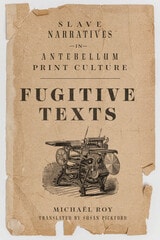
Fugitive Texts
Slave Narratives in Antebellum Print CultureMichaël Roy, translated by Susan Pickford
University of Wisconsin Press, 2024
In Fugitive Texts, Michaël Roy offers the first book-length study of the slave narrative as a material artifact. Drawing on a wide range of sources, he reconstructs the publication histories of a number of famous and lesser-known narratives, placing them against the changing backdrop of antebellum print culture. Slave narratives, he shows, were produced through a variety of print networks. Remarkably few were published under the full control of white-led antislavery societies; most were self-published and distributed by the authors, while some were issued by commercial publishers who hoped to capitalize on the success of Harriet Beecher Stowe’s Uncle Tom’s Cabin. The material lives of these texts, Roy argues, did not end within the pages. Antebellum slave narratives were “fugitive texts” apt to be embodied in various written, oral, and visual forms.
Published to rave reviews in French, Fugitive Texts illuminates the heterogeneous nature of a genre often described in monolithic terms and ultimately paves the way for a redefinition of the literary form we have come to recognize as “the slave narrative.”
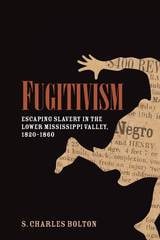
Fugitivism
Escaping Slavery in the Lower Mississippi Valley, 1820-1860S. Charles Bolton
University of Arkansas Press, 2019
Winner, 2020 Booker Worthen Literary Prize
During the antebellum years, over 750,000 enslaved people were taken to the Lower Mississippi Valley, where two-thirds of them were sold in the slave markets of New Orleans, Natchez, and Memphis. Those who ended up in Louisiana found themselves in an environment of swamplands, sugar plantations, French-speaking creoles, and the exotic metropolis of New Orleans. Those sold to planters in the newly-opened Mississippi Delta cleared land and cultivated cotton for owners who had moved west to get rich as quickly as possible, driving this labor force to harsh extremes.
Like enslaved people all over the South, those in the Lower Mississippi Valley left home at night for clandestine parties or religious meetings, sometimes “laying out” nearby for a few days or weeks. Some of them fled to New Orleans and other southern cities where they could find refuge in the subculture of slaves and free blacks living there, and a few attempted to live permanently free in the swamps and forests of the surrounding area. Fugitives also tried to returnto eastern slave states to rejoin families from whom they had been separated. Some sought freedom on the northern side of the Ohio River; othersfled to Mexico for the same purpose.
Fugitivism provides a wealth of new information taken from advertisements, newspaper accounts, and court records. It explains how escapees made use of steamboat transportation, how urban runaways differed from their rural counterparts, how enslaved people were victimized by slave stealers, how conflicts between black fugitives and the white people who tried to capture them encouraged a culture of violence in the South, and how runaway slaves from the Lower Mississippi Valley influenced the abolitionist movement in the North.
Readers will discover that along with an end to oppression, freedom-seeking slaves wanted the same opportunities afforded to most Americans.

Fuller in Her Own Time
A Biographical Chronicle of Her Life, Drawn from Recollections, Interviews, and Memoirs by Family, Friends, and AssociatesJoel Myerson
University of Iowa Press, 2008
The forty-one remembrances from Nathaniel Hawthorne, Oliver Wendell Holmes, Ralph Waldo Emerson, Thomas Carlyle, Harriet Martineau, Henry James, and twenty-four others chart Fuller’s expanding influence from schooldays in Boston, meetings at the Transcendental Club, teaching in Providence and Boston, work on the New York Tribune, publications and conversations, travels in the British Isles, and life and love in Italy before her tragic early death. Joel Myerson’s perceptive introduction assesses the pre- and postmortem building of Fuller’s reputation as well as her relationship to the prominent Transcendentalists, reformers, literati, and other personalities of her time, and his headnotes to each selection present valuable connecting contexts.
The woman who admitted that “at nineteen she was the most intolerable girl that ever took a seat in a drawing-room,” whose Woman in the Nineteenth Century is considered the first major book-length feminist call to action in America, never conformed to nineteenth-century expectations of self-effacing womanhood. The fascinating contradictions revealed by these narratives create a lively, lifelike biography of Fuller’s “rare gifts and solid acquirements . . . and unfailing intellectual sympathy.”
Functions of Victorian Culture at the Present Time
Christine L. Krueger
Ohio University Press, 2002

Fur Trappers Traders Of The Far Southwest
Matthew Despain
Utah State University Press, 1997

Future Perfect
American Science Fiction of the Nineteenth Century: An AnthologyFranklin, H. Bruce
Rutgers University Press, 1995
This selection of unusual storeis by important American writers-Hawthorne, Melville, Poe, Bellamy and Twain-and by less well-known tellers such as Ambrose Bierce, S. Weir Mitchell and Fitz-James O'Brien, challenges the commonly held belief that science fiction is a twenthiethcentury phenomenon, or that it began with Jule Verne and H,. G. Wells. Here are tales of marvelous inventions, automanta, biolgocial and psychological experiments, utopias, extra-sensory perception and time and space travel. Many of them have been out of print since before World War I, but they remain high in intrinsic interest of the general reader and for the specialist.
The accompanying critical essays explore the relationships between science fiction and other financial modes, and illuminate the nataure of the bonds betwen science and society and fantasies and social aspirations. Professor Franklin also offers an original, theoretical definition of science ficiton. This book comes as a revelatin. One of the best-edited anthologies I have ever encountered...Mr. Franklin's critical introductions, containing much valuable information about many works not included in this book, are as interesting as the stories he prints.