Results by title
2817 books match the query 'Nature' and 165 start with f
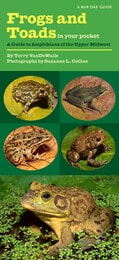
Frogs and Toads in Your Pocket
A Guide to Amphibians of the Upper MidwestTerry VanDeWalle
University of Iowa Press, 2011
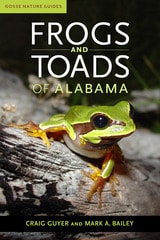
Frogs and Toads of Alabama
Craig Guyer and Mark A. Bailey
University of Alabama Press, 2023
From forest floor to backyard pond, discover Alabama’s frogs and toads in vivid detail.
Frogs and Toads of Alabama is the most comprehensive taxonomy of the anuran fauna gathered since Robert H. Mount’s 1975 volume on the reptiles and amphibians of Alabama. This richly illustrated guide provides an up-to-date summary of the taxonomy and life history of both native frogs and toads and those introduced to the state.
Alabama possesses one of the most species-rich biotas of North America, and this richness is reflected in its frogs and toads. The authors examine all known species within the state and describe important regional variations in each species, including changes within species across the state’s many habitats. Significant field studies, pertaining especially to species conservation, inform each account.
The life history entry for each species consists of scientific and common names, full-color photographs, a morphological description, discussion of habits and life cycle, and a distribution map depicting areas in which the species is located throughout the state, as well as notes on conservation and management practices. The illustrated taxonomic keys provided for families, genera, species, and subspecies will be an invaluable resource to herpetologists.
This extensive guide will serve as a single resource for understanding the rich natural history of Alabama by shedding light on this important aspect of its biodiversity, especially in light of ongoing changes in the habitats of many of Alabama’s herpetofauna. Accessible to all, this volume is valuable for both the professional herpetologist and the general reader interested in frogs and toads.
From Here to There and Back Again
Sue Hubbell
University of Michigan Press, 2004
"Sue Hubbell's From Here to There and Back Again is stylish and thought-provoking. As her brother I have long admired her mince pies and her ability to knit her own thermal underwear."
---Bil Gilbert
"The real masterwork that Sue Hubbell has created is her life."
---New York Times Book Review
"A latter-day Henry Thoreau with a sense of the absurd."
---Chicago Sun-Times
"Sue Hubbell writes splendidly."
---William Least Heat-Moon
"Prose as clear, languorous and beautiful as honey poured from a jar."
---People
From Here to There and Back Again is the much-anticipated collection of essays on an array of offbeat and engrossing subjects by magazine essayist and nature writer Sue Hubbell, author of A Country Year, Shrinking the Cat, and Waiting for Aphrodite.
Reading Sue Hubbell is like embarking on a journey of discovery with a close friend. Her writing is witty, learned yet unassuming, intensely personal, and pointedly honest as she ranges far and wide on such topics as after-hours truck stops, the country's best pie restaurants, bowling shoes, Costa Rica's blue morpho butterfly, earthquakes, and the honey trade. Several of her pieces take place in Michigan locales as well, including Elvis sightings in Vicksburg and the magicians' convention in Colon. In the end you'll return from these travels refreshed, enlightened-and wiser.
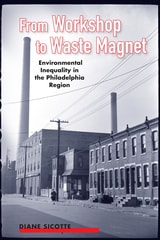
From Workshop to Waste Magnet
Environmental Inequality in the Philadelphia RegionSicotte, Diane
Rutgers University Press, 2016
From a Limestone Ledge
Some Essays and Other Ruminations about Country Life in TexasBy John Graves<br>Foreword by Bill Wittliff<br>Illustrations by Glenn Wolff
University of Texas Press, 2016
“Another fine, reflective, anecdotal look at rural Texas.” —New Yorker
“Graves writes eloquently about a countryman’s concerns. There's not a false note in the book.” —Boston Globe
“Like the unmortared stone fences of Graves’s native hill country, From a Limestone Ledge is constructed of bits and pieces never designed to fit together, yet made to achieve a unity that is more enduring than the sum of its individual parts by the hands of a master craftsman.” —Southwestern Historical Quarterly
“The beauty of his work endures, and there is a greater pride in Texans’ hearts for their home, I think, than there would be if he hadn’t written the books he did.” —Rick Bass, Garden & Gun
“In describing the particulars of his surroundings, Graves often was describing the world in microcosm and the place and plight of humankind in it.” —Bryan Woolley, Dallas Morning News

From the Lookout
Memories of Peninsula State Park’s Summer Camp for GirlsKathleen Harris
Wisconsin Historical Society Press, 2020
With big ideas, little money, and no experience, Alice Orr Clark and Frances Louise “Kidy” Mabley founded Meenahga as a place for young women to refine their manners, enjoy outdoor leisure activities, and learn woodcraft. From the Lookout is an account of these experiences, a history of Camp Meenahga informed by what campers, counselors, and others left behind, including letters home, notes from Clark and Mabley, and many pages from the camp yearbook and newsletter Pack and Paddle.
Brimming with nostalgia, From the Lookout brings to life the sights, sounds, and smells of an idyllic summer retreat, one that long after it closed lived on as a place of respite in the memories of those who knew and loved it best.
From the Mountains to the Sea
Protecting Nature in Postwar New HampshireKimberly A. Jarvis
University of Massachusetts Press, 2020
Shaped by New Hampshire's unique conservation focus on both resource use and preservation that developed during the first years of the twentieth century, as well as on the tradition of home rule in the state, the outcome of each campaign relied on the insight into, appreciation for, and dedication to protecting the historic and aesthetic values of these three places.

From the Nature of the Mind to Personal Dignity
The Significance of Rosmini's PhilosophyJuan F. Franck
Catholic University of America Press, 2006
From the Seashore to the Seafloor
An Illustrated Tour of Sandy Beaches, Kelp Forests, Coral Reefs, and Life in the Ocean's DepthsJanet Voight and Peggy Macnamara
University of Chicago Press, 2022
Have you ever walked along the beach and wondered what kind of creatures can be found beneath the waves? Have you pictured what it would be like to see the ocean not from the shore but from its depths? These questions drive Janet Voight, an expert on mollusks who has explored the seas in the submersible Alvin that can dive some 14,000 feet below the water’s surface. In this book, she partners with artist Peggy Macnamara to invite readers to share her undersea journeys of discovery.
With accessible scientific descriptions, Voight introduces the animals that inhabit rocky and sandy shores, explains the fragility of coral reefs, and honors the extraordinary creatures that must search for food in the ocean’s depths, where light and heat are rare. These fascinating insights are accompanied by Macnamara’s stunning watercolors, which illuminate these ecosystems and other scenes from Voight’s research. Together, they show connections between life at every depth—and warn of the threats these beguiling places and their eccentric denizens face.
Frozen Fauna of the Mammoth Steppe
The Story of Blue BabeR. Dale Guthrie
University of Chicago Press, 1990
The 36,000-year-old bison mummy, coated with blue mineral crystals, was dubbed "Blue Babe." Guthrie conveys the excitement of its excavation and shows how he made use of evidence from living animals, other Pleistocene mummies, Paleolithic art, and geological data. With photographs and scores of detailed drawings, he takes the reader through the excavation and subsequent detective work, analyzing the animal's carcass and its surroundings, the circumstances of its death, its appearance in life, the landscape it inhabited, and the processes of preservation by freezing. His examination shows that Blue Babe died in early winter, falling prey to lions that inhabited the Arctic during the Pleistocene era.
Guthrie uses information gleaned from his study of Blue Babe to provide a broad picture of bison evolutionary history and ecology, including speculations on the interactions of bison and Ice Age peoples. His description of the Mammoth Steppe as a cold, dry, grassy plain is based on an entirely new way of reading the fossil record.
Fuel for Growth
Water and Arizona's Urban EnvironmentDouglas E. Kupel
University of Arizona Press, 2003
Fuel for Growth describes and interprets the history of water resource development and its relationship to urban development in Arizona's three signature cities: Phoenix, Tucson, and Flagstaff. These three urban areas could hardly be more different: a growth-oriented metropolis, an environmentally conscious city with deep cultural roots, and an outdoor-friendly mountain town. Despite these differences, their community leaders and public officials have taken similar approaches to developing water resources with varying degrees of success and acceptance.
Douglas Kupel has created a new vision of water history based on the Arizona experience. He challenges many of the traditional assumptions of environmental history by revealing that the West's aridity has had relatively little impact on the development of municipal water infrastructure in these cities. While urban growth in the West is often characterized as the product of an elite group of water leaders, the development of Arizona's cities is shown to reflect the broad aspirations of all their citizens.
The book traces water development from the era of private water service to municipal ownership of water utilities and examines the impact of the post-World War II boom and subsequent expansion. Taking in the Salt River Project, the Central Arizona Project, and the Groundwater Management Act of 1980, Kupel explores the ongoing struggle between growth and environmentalism. He advocates public policy measures that can sustain a water future for the state.
As the urban West enters a new century of water management, Arizona's progress will increasingly be tied to that of its ever-expanding cities. Fuel for Growth documents an earlier era of urban water use and provides important recommendations for the future path of water development in the West's key population centers.
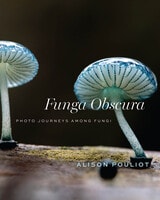
Funga Obscura
Photo Journeys Among FungiAlison Pouliot
University of Chicago Press, 2025
An unforgettable visual journey through the kingdom of fungi, both enigmatic and entrancing.
Recyclers, creators of soil, enablers of life, and food for many—fungi are as dynamic as they are diverse. And, throughout her career, Alison Pouliot has observed these organisms with a unique vision. As a scientist and photographer, she has led hundreds of forays through the forests of the Americas, Australia, and Europe. In this book, readers can travel along with her on these global explorations through stunning photographs and meditations on the landscape. She says her camera is where fungal lives come most clearly into focus. And like the camera obscura, this book, Funga Obscura, captures brief mycological moments and unforgettable fungus microcosms.
The word funga refers to the fungi of a region, and Pouliot’s photography spans continents. We see a parade of violet webcap mushrooms, spotted in the understory of a Pacific Northwest forest; brilliantly blue pixie’s parasols in Australia; an Italian alpine lichen, looking for all the world like a treasure map; and a showstopping whitelaced shank, ready to spread its spores in Switzerland. We learn that fungi live almost everywhere, from our lawns to forests and woodlands, from the ocean’s depths to deserts and alpine peaks. Yet, like a web of rootlike mycelium, Funga Obscura goes deeper to investigate how fungi shape landscapes and interact with other organisms, including humans. This journey spans eons, from long ago in evolutionary time, when fungi first emerged from the ocean onto land, to today, when we witness their work all around us. The scenes here challenge our ideas about what fungi are, what they do, and why they matter.
In Pouliot’s photographs, you might recognize a few old friends, but many mushrooms will be new acquaintances. Sometimes they make their presence immediately known; at other times, they just provide clues—and trails to follow.
Future Remains
A Cabinet of Curiosities for the AnthropoceneEdited by Gregg Mitman, Marco Armiero, Robert S. Emmett
University of Chicago Press, 2018
Future Remains is a thoughtful and creative meditation on these questions. The fifteen objects gathered in this book resemble more the tarots of a fortuneteller than the archaeological finds of an expedition—they speak of planetary futures. Marco Armiero, Robert S. Emmett, and Gregg Mitman have assembled a cabinet of curiosities for the Anthropocene, bringing together a mix of lively essays, creatively chosen objects, and stunning photographs by acclaimed photographer Tim Flach. The result is a book that interrogates the origins, implications, and potential dangers of the Anthropocene and makes us wonder anew about what exactly human history is made of.
Future Sea
How to Rescue and Protect the World’s OceansDeborah Rowan Wright
University of Chicago Press, 2020
The world’s oceans face multiple threats: the effects of climate change, pollution, overfishing, plastic waste, and more. Confronted with the immensity of these challenges and of the oceans themselves, we might wonder what more can be done to stop their decline and better protect the sea and marine life. Such widespread environmental threats call for a simple but significant shift in reasoning to bring about long-overdue, elemental change in the way we use ocean resources. In Future Sea, ocean advocate and marine-policy researcher Deborah Rowan Wright provides the tools for that shift. Questioning the underlying philosophy of established ocean conservation approaches, Rowan Wright lays out a radical alternative: a bold and far-reaching strategy of 100 percent ocean protection that would put an end to destructive industrial activities, better safeguard marine biodiversity, and enable ocean wildlife to return and thrive along coasts and in seas around the globe.
Future Sea is essentially concerned with the solutions and not the problems. Rowan Wright shines a light on existing international laws intended to keep marine environments safe that could underpin this new strategy. She gathers inspiring stories of communities and countries using ocean resources wisely, as well as of successful conservation projects, to build up a cautiously optimistic picture of the future for our oceans—counteracting all-too-prevalent reports of doom and gloom. A passionate, sweeping, and personal account, Future Sea not only argues for systemic change in how we manage what we do in the sea but also describes steps that anyone, from children to political leaders (or indeed, any reader of the book), can take toward safeguarding the oceans and their extraordinary wildlife.
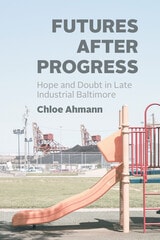
Futures after Progress
Hope and Doubt in Late Industrial BaltimoreChloe Ahmann
University of Chicago Press, 2024
Factory fires, chemical explosions, and aerial pollutants have inexorably shaped South Baltimore into one of the most polluted places in the country. In Futures after Progress, anthropologist Chloe Ahmann explores the rise and fall of industrial lifeways on this edge of the city and the uncertainties that linger in their wake. Writing from the community of Curtis Bay, where two hundred years of technocratic hubris have carried lethal costs, Ahmann also follows local efforts to realize a good future after industry and the rifts competing visions opened between neighbors.
Examining tensions between White and Black residents, environmental activists and industrial enthusiasts, local elders and younger generations, Ahmann shows how this community has become a battleground for competing political futures whose stakes reverberate beyond its six square miles in a present after progress has lost steam. And yet—as one young resident explains—“that’s not how the story ends.” Rigorous and moving, Futures after Progress probes the deep roots of our ecological predicament, offering insight into what lies ahead for a country beset by dreams deferred and a planet on the precipice of change.