Results by title
3703 books match the query '19th Century' and 84 start with g

GENERATION OF BOOMERS
Shelton Stromquist
University of Illinois Press, 2000
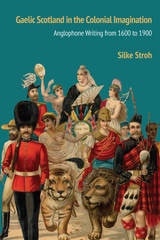
Gaelic Scotland in the Colonial Imagination
Anglophone Writing from 1600 to 1900Silke Stroh
Northwestern University Press, 2017
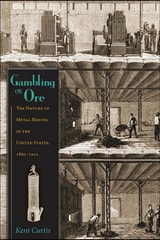
Gambling on Ore
The Nature of Metal Mining in the United States, 1860–1910Kent Curtis
University Press of Colorado, 2013
In Montana, legal issues and politics—such as unexpected consequences of federal mining law and the electrification of the United States—further complicated the mining industry’s already complex relationship to geology, while government policy, legal frameworks, dominant understandings of nature, and the exigencies of profit and production drove the industry in momentous and surprising directions. Despite its many uncertainties, mining became an important part of American culture and daily life.
Gambling on Ore unpacks the tangled relationships between mining and the natural world that gave material possibility to the age of electricity. Metal mining has had a profound influence on the human ecology and the social relationships of North America through the twentieth century and throughout the world after World War II. Understanding how we forged these relationships is central to understanding the environmental history of the United States after 1850.
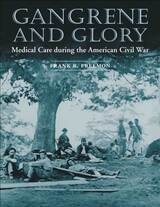
Gangrene and Glory
Medical Care during the American Civil WarFrank R. Freemon
University of Illinois Press, 1998
A medical doctor and a credentialed historian, Frank R. Freemon combines poignant, sometimes horrifying anecdotes of amputation, infection, and death with a clearheaded discussion of the state of medical knowledge, the effect of the military bureaucracy on medical supplies, and the members of the medical community who risked their lives, their health, and even their careers to provide appropriate care to the wounded. Freemon examines the impact on major campaigns--Manassas, Gettysburg, Vicksburg, Shiloh, Atlanta--of ignorance, understaffing, inexperience, overcrowded hospitals, insufficient access to ambulances, and inadequate supplies of essentials such as quinine.
Presenting the medical side of the war from a variety of perspectives--the Union, the Confederacy, doctors, nurses, soldiers, and their families--Gangrene and Glory achieves a peculiar immediacy by restricting its scope to the knowledge and perceptions available to its nineteenth-century subjects. Now available for the first time in paperback, this important volume takes a hard, close look at a neglected and crucial aspect of this bloody conflict.
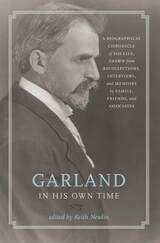
Garland in His Own Time
A Biographical Chronicle of His Life, Drawn from Recollections, Interviews, and Memoirs by Family, Friends, and AssociatesKeith Newlin
University of Iowa Press, 2013

Gastrodiplomacy
Chinese Exclusion and the Ascent of Chinese Restaurants in New York City, 1870–1943Heather Ruth Lee
University of Chicago Press, 2027
Traces how Chinese migrants challenged racialization and disenfranchisement by establishing Chinese restaurants during the Gilded Age.
In Gastrodiplomacy, Heather Ruth Lee dives deep into not just the history of Chinese restaurants in early twentieth-century New York City but the delicate, inchoate, and constantly evolving dynamics among their owners, workers, and their predominantly white clientele. Lee argues that the stylistic and capitalist choices made by restaurateurs (“gastrodiplomats”) had outsized political effects on paternalistic white diners (“gastroliberals”) who patronized their establishments, particularly when it came to racial relations in cities that were growing and diversifying. Lee is not starry-eyed—satisfying white tongues and stomachs didn’t lead to an urban utopia of peace, harmony, and brotherhood—but she shows the great and subtle influences of Chinese migrants on American urban space, culture, and metropolitan identity in a defining time.
In Lee’s capable and compelling telling, the Chinese restaurant becomes a distinctive locus for the negotiation of political power, cultural influence, urban identity, and more. Gastrodiplomacy reveals much about burgeoning and increasingly cosmopolitan American cities, as well as about their dynamic relationships with the fluidities of the American character.
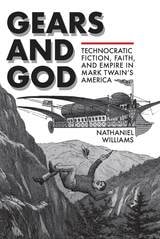
Gears and God
Technocratic Fiction, Faith, and Empire in Mark Twain's AmericaNathaniel Williams
University of Alabama Press, 2018
In Gears and God: Technocratic Fiction, Faith, and Empire in Mark Twain’s America, Nathaniel Williams analyzes the genre of technology-themed exploration novels—dime novel adventure stories featuring steam-powered and electrified robots, airships, and submersibles. This genre proliferated during the same cultural moment when evolutionary science was dismantling Americans’ prevailing, biblically based understanding of human history.
While their heyday occurred in the late 1800s, technocratic adventure novels like Twain’s A Connecticut Yankee in King Arthur’s Court inspired later fiction about science and technology. Similar to the science fiction plotlines of writers like Jules Verne and H. Rider Haggard, and anticipating the adventures of Tom Swift some decades later, these novels feature Americans using technology to visit and seize control of remote locales, a trait that has led many scholars to view them primarily as protoimperialist narratives. Their legacy, however, is more complicated. As they grew in popularity, such works became as concerned with the preservation of a fraught Anglo-Protestant American identity as they were with spreading that identity across the globe.
Many of these novels frequently assert the Bible’s authority as a historical source. Collectively, such stories popularized the notion that technology and travel might essentially “prove” the Bible’s veracity—a message that continues to be deployed in contemporary debates over intelligent design, the teaching of evolution in public schools, and in reality TV shows that seek historical evidence for biblical events. Williams argues that these fictions performed significant cultural work, and he consolidates evidence from the novels themselves, as well as news articles, sermons, and other sources of the era, outlining and mapping the development of technocratic fiction.
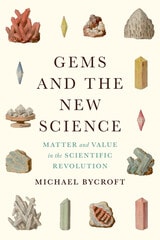
Gems and the New Science
Matter and Value in the Scientific RevolutionMichael Bycroft
University of Chicago Press, 2026
In Gems and the New Science, Michael Bycroft argues that gems were connected to major developments in the “new science” between the sixteenth and nineteenth centuries. As he explains, precious and semiprecious stones were at the center of dramatic shifts in natural knowledge in early modern Europe. They were used to investigate luminescence, electricity, combustion, chemical composition, and more. They were collected by naturalists; measured by mathematicians; and rubbed, burned, and dissolved by experimental philosophers. This led to the demise of the traditional way of classifying gems—which grouped them by transparency, color, and locality—and the turn to density, refraction, chemistry, and crystallography as more reliable guides for sorting these substances.
The science of gems shows that material evaluation was as important as material production in the history of science. It also shows the value of seeing science as the product of the interaction between different material worlds. The book begins by bringing these insights to bear on five themes of the Scientific Revolution. Each of the subsequent chapters deals with a major episode in early modern science, from the expansion of natural history in the sixteenth century to the emergence of applied science early in the nineteenth century. This important work is not only the first book-length history of the science of gems but also a fresh interpretation of the Scientific Revolution and an argument for using a new form of materialism to understand the evolution of science.
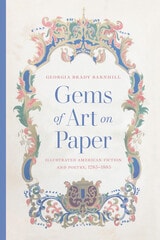
Gems of Art on Paper
Illustrated American Fiction and Poetry, 1785–1885Georgia Brady Barnhill
University of Massachusetts Press, 2021
In the immediate aftermath of the Revolutionary War, only the wealthiest Americans could afford to enjoy illustrated books and prints. But, by the end of the next century, it was commonplace for publishers to load their books with reproductions of fine art and beautiful new commissions from amateur and professional artists.
Georgia Brady Barnhill, an expert on the visual culture of this period, explains the costs and risks that publishers faced as they brought about the transition from a sparse visual culture to a rich one. Establishing new practices and investing in new technologies to enhance works of fiction and poetry, bookmakers worked closely with skilled draftsmen, engravers, and printers to reach an increasingly literate and discriminating American middle class. Barnhill argues that while scholars have largely overlooked the efforts of early American illustrators, the works of art that they produced impacted readers' understandings of the texts they encountered, and greatly enriched the nation's cultural life.
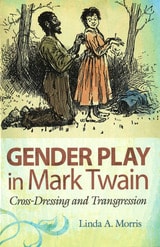
Gender Play in Mark Twain
Cross-Dressing and TransgressionLinda A. Morris
University of Missouri Press, 2007
Huckleberry Finn dressing as a girl is a famously comic scene in Mark Twain’s novel but hardly out of character—for the author, that is. Twain “troubled gender” in much of his otherwise traditional fiction, depicting children whose sexual identities are switched at birth, tomboys, same-sex married couples, and even a male French painter who impersonates his own fictive sister and becomes engaged to another man.
This book explores Mark Twain’s extensive use of cross-dressing across his career by exposing the substantial cast of characters who masqueraded as members of the opposite sex or who otherwise defied gender expectations. Linda Morris grounds her study in an understanding of the era’s theatrical cross-dressing and changing mores and even events in the Clemens household. She examines and interprets Twain’s exploration of characters who transgress gendered conventions while tracing the degree to which themes of gender disruption interact with other themes, such as his critique of race, his concern with death in his classic “boys’ books,” and his career-long preoccupation with twins and twinning.
Approaching familiar texts in surprising new ways, Morris reexamines the relationship between Huck and Jim; discusses racial and gender crossing in Pudd’nhead Wilson; and sheds new light on Twain’s difficulty in depicting the most famous cross-dresser in history, Joan of Arc. She also considers a number of his later “transvestite tales” that feature transgressive figures such as Hellfire Hotchkiss, who is hampered by her “misplaced sex.”
Morris challenges views of Twain that see his work as reinforcing traditional notions of gender along sharply divided lines. She shows that Twain depicts cross-dressing sometimes as comic or absurd, other times as darkly tragic—but that even at his most playful, he contests traditional Victorian notions about the fixity of gender roles.
Analyzing such characteristics of Twain’s fiction as his fascination with details of clothing and the ever-present element of play, Morris shows us his understanding that gender, like race, is a social construction—and above all a performance. Gender Play in Mark Twain: Cross-Dressing and Transgression broadens our understanding of the writer as it lends rich insight into his works.
Gender and Generation on the Far Western Frontier
Cynthia Culver Prescott
University of Arizona Press, 2007
In Gender and Generation on the Far Western Frontier, Cynthia Culver Prescott expertly explores the shifting gender roles and ideologies that countless Anglo-American settlers struggled with in Oregon’s Willamette Valley between 1845 and 1900. Drawing on traditional social history sources as well as divorce records, married women’s property records, period photographs, and material culture, Prescott reveals that Oregon settlers pursued a moving target of middle-class identity in the second half of the nineteenth century.
Prescott traces long-term ideological changes, arguing that favorable farming conditions enabled Oregon families to progress from accepting flexible frontier roles to participating in a national consumer culture in only one generation. As settlers’ children came of age, participation in this new culture of consumption and refined leisure became the marker of the middle class. Middle-class culture shifted from the first generation’s emphasis on genteel behavior to a newer genteel consumption.
This absorbing volume reveals the shifting boundaries of traditional women’s spheres, the complicated relationships between fathers and sons, and the second generation’s struggle to balance their parents’ ideology with a changing national sense of class consciousness.
Gender and the Social Gospel
Edited by Wendy J. Deichmann Edwards and Carolyn De Swarte Gifford
University of Illinois Press, 2003
A practical theological response to the stark realities of poverty and injustice prevalent in turn-of-the-century America, the social gospel movement sought to apply the teachings of Jesus and the message of Christian salvation to society by striving to improve the lives of the impoverished and the disenfranchised. The contributors to this volume set out to broaden our understanding of this radical movement by examining the lives of some of its passionate and vibrant female participants and the ways in which their involvement expanded and enriched the scope of its activity.
In addition to examining the lives of individual women, the essays in Gender and the Social Gospel contain broader analyses of the gender and racial issues that have caused the histories of movements such as the social gospel to be viewed almost exclusively in terms of their male, European-American, intellectual participants at the expense of the women, African Americans, and Canadians whose contributions were just as worthy of attention.
Gendered Justice in the American West
Women Prisoners in Men's PenitentiariesAnne M. Butler
University of Illinois Press, 1997
Drawing on prison records and the words of the women themselves, Gendered Justice in the American West places the injustices women prisoners endured in the context of the structures of male authority and female powerlessness that pervaded all of American society. Butler's poignant cross-cultural account explores how nineteenth-century criminologists constructed the "criminal woman"; how the women's age, race, class, and gender influenced their court proceedings; and what kinds of violence women inmates encountered. She also examines the prisoners' diet, illnesses, and experiences with pregnancy and child-bearing, as well as their survival strategies.
Gendered Strife and Confusion
The Political Culture of ReconstructionLaura F. Edwards
University of Illinois Press, 1997

Gendering Bodies/Performing Art
Dance and Literature in Early Twentieth-Century British CultureAmy Koritz
University of Michigan Press, 1995

Gendering the Fair
Histories of Women and Gender at World's FairsEdited by TJ Boisseau and Abigail M. Markwyn
University of Illinois Press, 2010
Genius Belabored
Childbed Fever and the Tragic Life of Ignaz SemmelweisTheodore G. Obenchain
University of Alabama Press, 2016
The fascinating story of Ignaz Semmelweis, a nineteenth-century obstetrician ostracized for his strident advocacy of disinfection as a way to prevent childbed fever.
In Genius Belabored: Childbed Fever and the Tragic Life of Ignaz Semmelweis, Theodore G. Obenchain traces the life story of a nineteenth-century Hungarian obstetrician who was shunned and marginalized by the medical establishment for advancing a far-sighted but unorthodox solution to the appalling mortality rates that plagued new mothers of the day.
In engrossing detail, Obenchain recreates for readers the sights, smells, and activities within a hospital of that day. In an era before the acceptance of modern germ science, physicians saw little need for cleanliness or hygiene. As a consequence, antiseptic measures were lax and rudimentary. Especially vulnerable to contamination were new mothers, who frequently contracted and died from childbed fever (puerperal fever). Genius Belabored follows Semmelweis’s awakening to the insight that many of these deaths could be avoided with basic antiseptic measures like hand washing.
The medical establishment, intellectually unprepared for Semmelweis’s prescient hypothesis, rejected it for a number of reasons. It was unorthodox and went against the lingering Christian tradition that the dangers of childbirth were inherent to the lives of women. Complicating matters, colleagues did not consider Semmelweis an easy physician to work with. His peers described him as strange and eccentric. Obenchain offers an empathetic and insightful argument that Semmelweis suffered from bipolar disorder and illuminates how his colleagues, however dedicated to empirical science they might have been, misjudged Semmelweis’s methods based upon ignorance and their emotional discomfort with him.
In Genius Belabored, Obenchain identifies Semmelweis’s rightful place in the pantheon of scientists and physicians whose discoveries have saved the lives of millions. Obenchain’s biography of Semmelweis offers unique insights into the practice of medicine and the mindsets of physicians working in the premodern era. This fascinating study offers much of interest to general readers as well as those interested in germ theory, the history of medicine and obstetrics, or anyone wishing to better understand the trajectory of modern medicine.
Genre of Autobiography in Victorian Literature
Clinton Machann
University of Michigan Press, 1995
Genre, Race, and the Production of Subjectivity in German Romanticism
Stephanie Galasso
Northwestern University Press, 2024
Late Enlightenment philosophers and writers like Herder, Goethe, and Schiller broke with conventions of form and genre to prioritize an idealized, and racially coded, universality. Newly translated literatures from colonial contexts served as the basis for their evaluations of how to contribute to a distinctly “German” national literary tradition, one that valorized modernity and freedom and thus fortified crucial determinants of modern concepts of whiteness. Through close readings of both canonical and less-studied Romantic texts, Stephanie Galasso examines the intimately entwined histories of racialized subjectivity and aesthetic theory and shows how literary genre is both symptomatic and generative of the cultural violence that underpinned the colonial project.
Poetic expression and its generic conventions continue to exert pressure on the framing and reception of the stories that can be told about interpersonal and structural experiences of oppression. Genre, Race, and the Production of Subjectivity in German Romanticism explores how white subjectivity is guarded by symbolic and material forms of violence.
Gentile New York
The Images of Non-Jews among Jewish ImmigrantsRibak, Gil
Rutgers University Press, 2012
The very question of “what do Jews think about the goyim” has fascinated Jews and Gentiles, anti-Semites and philo-Semites alike. Much has been written about immigrant Jews in nineteenth- and twentieth-century New York City, but Gil Ribak’s critical look at the origins of Jewish liberalism in America provides a more complicated and nuanced picture of the Americanization process.
Gentile New York examines these newcomers’ evolving feelings toward non-Jews through four critical decades in the American Jewish experience. Ribak considers how they perceived Gentiles in general as well as such different groups as “Yankees” (a common term for WASPs in many Yiddish sources), Germans, Irish, Italians, Poles, and African Americans. As they discovered the complexity of America’s racial relations, the immigrants found themselves at odds with “white” American values or behavior and were drawn instead into cooperative relationships with other minorities. Sparked with many previously unknown anecdotes, quotations, and events, Ribak’s research relies on an impressive number of memoirs, autobiographies, novels, newspapers, and journals culled from both sides of the Atlantic.
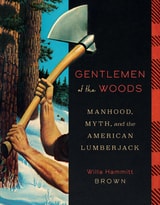
Gentlemen of the Woods
Manhood, Myth, and the American LumberjackWilla Hammitt Brown
University of Minnesota Press, 2025
Lumberjacks: the men, the myth, and the making of an American legend
The folk hero Paul Bunyan, burly, bearded, wielding his big ax, stands astride the story of the upper Midwest—a manly symbol of the labor that cleared the vast north woods for the march of industrialization while somehow also maintaining an aura of pristine nature. This idea, celebrated in popular culture with songs and folktales, receives a long overdue and thoroughly revealing correction in Gentlemen of the Woods, a cultural history of the life and lore of the real lumberjack and his true place in American history.
Now recalled as heroes of wilderness and masculinity, lumberjacks in their own time were despised as amoral transients. Willa Hammitt Brown shows that nineteenth-century jacks defined their communities of itinerant workers by metrics of manhood that were abhorrent to the residents of the nearby Northwoods boomtowns, valuing risk-taking and skill rather than restraint and control. Reviewing songs, stories, and firsthand accounts from loggers, Brown brings to life the activities and experiences of the lumberjacks as they moved from camp to camp. She contrasts this view with the popular image cultivated by retreating lumber companies that had to sell off utterly barren land. This mythologized image glorified the lumberjack and evoked a kindly, flannel-wearing, naturalist hero.
Along with its portrait of lumberjack life and its analysis of the creation of lumberjack myth, Gentlemen of the Woods offers new insight into the intersections of race and social class in the logging enterprise, considering the actual and perceived roles of outsider lumberjacks and Native inhabitants of the northern forests. Anchored in the dual forces of capitalism and colonization, this lively and compulsively readable account offers a new way to understand a myth and history that has long captured our collective imagination.
Gentlemen on the Prairie
Victorians in Pioneer IowaHarnack, Curtis
University of Iowa Press, 1985
@font-face { font-family: "Palatino";}@font-face { font-family: "?????? Pro W3";}p.MsoNormal, li.MsoNormal, div.MsoNormal { margin: 0in 0in 0.0001pt; font-size: 12pt; font-family: "Times New Roman"; }p.FreeForm, li.FreeForm, div.FreeForm { margin: 0in 0in 0.0001pt; font-size: 12pt; font-family: "Times New Roman"; color: black; }div.Section1 { page: Section1; }
In the 1880s, the well-connected young Englishman William B. Close and his three brothers, having bought thousands of acres of northwest Iowa prairie, conceived the idea of enticing sons of Britain’s upper classes to pursue the life of the landed gentry on these fertile acres. “Yesterday a wilderness, today an empire”: their bizarre experiment, which created a colony for people “of the better class” who were not in line to inherit land but whose fathers would set them up in farming, flourished in Le Mars, Iowa (and later in Pipestone, Minnesota), with over five hundred youths having a go at farming. In Gentlemen on the Prairie, Curtis Harnack tells the remarkable story of this quite unusual chapter in the settling of the Midwest.
Many of these immigrants had no interest in American citizenship but enjoyed or endured the challenging adventure of remaining part of the empire while stranded on the plains. They didn’t mix socially with other Le Mars area residents but enjoyed such sports as horse racing, fox hunts, polo, and an annual derby followed by a glittering grand ball. Their pubs were named the House of Lords, the House of Commons, and Windsor Castle; the Prairie Club was a replica of a London gentlemen’s club, an opera house attracted traveling shows, and their principal hotel was Albion House. In St. George’s Episcopal Church, prayers were offered for the well-being of Queen Victoria.
Problems soon surfaced, however, even for these well-heeled aristocrats. The chief problem was farm labor; there was no native population to exploit, and immigrant workers soon bought their own land. Although sisters might visit the colonists and sometimes marry one of them, appropriate female companionship was scarce. The climate was brutal in its extremes, and many colonists soon sold their acres at a profit and moved to countries affiliated with Britain. When the financial depression in the early 1890s lowered land values and made agriculture less profitable, the colony collapsed. Harnack skillfully draws upon the founder’s “Prairie Journal,” company ledgers, and other records to create an engaging, engrossing story of this quixotic pioneering experiment.

Geographies of Mars
Seeing and Knowing the Red PlanetK. Maria D. Lane
University of Chicago Press, 2011
A highly original exploration of geography’s spatial dimensions at the beginning of the twentieth century, offering a new view of the mapping of far-off worlds.
One of the first maps of Mars, published by an Italian astronomer in 1877, with its pattern of canals, fueled belief in intelligent life forms on the distant red planet—a hope that continued into the 1960s. Although the Martian canals have long since been dismissed as a famous error in the history of science, K. Maria D. Lane argues that there was nothing accidental about these early interpretations. Indeed, she argues, the construction of Mars as an incomprehensibly complex and engineered world both reflected and challenged dominant geopolitical themes during a time of major cultural, intellectual, political, and economic transition in the Western world.
Geographies of Mars telescopes in on a critical period in the development of the geographical imagination, when European imperialism was at its zenith and American expansionism had begun in earnest. Astronomers working in the new observatories of the American Southwest or in the remote heights of the South American Andes were inspired, Lane finds, by their own physical surroundings and used representations of the Earth’s arid landscapes to establish credibility for their observations of Mars. With this simple shift to the geographer’s point of view, Lane deftly explains some of the most perplexing stances on Mars taken by familiar protagonists such as Percival Lowell, Alfred Russel Wallace, and Lester Frank Ward.

Geographies of Nineteenth-Century Science
Edited by David N. Livingstone and Charles W. J. Withers
University of Chicago Press, 2011
In Geographies of Nineteenth-Century Science, David N. Livingstone and Charles W. J. Withers gather essays that deftly navigate the spaces of science in this significant period and reveal how each is embedded in wider systems of meaning, authority, and identity. Chapters from a distinguished range of contributors explore the places of creation, the paths of knowledge transmission and reception, and the import of exchange networks at various scales. Studies range from the inspection of the places of London science, which show how different scientific sites operated different moral and epistemic economies, to the scrutiny of the ways in which the museum space of the Smithsonian Institution and the expansive space of the American West produced science and framed geographical understanding. This volume makes clear that the science of this era varied in its constitution and reputation in relation to place and personnel, in its nature by virtue of its different epistemic practices, in its audiences, and in the ways in which it was put to work.
Geographies of Philological Knowledge
Postcoloniality and the Transatlantic National EpicNadia R. Altschul
University of Chicago Press, 2012
Geography Unbound
French Geographic Science from Cassini to HumboldtAnne Marie Claire Godlewska
University of Chicago Press, 1999
Anne Godlewska examines this crisis, the often conservative reactions of geographers to it, and the work of researchers at the margins of the field who helped chart its future course. She tells her story partly through the lives and careers of individuals, from the deposed cabinet geographer Cassini IV to Volney, von Humboldt, and Letronne (innovators in human, physical, and historical geography), and partly through the institutions with which they were associated such as the Encyclopédie and the Jesuit and military colleges.
Geography Unbound presents an insightful portrait of a crucial period in the development of modern geography, whose unstable disciplinary status is still very much an issue today.

George Dixon
The Short Life of Boxing's First Black World Champion, 1870–1908Jason Winders
University of Arkansas Press, 2021
Winner, 2022 NASSH Book Award (Monograph)
On September 6, 1892, a diminutive Black prizefighter brutally dispatched an overmatched white hope in the New Orleans Carnival of Champions boxing tournament. That victory sparked celebrations across Black communities nationwide but fostered unease among sporting fans and officials, delaying public acceptance of mixed-race fighting for half a century. This turn echoed the nation’s disintegrating relations between whites and Blacks and foreshadowed America’s embrace of racial segregation.
In this work of sporting and social history we have a biography of Canadian-born, Boston-raised boxer George Dixon (1870–1908), the first Black world champion of any sport and the first Black world boxing champion in any division. George Dixon: The Short Life of Boxing’s First Black World Champion, 1870–1908 chronicles the life of the most consequential Black athlete of the nineteenth century and details for the first time his Carnival appearance, perhaps the most significant bout involving a Black fighter until Jack Johnson began his reign in 1908. Yet despite his triumphs, Dixon has been lost to history, overshadowed by Black athletes whose activism against white supremacy far exceeded his own.
George Dixon reveals the story of a man trapped between the white world he served and the Black world that worshipped him. By ceding control to a manipulative white promoter, Dixon was steered through the white power structure of Gilded Age prizefighting, becoming world famous and one of North America’s richest Black men. Unable to hold on to his wealth, however, and battered by his vices, a depleted Dixon was abandoned by his white supporters just as the rising tide of Jim Crow limited both his prospects and the freedom of Blacks nationwide.
George Eliot in Society
Travels Abroad and Sundays at the PrioryKathleen McCormack
The Ohio State University Press, 2013
George Eliot’s Serial Fiction
Carol A. Martin
The Ohio State University Press, 1994

George Inness and the Science of Landscape
Rachael Ziady DeLue
University of Chicago Press, 2005
Throughout his career, Inness struggled to make visible what was invisible to the human eye by combining a deep interest in nineteenth-century scientific inquiry—including optics, psychology, physiology, and mathematics—with an idiosyncratic brand of mysticism. Rachael Ziady DeLue's George Inness and the Science of Landscape—the first in-depth examination of Inness's career to appear in several decades—demonstrates how the artistic, spiritual, and scientific aspects of Inness's art found expression in his masterful landscapes. In fact, Inness's practice was not merely shaped by his preoccupation with the nature and limits of human perception; he conceived of his labor as a science in its own right.
This lavishly illustrated work reveals Inness as profoundly invested in the science and philosophy of his time and illuminates the complex manner in which the fields of art and science intersected in nineteenth-century America. Long-awaited, this reevaluation of one of the major figures of nineteenth-century American art will prove to be a seminal text in the fields of art history and American studies.
Germaine De Staël, George Sand, and the Victorian Woman Artist
Linda M. Lewis
University of Missouri Press, 2003
German Americans on the Middle Border
From Antislavery to Reconciliation, 1830–1877Zachary Stuart Garrison
Southern Illinois University Press, 2020
Liberal German immigrants, having escaped the European aristocracy who undermined their revolution and the formation of a free nation, viewed slaveholders as a specter of European feudalism. During the antebellum years, many liberal German Americans feared slavery would inhibit westward progress, and so they embraced the Free Soil and Free Labor movements and the new Republican Party. Most joined the Union ranks during the Civil War.
After the war, in a region largely opposed to black citizenship and Radical Republican rule, German Americans were seen as dangerous outsiders. Facing a conservative resurgence, liberal German Republicans employed the same line of reasoning they had once used to justify emancipation: A united nation required the end of both federal occupation in the South and special protections for African Americans. Having played a role in securing the Union, Germans largely abandoned the freedmen and freedwomen. They adopted reconciliation in order to secure their place in the reunified nation. Garrison’s unique transnational perspective to the sectional crisis, the Civil War, and the postwar era complicates our understanding of German Americans on the middle border.
German Liberalism in the Nineteenth Century
James J. Sheehan
University of Chicago Press, 1978
German Settlement in Missouri
New Land, Old WaysRobyn Burnett & Ken Luebbering
University of Missouri Press, 1996
German immigrants came to America for two main reasons: to seek opportunities in the New World, and to avoid political and economic problems in Europe. In German Settlement in Missouri, Robyn Burnett and Ken Luebbering demonstrate the crucial role that the German immigrants and their descendants played in the settlement and development of Missouri's architectural, political, religious, economic, and social landscape. Relying heavily on unpublished memoirs, letters, diaries, and official records, the authors provide important new narratives and firsthand commentary from the immigrants themselves.
Between 1800 and 1919, more than 7 million people came to the United States from German-speaking lands. The German immigrants established towns as they moved up the Missouri River into the frontier, resuming their traditional ways as they settled. As a result, the culture of the frontier changed dramatically. The Germans farmed differently from their American neighbors. They started vineyards and wineries, published German-language newspapers, and entered Missouri politics.
The decades following the Civil War brought the golden age of German culture in the state. The populations of many small towns were entirely German, and traditions from the homeland thrived. German-language schools, publications, and church services were common. As the German businesses in St. Louis and other towns flourished, the immigrants and their descendants prospered. The loyalty of the Missouri Germans was tested in World War I, and the anti-immigrant sentiment during the war and the period of prohibition after it dealt serious blows to their culture. However, German traditions had already found their way into mainstream American life.
Informative and clearly written, German Settlement in Missouri will be of interest to all readers, especially those interested in ethnic history.

German Women for Empire, 1884-1945
Lora Wildenthal
Duke University Press, 2001
In confrontation and sometimes cooperation with men over their place in the colonial project, German women launched nationalist and colonialist campaigns for increased settlement and new state policies. Wildenthal analyzes recently accessible Colonial Office archives as well as mission society records, periodicals, women’s memoirs, and fiction to show how these women created niches for themselves in the colonies. They emphasized their unique importance for white racial “purity” and the inculcation of German culture in the family. While pressing for career opportunities for themselves, these women also campaigned against interracial marriage and circulated an image of African and Pacific women as sexually promiscuous and inferior. As Wildenthal discusses, the German colonial imaginary persisted even after the German colonial empire was no longer a reality. The women’s colonial movement continued into the Nazi era, combining with other movements to help turn the racialist thought of the late-nineteenth and early-twentieth centuries into the hierarchical evaluation of German citizens as well as colonial subjects.
Students and scholars of women’s history, modern German history, colonial politics and culture, postcolonial theory, race/ethnicity, and gender will welcome this groundbreaking study.

Germans and Texans
Commerce, Migration, and Culture in the Days of the Lone Star RepublicBy Walter Struve
University of Texas Press, 1996
During the brief history of the Republic of Texas (1836-1845), over 10,000 Germans emigrated to Texas. Perhaps best remembered today are the farmers who settled the Texas Hill Country, yet many of the German immigrants were merchants and businesspeople who helped make Galveston a thriving international port and Houston an early Texas business center. This book tells their story.
Drawing on extensive research on both sides of the Atlantic, Walter Struve explores the conditions that led nineteenth-century Europeans to establish themselves on the North American frontier. In particular, he traces the similarity in social, economic, and cultural conditions in Germany and the Republic of Texas and shows how these similarities encouraged German emigration and allowed some immigrants to prosper in their new home. Particularly interesting is the translation of a collection of letters from Charles Giesecke to his brother in Germany which provide insight into the business and familial concerns of a German merchant and farmer.
This wealth of information illuminates previously neglected aspects of intercontinental migration in the nineteenth century. The book will be important reading for a wide public and scholarly audience.
Germans in Illinois
Miranda E. Wilkerson and Heather Richmond
Southern Illinois University Press, 2019
The promise of cheap land and fertile soil in rural areas and emerging industries in cities attracted three major waves of German-speaking immigrants to Illinois in search of freedom and economic opportunities. Before long the state was dotted with German churches, schools, cultural institutions, and place names. German churches served not only as meeting places but also as a means of keeping language and culture alive. Names of Illinois cities and towns of German origin include New Baden, Darmstadt, Bismarck, and Hamburg. In Chicago, many streets, parks, and buildings bear German names, including Altgeld Street, Germania Place, Humboldt Park, and Goethe Elementary School. Some of the most lively and ubiquitous organizations, such as Sängerbunde, or singer societies, and the Turnverein, or Turner Society, also preserved a bit of the Fatherland.
Exploring the complex and ever-evolving German American identity in the growing diversity of Illinois’s linguistic and ethnic landscape, this book contextualizes their experiences and corrects widely held assumptions about assimilation and cultural identity. Federal census data, photographs, lively biographical sketches, and newly created maps bring the complex story of German immigration to life. The generously illustrated volume also features detailed notes, suggestions for further reading, and an annotated list of books, journal articles, and other sources of information.

Germany's Wild East
Constructing Poland as Colonial SpaceKristin Kopp
University of Michigan Press, 2012
While conventional definitions locate colonial space overseas, Kristin Kopp argues that it was possible to understand both distant continents and adjacent Eastern Europe as parts of the same global periphery dependent upon Western European civilizing efforts. However, proximity to the source of aid translated to greater benefits for Eastern Europe than for more distant regions.

Ghostly Communion
Cross-Cultural Spiritualism in Nineteenth-Century American LiteratureJohn J. Kucich
Dartmouth College Press, 2015
Ghostly Past, Capitalist Presence
A Social History of Fear in Colonial BengalTithi Bhattacharya
Duke University Press, 2024
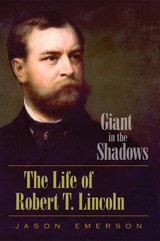
Giant in the Shadows
The Life of Robert T. LincolnJason Emerson
Southern Illinois University Press, 2012
University Press Books for Public and Secondary Schools, 2013 edition
Book of the Year by the Illinois State historical Society, 2013
Although he was Abraham and Mary Lincoln’s oldest and last surviving son, the details of Robert T. Lincoln’s life are misunderstood by some and unknown to many others. Nearly half a century after the last biography about Abraham Lincoln’s son was published, historian and author Jason Emerson illuminates the life of this remarkable man and his achievements in Giant in the Shadows: The Life of Robert T. Lincoln. Emerson, after nearly ten years of research, draws upon previously unavailable materials to offer the first truly definitive biography of the famous lawyer, businessman, and statesman who, much more than merely the son of America’s most famous president, made his own indelible mark on one of the most progressive and dynamic eras in United States history.
Born in a boardinghouse but passing his last days at ease on a lavish country estate, Robert Lincoln played many roles during his lifetime. As a president’s son, a Union soldier, an ambassador to Great Britain, and a U.S. secretary of war, Lincoln was indisputably a titan of his age. Much like his father, he became one of the nation’s most respected and influential men, building a successful law practice in the city of Chicago, serving shrewdly as president of the Pullman Car Company, and at one time even being considered as a candidate for the U.S. presidency.
Along the way he bore witness to some of the most dramatic moments in America’s history, including Robert E. Lee’s surrender at Appomattox Courthouse; the advent of the railroad, telephone, electrical, and automobile industries; the circumstances surrounding the assassinations of three presidents of the United States; and the momentous presidential election of 1912. Giant in the Shadows also reveals Robert T. Lincoln’s complex relationships with his famous parents and includes previously unpublished insights into their personalities. Emerson reveals new details about Robert’s role as his father’s confidant during the brutal years of the Civil War and his reaction to his father’s murder; his prosecution of the thieves who attempted to steal his father’s body in 1876 and the extraordinary measures he took to ensure it would never happen again; as well as details about the painful decision to have his mother committed to a mental facility. In addition Emerson explores the relationship between Robert and his children, and exposes the actual story of his stewardship of the Lincoln legacy—including what he and his wife really destroyed and what was preserved. Emerson also delves into the true reason Robert is not buried in the Lincoln tomb in Springfield but instead was interred at Arlington National Cemetery.
Meticulously researched, full of never-before-seen photographs and new insight into historical events, Giant in the Shadows is the missing chapter of the Lincoln family story. Emerson’s riveting work is more than simply a biography; it is a tale of American achievement in the Gilded Age and the endurance of the Lincoln legacy.
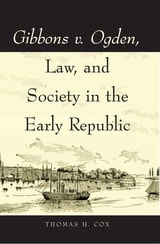
Gibbons v. Ogden, Law, and Society in the Early Republic
Thomas H. Cox
Ohio University Press, 2009
Gibbons v. Ogden, Law, and Society in the Early Republic examines a landmark decision in American jurisprudence, the first Supreme Court case to deal with the thorny legal issue of interstate commerce.
Decided in 1824, Gibbons v. Ogden arose out of litigation between owners of rival steamboat lines over passenger and freight routes between the neighboring states of New York and New Jersey. But what began as a local dispute over the right to ferry the paying public from the New Jersey shore to New York City soon found its way into John Marshall’s court and constitutional history. The case is consistently ranked as one of the twenty most significant Supreme Court decisions and is still taught in constitutional law courses, cited in state and federal cases, and quoted in articles on constitutional, business, and technological history.
Gibbons v. Ogden initially attracted enormous public attention because it involved the development of a new and sensational form of technology. To early Americans, steamboats were floating symbols of progress—cheaper and quicker transportation that could bring goods to market and refinement to the backcountry. A product of the rough-and-tumble world of nascent capitalism and legal innovation, the case became a landmark decision that established the supremacy of federal regulation of interstate trade, curtailed states’ rights, and promoted a national market economy. The case has been invoked by prohibitionists, New Dealers, civil rights activists, and social conservatives alike in debates over federal regulation of issues ranging from labor standards to gun control. This lively study fills in the social and political context in which the case was decided—the colorful and fascinating personalities, the entrepreneurial spirit of the early republic, and the technological breakthroughs that brought modernity to the masses.
Gifts of Power
The Writings of Rebecca Jackson, Black Visionary, Shaker EldressJean M. Humez
University of Massachusetts Press, 1981
A free black woman in antebellum America, Rebecca Cox Jackson (1795–1871) was an independent itinerant preacher and religious visionary who founded a Shaker community in Philadelphia that survived her death by twenty-five years. Gifts of Power contains her complete extant writings, covering the period 1830 to 1864.

Gilbert and Gubar's The Madwoman in the Attic after Thirty Years
Edited by Annette R. Federico, Foreward by Sandra M. Gilbert
University of Missouri Press, 2011
When it was published in 1979, Sandra M. Gilbert and Susan Gubar's The Madwoman in the Attic: The Woman Writer and the Nineteenth-Century Literary Imaginationwas hailed as a pathbreaking work of criticism, changing the way future scholars would read Jane Austen, Mary Shelley, the Brontës, George Eliot, and Emily Dickinson. This thirtieth-anniversary collection adds both valuable reassessments and new readings and analyses inspired by Gilbert and Gubar’s approach. It includes work by established and up-and-coming scholars, as well as retrospective accounts of the ways in which The Madwoman in the Attic has influenced teaching, feminist activism, and the lives of women in academia.
These contributions represent both the diversity of today’s feminist criticism and the tremendous expansion of the nineteenth-century canon. The authors take as their subjects specific nineteenth- and twentieth-century women writers, the state of feminist theory and pedagogy, genre studies, film, race, and postcolonialism, with approaches ranging from ecofeminism to psychoanalysis. And although each essay opens Madwoman to a different page, all provocatively circle back—with admiration and respect, objections and challenges, questions and arguments—to Gilbert and Gubar's groundbreaking work.
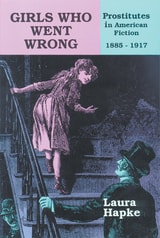
Girls Who Went Wrong
Prostitutes in American Fiction, 1885–1917Laura Hapke
University of Wisconsin Press, 1989
The period 1885 to 1917 saw thousands of American crusaders working hard to “save the fallen women,” but little on the part of American social protest writers. In this first work on the subject, Laura Hapke examines how writers attempted to turn an outcast into a heroine in a literature otherwise known for its puritanical attitude toward the fallen woman. She focuses on how these authors (all male) expressed late-Victorian conflicts about female sexuality. If, as they all maintained, women have an innate preference for chastity, how could they account for the prostitute? Was she a sinner, suggesting the potential waywardness of all women? Or, if she was a victim, what of her “depravity”?
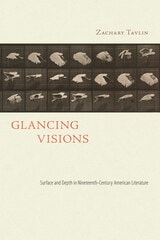
Glancing Visions
Surface and Depth in Nineteenth-Century American LiteratureZachary Tavlin
University of Alabama Press, 2023
How the “glance” rather than the “gaze” in nineteenth-century literature and art anticipates the turn to modernism
The sweeping vantages that typify American landscape painting from the nineteenth century by Thomas Cole and other members of the Hudson River School are often interpreted for their geopolitical connotations, as visual attempts to tame the wild, alleviating fears of a savage frontier through views that subdue the landscape to the eye. But many literary figures of the era display a purposeful disdain for the “possessive gaze,” signaling a preference for subtle glances, often informed by early photography, Impressionism, new techniques in portraiture, and, soon after, the dawn of cinema. The visual subjectivities and contingencies introduced by these media made room for a visual counternarrative, one informed by a mode of seeing that moves fast and lightly across the surface of things.
Tavlin probes Nathaniel Hawthorne’s theory of the imagination at a turning point in the history of photography, when momentary glances take on new narrative potentials. The poetry of Frances Ellen Watkins Harper toggles between gazes and glances, unsettling two competing forms of racialized seeing as they pertain to nineteenth-century Black life and racial hierarchies—the sentimental gaze and the slave trader’s glance—highlighting the life-and-death stakes of looking and looking away. Emily Dickinson’s syntactical oddities and her lifelong process of stitching and unstitching the poems that constitute her corpus all derive from a commitment to immanence associated with animal perception. Tavlin investigates, as well, Henry James’s vexed relationship to painterly Impressionism and William Carlos Williams’s imagist poetics as a response to early cinema’s use of the cut as the basis for a new visual grammar.
Each of these literary artists—via their own distinctive sensibilities and the artistic or technological counterparts that informed them—refuse the authoritative, all-possessive gaze in favor of the glance, a mode of seeing, thinking, and being that made way for the twentieth century’s twist on modernity. Glancing Visions will be of interest to scholars and teachers of American literature and literary history, visual culture, visual theory, aesthetic philosophy, and phenomenology.
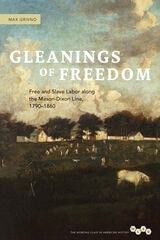
Gleanings of Freedom
Free and Slave Labor along the Mason-Dixon Line, 1790-1860Max Grivno
University of Illinois Press, 2014

Global Trade and Visual Arts in Federal New England
Patricia Johnston
University of New Hampshire Press, 2014
This book will appeal to a broad audience of historians and students of American visual art, as well as scholars and students of fine and decorative arts.
Hardcover is un-jacketed.

Globalizing Race
Antisemitism and Empire in French and European CultureDorian Bell
Northwestern University Press, 2018
Globalizing Race explores how intersections between French antisemitism and imperialism shaped the development of European racial thought. Ranging from the African misadventures of the antisemitic Marquis de Morès to the Parisian novels and newspapers of late nineteenth-century professional antisemites, Dorian Bell argues that France’s colonial expansion helped antisemitism take its modern, racializing form—and that, conversely, antisemitism influenced the elaboration of the imperial project itself.
Globalizing Race radiates from France to place authors like Guy de Maupassant and Émile Zola into sustained relation with thinkers from across the ideological spectrum, including Hannah Arendt, Friedrich Nietzsche, Frantz Fanon, Karl Marx, Max Horkheimer, and Theodor Adorno. Engaging with what has been called the “spatial turn” in social theory, the book offers new tools for thinking about how racisms interact across space and time. Among these is what Bell calls racial scalarity. Race, Bell argues, did not just become globalized when European racism and antisemitism accompanied imperial penetration into the farthest reaches of the world. Rather, race became most thoroughly global as a method for constructing and negotiating the different scales (national, global, etc.) necessary for the development of imperial capitalism.
As France, Europe, and the world confront a rising tide of Islamophobia, Globalizing Race also brings into fascinating focus how present-day French responses to Muslim antisemitism hark back to older, problematic modes of representing the European colonial periphery.

Globalizing the Lower Rio Grande
European Entrepreneurs in the Borderlands, 1749-1881Kyle Carpenter
University of North Texas Press, 2024