Results by title
87 books match the query 'AIDS (Disease)' and 3 start with g

Gary In Your Pocket
Stories and Notebooks of Gary FisherGary Fisher
Duke University Press, 1996
A uniquely intimate, unflinching testimony of the experience of a young, African American gay man in the AIDS emergency, Gary in Your Pocket includes an introduction by Don Belton that describes Fisher’s achievement in the context of other work by Black gay men such as Marlon Riggs and Essex Hemphill, and a biographical afterword by Eve Kosofsky Sedgwick.

Globalizing Aids
Cindy Patton
University of Minnesota Press, 2002
A long-awaited look at responses to the AIDS epidemic in relation to globalization
As AIDS began to appear around the "global village" in the early 1980s, the closeness brought by new technologies no longer promised wondrous cultural exchange; instead it made possible the transmission of a frightening new kind of disease. International scientific institutions and news organizations quickly constructed a "place" for AIDS in the global imaginary: from the heart of Africa and gay bathhouses in San Francisco to the back streets of Southeast Asia and poverty-stricken neighborhoods in the United States. Such simplistic accounts helped recycle racist ideas about Africans and Asians, intensified homophobic visions of irresponsible gay sexuality, and ignored the scientific and human reality of local experiences of the epidemic.
In Globalizing AIDS, pioneering cultural critic Cindy Patton looks at the complex interaction between modern science, media coverage, and local activism during the first decade of the epidemic. Patton's critique of both the production of scientific credibility and the implementation of public health policy at the local level offers a bold reevaluation of how we think about AIDS and an innovative approach to the reality of the disease.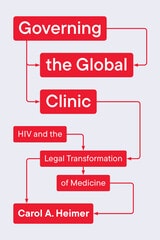
Governing the Global Clinic
HIV and the Legal Transformation of MedicineCarol A. Heimer
University of Chicago Press, 2025
A deep examination of how new, legalistic norms affected the trajectory of global HIV care and altered the practice of medicine.
HIV emerged in the world at a time when medicine and healthcare were undergoing two major transformations: globalization and a turn toward legally inflected, rule-based ways of doing things. It accelerated both trends. While pestilence and disease are generally considered the domain of biological sciences and medicine, social arrangements—and law in particular—are also crucial.
Drawing on years of research in HIV clinics in the United States, Thailand, South Africa, and Uganda, Governing the Global Clinic examines how growing norms of legalized accountability have altered the work of healthcare systems and how the effects of legalization vary across different national contexts. A key feature of legalism is universalistic language, but, in practice, rules are usually imported from richer countries (especially the United States) to poorer ones that have less adequate infrastructure and fewer resources with which to implement them. Challenging readers to reconsider the impulse to use law to organize and govern social life, Governing the Global Clinic poses difficult questions: When do rules solve problems, and when do they create new problems? When do rules become decoupled from ethics, and when do they lead to deeper moral commitments? When do rules reduce inequality? And when do they reflect, reproduce, and even amplify inequality?