312 books match the query 'African American authors' and 6 start with g
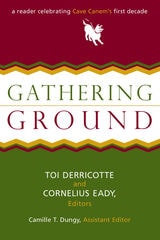
cover of Gathering Ground: A Reader Celebrating Cave Canem's First Decade

Gathering Ground

A Reader Celebrating Cave Canem's First Decade

Toi Derricotte and Cornelius Eady, Editors

University of Michigan Press, 2006

Cave Canem has for the past ten years dedicated itself to the discovery and cultivation of new voices in African American poetry. Founded in 1996 by prizewinning poets Toi Derricotte and Cornelius Eady, Cave Canem began as a weeklong summer workshop/retreat and has now expanded to include regional workshops, poetry readings, a series of public conversations between major poets and emerging younger poets, and an annual first-book prize.

To mark the first decade of this pathbreaking project, Gathering Ground presents more than one hundred poems by Cave Canem participants and faculty. It embraces an impressive and eclectic gathering of forms, including sonnets, a bop (a new form created by a Cave Canem faculty member), blues, sestinas, prose poems, centos, free verse, and more. The roster of distinguished contributors includes Lucille Clifton, Yusef Komunyakaa, Marilyn Nelson, Sonya Sanchez, Al Young, and many others.

For newcomers and aficionados alike, Gathering Ground assembles in one place the most innovative voices in contemporary African American poetry and boldly attests to the important position it holds in verse-making today.

Toi Derricotte is author of the memoir The Black Notebooks and of four books of poetry: Tender, Captivity, Natural Birth, and The Empress of the Death House. She is Professor of English at the University of Pittsburgh. Cornelius Eady is the author of Brutal Imagination, Autobiography of a Jukebox, You Don't Miss Your Water, The Gathering of My Name, and Victims of the Latest Dance Craze. He is Associate Professor of English at the University of Notre Dame.

[more]
cover of Geographies of Flight: Phillis Wheatley to Octavia Butler

Geographies of Flight

Phillis Wheatley to Octavia Butler

William Merrill Decker

Northwestern University Press, 2020

African American writing commonly represents New World topography as a set of entrapments, contesting the open horizons, westward expansion, and individual freedom characteristic of the white, Eurocentric literary tradition. Geographies of Flight: Phillis Wheatley to Octavia Butler provides the first comprehensive treatment of the ways in which African American authors across three centuries have confronted the predicament of inhabiting space under conditions of bondage and structural oppression. William Merrill Decker examines how, in testifying to those conditions, fourteen black authors have sought to transform a national cartography that, well into the twenty-first century, reflects white supremacist assumptions. These writers question the spatial dimensions of a mythic American liberty and develop countergeographies in which descendants of the African diaspora lay claim to the America they have materially and culturally created.

Tracking the testimonial voice in a range of literary genres, Geographies of Flight explores themes of placement and mobility in the work of Phillis Wheatley, Olaudah Equiano, David Walker, Frederick Douglass, Harriet Jacobs, Booker T. Washington, Ida B. Wells-Barnett, W. E. B. Du Bois, Richard Wright, Ralph Ellison, Malcolm X, James Baldwin, Toni Morrison, and Octavia Butler.
[more]
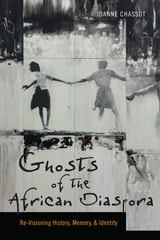
cover of Ghosts of the African Diaspora: Re-Visioning History, Memory, and Identity

Ghosts of the African Diaspora

Re-Visioning History, Memory, and Identity

Joanne Chassot

Dartmouth College Press, 2018
The first monograph to investigate the poetics and politics of haunting in African diaspora literature, Ghosts of the African Diaspora: Re-Visioning History, Memory, and Identity examines literary works by five contemporary writers—Fred D’Aguiar, Gloria Naylor, Paule Marshall, Michelle Cliff, and Toni Morrison. Joanne Chassot argues that reading these texts through the lens of the ghost does cultural, theoretical, and political work crucial to the writers’ engagement with issues of identity, memory, and history. Drawing on memory and trauma studies, postcolonial studies, and queer theory, this truly interdisciplinary volume makes an important contribution to the fast-growing field of spectrality studies.
[more]
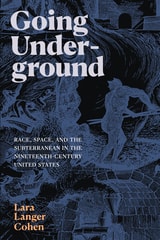
cover of Going Underground: Race, Space, and the Subterranean in the Nineteenth-Century United States

Going Underground

Race, Space, and the Subterranean in the Nineteenth-Century United States

Lara Langer Cohen

Duke University Press, 2023
First popularized by newspaper coverage of the Underground Railroad in the 1840s, the underground serves as a metaphor for subversive activity that remains central to our political vocabulary. In Going Underground, Lara Langer Cohen excavates the long history of this now familiar idea while seeking out versions of the underground that were left behind along the way. Outlining how the underground’s figurative sense first took shape through the associations of literal subterranean spaces with racialized Blackness, she examines a vibrant world of nineteenth-century US subterranean literature that includes Black radical manifestos, anarchist periodicals, sensationalist exposés of the urban underworld, manuals for sex magic, and the initiation rites of secret societies. Cohen finds that the undergrounds in this literature offer sites of political possibility that exceed the familiar framework of resistance, suggesting that nineteenth-century undergrounds can inspire new modes of world-making and world-breaking for a time when this world feels increasingly untenable.
[more]
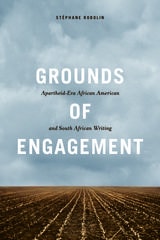
cover of Grounds of Engagement: Apartheid-Era African-American and South African Writing

Grounds of Engagement

Apartheid-Era African-American and South African Writing

Stephane Robolin

University of Illinois Press, 2019
Part literary history, part cultural study, Grounds of Engagement examines the relationships and exchanges between black South African and African American writers who sought to create common ground throughout the antiapartheid era. Stéphane Robolin argues that the authors' geographic imaginations crucially defined their individual interactions and, ultimately, the literary traditions on both sides of the Atlantic. Subject to the tyranny of segregation, authors such as Richard Wright, Bessie Head, Langston Hughes, Gwendolyn Brooks, Keorapetse Kgositsile, Michelle Cliff, and Richard Rive charted their racialized landscapes and invented freer alternative geographies. They crafted rich representations of place to challenge the stark social and spatial arrangements that framed their lives. Those representations, Robolin contends, also articulated their desires for black transnational belonging and political solidarity. The first book to examine U.S. and South African literary exchanges in spatial terms, Grounds of Engagement identifies key moments in the understudied history of black cross-cultural exchange and exposes how geography serves as an indispensable means of shaping and reshaping modern racial meaning.
[more]
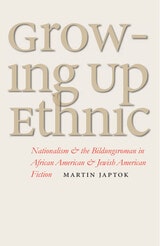
cover of Growing Up Ethnic: Nationalism and the Bildungsroman in African American and Jewish American Fiction

Growing Up Ethnic

Nationalism and the Bildungsroman in African American and Jewish American Fiction

Japtok, Martin

University of Iowa Press, 2005

Growing Up Ethnic examines the presence of literary similarities between African American and Jewish American coming-of-age stories in the first half of the twentieth century; often these similarities exceed what could be explained by sociohistorical correspondences alone. Martin Japtok argues that these similarities result from the way both African American and Jewish American authors have conceptualized their "ethnic situation." The issue of "race" and its social repercussions certainly defy any easy comparisons. However, the fact that the ethnic situations are far from identical in the case of these two groups only highlights the striking thematic correspondences in how a number of African American and Jewish American coming-of-age stories construct ethnicity. Japtok studies three pairs of novels--James Weldon Johnson's Autobiography of an Ex-Coloured Man and Samuel Ornitz's Haunch, Paunch and Jowl, Jessie Fauset's Plum Bun and Edna Ferber's Fanny Herself, and Paule Marshall's Brown Girl, Brownstones and Anzia Yezierska's Bread Giver--and argues that the similarities can be explained with reference to mainly two factors, ultimately intertwined: cultural nationalism and the Bildungsroman genre. Growing Up Ethnic shows that the parallel configurations in the novels, which often see ethnicity in terms of spirituality, as inherent artistic ability, and as communal responsibility, are rooted in nationalist ideology. However, due to the authors' generic choice--the Bildungsroman--the tendency to view ethnicity through the rhetorical lens of communalism and spiritual essence runs head-on into the individualist assumptions of the protagonist-centered Bildungsroman. The negotiations between these ideological counterpoints characterize the novels and reflect and refract the intellectual ferment of their time. This fresh look at ethnic American literatures in the context of cultural nationalism and the Bildungsroman will be of great interest to students and scholars of literary and race studies.
[more]