64 books match the query 'African Diaspora' and 4 start with g

cover of Ghost Voices: A Poem in Prayer

Ghost Voices

A Poem in Prayer

Quincy Troupe

Northwestern University Press, 2019

If we were all brave enough to resurrect the voices lost from our humanity, what would they say? Award-winning poet Quincy Troupe, spokesman for the humanizing forces of poetry, music, and art, parts the Atlantic and rattles the ground built on slavery with Ghost Voices: A Poem in Prayer.

we are crossing, / we are / crossing, / we are crossing in big salt water, // we are crossing, // crossing under a sky of no guilt / we have left home // though we know we will go back / someday, / see our people / as we knew them . . .

Troupe re-creates the history of lost voices between the waters of Africa, Cuba, and the United States. His daring poetics drenched in new forms-notably the seven-elevens-clench transformative narratives spurred on by a relentless, rhythmic language that mimics the foaming waves of the Atlantic Ocean and the Caribbean Sea. His personae speak quantum litanies within one epic, sermonic-gospel to articulate our most ancient ways of storytelling and survival.
 
[more]
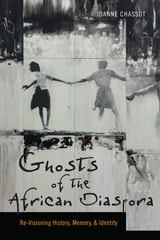
cover of Ghosts of the African Diaspora: Re-Visioning History, Memory, and Identity

Ghosts of the African Diaspora

Re-Visioning History, Memory, and Identity

Joanne Chassot

Dartmouth College Press, 2018
The first monograph to investigate the poetics and politics of haunting in African diaspora literature, Ghosts of the African Diaspora: Re-Visioning History, Memory, and Identity examines literary works by five contemporary writers—Fred D’Aguiar, Gloria Naylor, Paule Marshall, Michelle Cliff, and Toni Morrison. Joanne Chassot argues that reading these texts through the lens of the ghost does cultural, theoretical, and political work crucial to the writers’ engagement with issues of identity, memory, and history. Drawing on memory and trauma studies, postcolonial studies, and queer theory, this truly interdisciplinary volume makes an important contribution to the fast-growing field of spectrality studies.
[more]
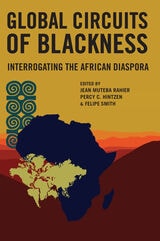
cover of Global Circuits of Blackness: Interrogating the African Diaspora

Global Circuits of Blackness

Interrogating the African Diaspora

Edited by Jean Muteba Rahier, Percy C. Hintzen, and Felipe Smith

University of Illinois Press, 2010

Global Circuits of Blackness is a sophisticated analysis of the interlocking diasporic connections between Africa, Europe, the Caribbean, and the Americas. A diverse and gifted group of scholars delve into the contradictions of diasporic identity by examining at close range the encounters of different forms of blackness converging on the global scene.
 
Contributors examine the many ways blacks have been misrecognized in a variety of contexts. They also explore how, as a direct result of transnational networking and processes of friction, blacks have deployed diasporic consciousness to interpellate forms of white supremacy that have naturalized black inferiority, inhumanity, and abjection. Various essays document the antagonism between African Americans and Africans regarding heritage tourism in West Africa, discuss the interaction between different forms of blackness in Toronto's Caribana Festival, probe the impact of the Civil Rights movement in America on diasporic communities elsewhere, and assess the anxiety about HIV and AIDS within black communities. The volume demonstrates that diaspora is a floating revelation of black consciousness that brings together, in a single space, dimensions of difference in forms and content of representations, practices, and meanings of blackness. Diaspora imposes considerable flexibility in what would otherwise be place-bound fixities.
 
Contributors are Marlon M. Bailey, Jung Ran Forte, Reena N. Goldthree, Percy C. Hintzen, Lyndon Phillip, Andrea Queeley, Jean Muteba Rahier, Stéphane Robolin, and Felipe Smith.
[more]
cover of Globalization and Race: Transformations in the Cultural Production of Blackness

Globalization and Race

Transformations in the Cultural Production of Blackness

Kamari Maxine Clarke and Deborah A. Thomas, eds.

Duke University Press, 2006

Kamari Maxine Clarke and Deborah A. Thomas argue that a firm grasp of globalization requires an understanding of how race has constituted, and been constituted by, global transformations. Focusing attention on race as an analytic category, this state-of-the-art collection of essays explores the changing meanings of blackness in the context of globalization. It illuminates the connections between contemporary global processes of racialization and transnational circulations set in motion by imperialism and slavery; between popular culture and global conceptions of blackness; and between the work of anthropologists, policymakers, religious revivalists, and activists and the solidification and globalization of racial categories.

A number of the essays bring to light the formative but not unproblematic influence of African American identity on other populations within the black diaspora. Among these are an examination of the impact of “black America” on racial identity and politics in mid-twentieth-century Liverpool and an inquiry into the distinctive experiences of blacks in Canada. Contributors investigate concepts of race and space in early-twenty-first century Harlem, the experiences of trafficked Nigerian sex workers in Italy, and the persistence of race in the purportedly non-racial language of the “New South Africa.” They highlight how blackness is consumed and expressed in Cuban timba music, in West Indian adolescent girls’ fascination with Buffy the Vampire Slayer, and in the incorporation of American rap music into black London culture. Connecting race to ethnicity, gender, sexuality, nationality, and religion, these essays reveal how new class economies, ideologies of belonging, and constructions of social difference are emerging from ongoing global transformations.

Contributors. Robert L. Adams, Lee D. Baker, Jacqueline Nassy Brown, Tina M. Campt, Kamari Maxine Clarke, Raymond Codrington, Grant Farred, Kesha Fikes, Isar Godreau, Ariana Hernandez-Reguant, Jayne O. Ifekwunigwe, John L. Jackson Jr., Oneka LaBennett, Naomi Pabst, Lena Sawyer, Deborah A. Thomas

[more]