Results by title
336 books match the query 'Age' and 6 start with g

Gadget Consciousness
Collective Thought, Will and Action in the Age of Social MediaJoss Hands
Pluto Press, 2019
What impact does our relentless fixation on the gadget have on the struggle for new kinds of solidarity, political articulation, and intelligence? In this groundbreaking study, Joss Hands explores the new political and social forces that are emerging in the age of social media, and examines how they are transforming our individual and class consciousness. Exploring a range of manifestations in the digital commons, he investigates what forms digital solidarity can take and asks how the communisms of the past might shape the solidarities of the future.
[more]
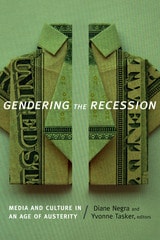
Gendering the Recession
Media and Culture in an Age of AusterityDiane Negra and Yvonne Tasker, eds.
Duke University Press, 2014
This timely, necessary collection of essays provides feminist analyses of a recession-era media culture characterized by the reemergence and refashioning of familiar gender tropes, including crisis masculinity, coping women, and postfeminist self-renewal. Interpreting media forms as diverse as reality television, financial journalism, novels, lifestyle blogs, popular cinema, and advertising, the contributors reveal gendered narratives that recur across media forms too often considered in isolation from one another. They also show how, with a few notable exceptions, recession-era popular culture promotes affective normalcy and transformative individual enterprise under duress while avoiding meaningful critique of the privileged white male or the destructive aspects of Western capitalism. By acknowledging the contradictions between political rhetoric and popular culture, and between diverse screen fantasies and lived realities, Gendering the Recession helps to make sense of our postboom cultural moment.
Contributors. Sarah Banet-Weiser, Hamilton Carroll, Hannah Hamad, Anikó Imre, Suzanne Leonard, Isabel Molina-Guzmán, Sinéad Molony, Elizabeth Nathanson, Diane Negra, Tim Snelson, Yvonne Tasker, Pamela Thoma
Contributors. Sarah Banet-Weiser, Hamilton Carroll, Hannah Hamad, Anikó Imre, Suzanne Leonard, Isabel Molina-Guzmán, Sinéad Molony, Elizabeth Nathanson, Diane Negra, Tim Snelson, Yvonne Tasker, Pamela Thoma
[more]
George Campbell
Rhetoric in the Age of EnlightenmentArthur E. Walzer
Southern Illinois University Press, 2003
This introductory book on George Campbell discusses details of his life and his intellectual milieu, including his role in the Scottish Enlightenment in Aberdeen. In addition, Arthur E. Walzer provides a thorough examination of Campbell's Philosophy of Rhetoric, the most important work in rhetorical theory of the Enlightenment. Brief analyses of Campbell's Dissertation on Miracles and Lectures on Pulpit Eloquence are also given.
[more]

Getting at the Author
Reimagining Books and Reading in the Age of American RealismBarbara Hochman
University of Massachusetts Press, 2009
Throughout the nineteenth century, American readers and reviewers assumed that a book revealed its author's individuality, that the experience of reading was a kind of conversation with the writer. Yet as Barbara Hochman shows in this illuminating study, the emergence of literary realism at the turn of the century called such assumptions into question. The realist aesthetic of narrative "objectivity" challenged the notion that a literary text reflects its author's personality.
But reading practices were slow to change; many resisted the effort to reconceptualize the relationship among writers, readers, and books. Even the most consistent advocates of "impartial" narration found it difficult to imagine a book without an author or to dissociate the experience of reading from the idea of a reciprocal human transaction.
In analyzing the battle over realism and the gradual shift in conventional reading practices, Hochman draws on a rich array of sources, including popular works, advertisements, and letters. She combines traditional modes of literary inquiry with methods adapted from the new historicism, cultural studies, and book history. By elucidating the realists' ambivalence about their own aesthetic criteria, she shows how a late nineteenth century conflict about reading practices reflected pressing tensions in American culture, and how that conflict shaped criteria of literary value for most of the twentieth century.
[more]
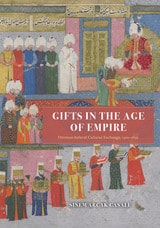
Gifts in the Age of Empire
Ottoman-Safavid Cultural Exchange, 1500–1639Sinem Arcak Casale
University of Chicago Press, 2023
Explores the Safavid and Ottoman empires through the lens of gifts.
When the Safavid dynasty, founded in 1501, built a state that championed Iranian identity and Twelver Shi'ism, it prompted the more established Ottoman Empire to align itself definitively with Sunni legalism. The political, religious, and military conflicts that arose have since been widely studied, but little attention has been paid to their diplomatic relationship. Sinem Arcak Casale here sets out to explore these two major Muslim empires through a surprising lens: gifts. Countless treasures—such as intricate carpets, gilded silver cups, and ivory-tusk knives—flowed from the Safavid to the Ottoman Empire throughout the sixteenth century. While only a handful now survive, records of these gifts exist in court chronicles, treasury records, poems, epistolary documents, ambassadorial reports, and travel narratives. Tracing this elaborate archive, Casale treats gifts as representative of the complicated Ottoman-Safavid coexistence, demonstrating how their rivalry was shaped as much by culture and aesthetics as it was by religious or military conflict. Gifts in the Age of Empire explores how gifts were no mere accessories to diplomacy but functioned as a mechanism of competitive interaction between these early modern Muslim courts.
When the Safavid dynasty, founded in 1501, built a state that championed Iranian identity and Twelver Shi'ism, it prompted the more established Ottoman Empire to align itself definitively with Sunni legalism. The political, religious, and military conflicts that arose have since been widely studied, but little attention has been paid to their diplomatic relationship. Sinem Arcak Casale here sets out to explore these two major Muslim empires through a surprising lens: gifts. Countless treasures—such as intricate carpets, gilded silver cups, and ivory-tusk knives—flowed from the Safavid to the Ottoman Empire throughout the sixteenth century. While only a handful now survive, records of these gifts exist in court chronicles, treasury records, poems, epistolary documents, ambassadorial reports, and travel narratives. Tracing this elaborate archive, Casale treats gifts as representative of the complicated Ottoman-Safavid coexistence, demonstrating how their rivalry was shaped as much by culture and aesthetics as it was by religious or military conflict. Gifts in the Age of Empire explores how gifts were no mere accessories to diplomacy but functioned as a mechanism of competitive interaction between these early modern Muslim courts.
[more]
Globalization in an Age of Crisis
Multilateral Economic Cooperation in the Twenty-First CenturyEdited by Robert C. Feenstra and Alan M. Taylor
University of Chicago Press, 2013
Along with its painful economic costs, the financial crisis of 2008 raised concerns over the future of international policy making. As in recessions past, new policy initiatives emerged, approaches that placed greater importance on protecting national interests than promoting international economic cooperation. Whether in fiscal or monetary policies, the control of currencies and capital flows, the regulation of finance, or the implementation of protectionist policies and barriers to trade, there has been an almost worldwide trend toward the prioritizing of national economic security. But what are the underlying economic causes of this trend, and what can economic research reveal about the possible consequences?
Prompted by these questions, Robert C. Feenstra and Alan M. Taylor have brought together top researchers with policy makers and practitioners whose contributions consider the ways in which the global economic order might address the challenges of globalization that have arisen over the last two decades and that have been intensified by the recent crisis. Chapters in this volume consider the critical linkages between issues, including exchange rates, global imbalances, and financial regulation, and plumb the political and economic outcomes of past policies for what they might tell us about the future of the global economic cooperation.
[more]