Results by title
297 books match the query 'Alabama' and 5 start with g
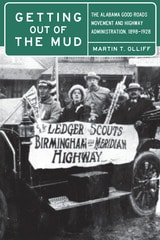
Getting Out of the Mud
The Alabama Good Roads Movement and Highway Administration, 1898–1928Martin T. Olliff, Foreword by David O. Whitten
University of Alabama Press, 2017
Recounts the history of the Good Roads Movement that arose in progressive-era Alabama, how it used the power of the state to achieve its objectives of improving market roads for farmers and highways for automobiles
Getting Out of the Mud: The Alabama Good Roads Movement and Highway Administration, 1898–1928 explores the history of the Good Roads Movement and investigates the nature of early twentieth-century progressivism in the state. Martin T. Olliff reveals how middle-class reformers secured political, economic, and social power not only by fighting against corporate domination and labor recalcitrance but also by proposing alternative projects like road improvement and identifying the interests of the rising middle class as being the most important to public interest.
With the development of national markets in the late nineteenth and early twentieth centuries, Americans began to regard the nation as a whole, rather than their state or region, as the most important political entity. Many Alabamians wished to travel beyond their local communities in all seasons without getting stuck in the mud of rudimentary rutted dirt roads. The onset of the automobile age bolstered the need for roadmaking, alerting both automobilists and good roads advocates to the possibility of a new transportation infrastructure. The Good Roads Movement began promoting farm-to-market roads, then highways that linked cities, then those that connected states. Federal matching funds for road construction after 1916 led state and federal governments to supplant the Good Roads Movement, building and administering the highway system that emerged by the late 1920s.
Olliff’s study of how Alabamians dealt with strained resources and overcame serious political obstacles in order to construct a road system that would accommodate economic growth in the twentieth century may offer clues to the resurrection of a similar strategy in our modern era. Many problems are unchanged over the hundred years between crises: Alabamians demand good roads and a government that has the capacity to build and maintain such an infrastructure while, at the same time, citizens are voting into office men and women who promise lower taxes and smaller government.

Ghosts Over the Boiler
Voices from Alabama's Death RowProject Hope to Abolish the Death Penalty; Edited by Katie Owens-Murphy
Vanderbilt University Press, 2023
Ghosts Over the Boiler is a curated collection of poetry, visual art, photographs, essays, creative writings, and other archival materials that have emerged from Alabama's death row from the organization Project Hope to Abolish the Death Penalty (PHADP). This group was founded at Holman Correctional Facility and has been operating autonomously since 1989 toward its mission to abolish the death penalty in Alabama and in the nation.

Gone to the Swamp
Raw Materials for the Good Life in the Mobile-Tensaw DeltaRobert Leslie Smith
University of Alabama Press, 2008
Normal0falsefalsefalseMicrosoftInternetExplorer4Normal0falsefalsefalseMicrosoftInternetExplorer4
To make a living here, one had to be capable, confident, clever and inventive, know a lot about survival, be able to fashion and repair tools, navigate a boat, fell a tree, treat a snakebite, make a meal from whatever was handy without asking too many questions about it, and get along with folks.
This fascinating and instructive book is the careful and unpretentious account of a man who was artful in all the skills needed to survive and raise a family in an area where most people would be lost or helpless. Smith’s story is an important record of a way of life beginning to disappear, a loss not fully yet realized. We are lucky to have a work that is both instructive and warm-hearted and that preserves so much hard-won knowledge.

Grass Widow
Making My Way in Depression AlabamaViola Goode Liddell
University of Alabama Press, 2004
An engaging account of one woman’s overcoming the Depression and small town mores.
Viola Goode Liddell’s short memoir tells the story of her return to Alabama in search of a husband and a new life. Thirty years old and recently divorced, Liddell comes back to her home state—with her young son—determined to survive, during the depths of the Depression. Liddell narrates the obstacles she faces as a single mother in the 1930s Deep South with self-deprecating humor and a confessional tone that reveal both her intelligence and her unapologetic ambitions.
Unable to earn, borrow, or beg enough money to support herself and her child, Liddell uses her family connections to secure a teaching position in Camden, Alabama. Even though an older sister’s status within the community helps her land the job, Liddell is warned that she must be very careful as she navigates the tricky social terrain of small town life, particularly when it comes to men. A commentary on the plight of women of the time is woven into the narrative as Liddell recounts her experience of being refused a loan at the local bank by her own brother-in-law.
Despite all the restrictions on her behavior and the crushing reality that she has become "the biggest nuisance in the family" because of her past, Liddell cheerfully and successfully builds a new life of respectability and hope.
Green Gold
Alabama's Forests and Forest IndustriesJames E. Fickle
University of Alabama Press, 2014
Green Gold is a thorough and valuable compilation of information on Alabama’s timber and forest products industry, the largest manufacturing industry in the state.
Alabama has the third-largest commercial forest in the nation, after only Georgia and Oregon. Fully two-thirds of the state’s land supports the growth of over fifteen billion trees on twenty-two million acres, which explains why Alabama looks entirely green from space. Green Gold presents the story of human use of and impact on Alabama’s forests from pioneer days to the present, as James E. Fickle chronicles the history of the industry from unbridled greed and exploitation through virtual abandonment to revival, restoration, and enlightened stewardship.
As the state’s largest manufacturing industry, forest products have traditionally included naval stores such as tar, pitch, and turpentine, especially in the southern longleaf stands; sawmill lumber, both hardwood and pine; and pulp and paper milling. Green Gold documents all aspects of the industry, including the advent of “scientific forestry” and the development of reforestation practices with sustained yields. Also addressed are the historical impacts of Native Americans and of early settlers who used axes, saws, and water- and steam-powered sawmills to clear and utilize forests. Along with an account of railroad logging and the big mills of the lumber bonanza days of the late nineteenth and early twentieth centuries, the book also chronicles the arrival of professional foresters to the state, who began to deal with the devastating legacy of “cut out and get out” logging and to fight the perennial curse of woods arson. Finally, Green Gold examines the rise of the tree farm movement, the rebirth of large-scale lumbering, the advent of modern environmental concerns, and the movement toward the “Fourth Forest” in Alabama.
A Copublication with the Alabama Forestry Foundation