402 books match the query 'American poetry' and 5 start with g

cover of Garden Theology

Garden Theology

Seán Mac Falls

Tupelo Press, 2022
The great tradition of Irish poetry courses through Seán Mac Falls’ blood and into his lines, as if he has spent a lifetime inhaling the sea breezes, cliffs, and peat bogs, ennobled from William Butler Yeats to Seamus Heaney to Eavan Boland. Here in a generous volume is a stunning treasury of pleasures, direct and appealing in voice, earthbound and empyrean in spirit, epistemological and rare.
[more]
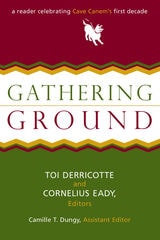
cover of Gathering Ground: A Reader Celebrating Cave Canem's First Decade

Gathering Ground

A Reader Celebrating Cave Canem's First Decade

Toi Derricotte and Cornelius Eady, Editors

University of Michigan Press, 2006

Cave Canem has for the past ten years dedicated itself to the discovery and cultivation of new voices in African American poetry. Founded in 1996 by prizewinning poets Toi Derricotte and Cornelius Eady, Cave Canem began as a weeklong summer workshop/retreat and has now expanded to include regional workshops, poetry readings, a series of public conversations between major poets and emerging younger poets, and an annual first-book prize.

To mark the first decade of this pathbreaking project, Gathering Ground presents more than one hundred poems by Cave Canem participants and faculty. It embraces an impressive and eclectic gathering of forms, including sonnets, a bop (a new form created by a Cave Canem faculty member), blues, sestinas, prose poems, centos, free verse, and more. The roster of distinguished contributors includes Lucille Clifton, Yusef Komunyakaa, Marilyn Nelson, Sonya Sanchez, Al Young, and many others.

For newcomers and aficionados alike, Gathering Ground assembles in one place the most innovative voices in contemporary African American poetry and boldly attests to the important position it holds in verse-making today.

Toi Derricotte is author of the memoir The Black Notebooks and of four books of poetry: Tender, Captivity, Natural Birth, and The Empress of the Death House. She is Professor of English at the University of Pittsburgh. Cornelius Eady is the author of Brutal Imagination, Autobiography of a Jukebox, You Don't Miss Your Water, The Gathering of My Name, and Victims of the Latest Dance Craze. He is Associate Professor of English at the University of Notre Dame.

[more]
cover of Ghostly Figures: Memory and Belatedness in Postwar American Poetry

Ghostly Figures

Memory and Belatedness in Postwar American Poetry

Ann Keniston

University of Iowa Press, 2015

From Sylvia Plath’s depictions of the Holocaust as a group of noncohering “bits” to AIDS elegies’ assertions that the dead posthumously persist in ghostly form and Susan Howe’s insistence that the past can be conveyed only through juxtaposed “scraps,” the condition of being too late is one that haunts post-World War II American poetry. This is a poetry saturated with temporal delay, partial recollection of the past, and the revelation that memory itself is accessible only in obstructed and manipulated ways. These postwar poems do not merely describe the condition of lateness: they enact it literally and figuratively by distorting chronology, boundary, and syntax, by referring to events indirectly, and by binding the condition of lateness to the impossibility of verifying the past. The speakers of these poems often indicate that they are too late by repetitively chronicling distorted events, refusing closure or resolution, and forging ghosts out of what once was tangible.

Ghostly Figures contends that this poetics of belatedness, along with the way it is bound to questions of poetic making, is a central, if critically neglected, force in postwar American poetry. Discussing works by Sylvia Plath, Adrienne Rich, Jorie Graham, Susan Howe, and a group of poets responding to the AIDS epidemic, Ann Keniston draws on and critically assesses trauma theory and psychoanalysis, as well as earlier discussions of witness, elegy, lyric trope and figure, postmodernism, allusion, and performance, to define the ghosts that clearly dramatize poetics of belatedness throughout the diverse poetry of post–World War II America.
[more]
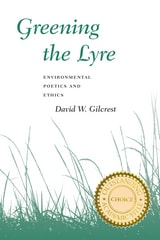
cover of Greening The Lyre: Environmental Poetics And Ethics

Greening The Lyre

Environmental Poetics And Ethics

David W. Gilcrest

University of Nevada Press, 2002

This work covers important and neglected ground—environmental language theory. Gilcrest poses two overarching questions: To what extent does contemporary nature poetry represent a recapitulation of familiar poetics? And, to what extent does contemporary nature poetry engage a poetics that stakes out new territory? He addresses these questions with important thinkers, especially Kenneth Burke, and considers such poets as Frost, Kunitz, Heaney, Ammons, Cardenal, and Rich.
[more]
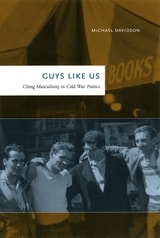
cover of Guys Like Us: Citing Masculinity in Cold War Poetics

Guys Like Us

Citing Masculinity in Cold War Poetics

Michael Davidson

University of Chicago Press, 2003

Guys Like Us considers how writers of the 1950s and '60s struggled to craft literature that countered the politics of consensus and anticommunist hysteria in America, and how notions of masculinity figured in their effort. Michael Davidson examines a wide range of postwar literature, from the fiction of Jack Kerouac to the poetry of Gwendolyn Brooks, Frank O'Hara, Elizabeth Bishop, and Sylvia Plath. He also explores the connection between masculinity and sexuality in films such as Chinatown and The Lady from Shanghai, as well as television shows, plays, and magazines from the period. What results is a virtuoso work that looks at American poetic and artistic innovation through the revealing lenses of gender and history.
[more]