Results by title
64 books match the query 'Anarchism' and 3 start with g
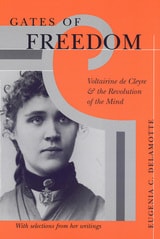
Gates of Freedom
Voltairine de Cleyre and the Revolution of the MindEugenia C. DeLamotte
University of Michigan Press, 2004
"The time is surely right to draw attention to Voltairine de Cleyre, one of the most uncompromisingly revolutionary of all American women writers . . . [Gates of Freedom] gives a fine selection of de Cleyre's work, while articulating it to contemporary critical and cultural concerns . . . . The book's organization, its tendency to tackle the most difficult issues head on, and its careful selection of published and unpublished work are all superb."
---Cary Nelson, University of Illinois
"The question of souls is old; we demand our bodies, now." These words are not from a feminist manifesto of the late twentieth century, but from a fiery speech given a hundred years earlier by Voltairine de Cleyre, a leading anarchist and radical thinker. A contemporary of Emma Goldman---who called her "the most gifted and brilliant anarchist woman America ever produced"---de Cleyre was a significant force in a major social movement that sought to transform American society and culture at its root. But she belongs to a group of late-nineteenth-century freethinkers, anarchists, and sex-radicals whose writing continues to be excluded from the U.S. literary and historical canon.
Gates of Freedom considers de Cleyre's speeches, letters, and essays, including her most well known essay, "Sex Slavery." Part I brings current critical concerns to bear on de Cleyre's writings, exploring her contributions to the anarchist movement, her analyses of justice and violence, and her views on women, sexuality, and the body. Eugenia DeLamotte demonstrates both de Cleyre's literary significance and the importance of her work to feminist theory, women's studies, literary and cultural studies, U.S. history, and contemporary social and cultural analysis. Part II presents a thematically organized selection of de Cleyre's stirring writings, making Gates of Freedom appealing to scholars, students, and anyone interested in Voltairine de Cleyre's fascinating life and rousing work.
[more]

Gerrard Winstanley
The Digger's Life and LegacyJohn Gurney
Pluto Press, 2012
'The power of property was brought into creation by the sword', so wrote Gerrard Winstanley (1609-1676) – Christian Communist, leader of the Diggers movement and bête noire of the landed aristocracy. Despite being one of the great English radicals, Winstanley remains unmentioned in today's lists of 'great Britons'.
John Gurney reveals the hidden history of Winstanley and his movement. As part of the radical ferment which swept England at the time of the civil war, Winstanley led the Diggers in taking over land and running it as 'a common treasury for all' – provoking violent opposition from landowners. Gurney also guides us through Winstanley's writings, which are among the most remarkable prose writings of his age.
Gerrard Winstanley: The Digger's Life and Legacy is a must read for students of English history and all those seeking to re-claim the commons today.
[more]
Gramsci is Dead
Anarchist Currents in the Newest Social MovementsRichard J. F. Day
Pluto Press, 2005
Gramsci and the concept of hegemony cast a long shadow over radical political theory. Yet how far has this theory got us? Is it still central to feminism, anti-capitalism, anti-racism, anarchism, and other radical social movements today?
Unlike previous revolutionary movements, Day argues, most contemporary radical social movements do not strive to take control of the state. Instead, they attempt to develop new forms of self-organisation that can run in parallel with---or as alternatives to---existing forms of social, political, and economic organization. This is to say that they follow a logic of affinity rather than one of hegemony.
This book draws together a variety of different strands in political theory to weave together an innovative new approach to politics today. Rigorous and wide-ranging, Day introduces and interrogates key concepts. From Hegel's concept of recognition, through theories of hegemony and affinity to Hardt and Negri's reflections on Empire, Day maps academia's theoretical and philosophical concerns onto today's politics of the street.
Ideal for all students of political theory, Day's fresh approach combines Marxist, Anarchist and Post-structuralist theory to shed new light on the politics and practice of contemporary social movements.
[more]