Results by title
266 books match the query 'Anecdotes' and 8 start with g
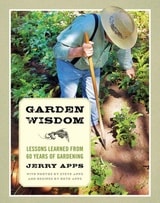
Garden Wisdom
Lessons Learned from 60 Years of GardeningJerry Apps
Wisconsin Historical Society Press, 2012
Step into the garden with writer and rural historian Jerry Apps. In this treasure trove of tips, recollections, and recipes, Jerry combines his hard-earned advice for garden success with a discussion of how tending a garden leads to a deeper understanding of nature and the land. From planning and planting to fending off critters and weeds, he walks us through the gardening year, imbuing his story with humor and passion and once again reminding us that working even a small piece of land provides many rewards.
Gichigami Hearts
Stories and Histories from MisaabekongLinda LeGarde Grover
University of Minnesota Press, 2021
Award-winning author Linda LeGarde Grover interweaves family and Ojibwe history with stories from Misaabekong (the place of the giants) on Lake Superior
Long before there was a Duluth, Minnesota, the massive outcropping that divides the city emerged from the ridge of gabbro rock running along the westward shore of Lake Superior. A great westward migration carried the Ojibwe people to this place, the Point of Rocks. Against this backdrop—Misaabekong, the place of the giants—the lives chronicled in Linda LeGarde Grover’s book unfold, some in myth, some in long-ago times, some in an imagined present, and some in the author’s family history, all with a deep and tenacious bond to the land, one another, and the Ojibwe culture.
Within the larger history, Grover tells the story of her ancestors’ arrival at the American Fur Post in far western Duluth more than two hundred years ago. Their fortunes and the family’s future are inextricably entwined with tales of marriages to voyageurs, relocations to reservation lands, encounters with the spirits of the lake and wood creatures, the renewal of life—in myth and in art, the search for meaning in the transformations of our day is always vital. Finally, in one man’s struggles, age-old tribulations, the intergenerational traumas of extended families and communities, and a uniquely Ojibwe appreciation for the natural and spiritual worlds converge, forging the Ojibwe worldview and will to survive as his legacy to his descendants.
Blending the seen and unseen, the old and the new, the amusing and the tragic and the hauntingly familiar, this lyrical work encapsulates a way of life forever vibrant at the Point of Rocks.
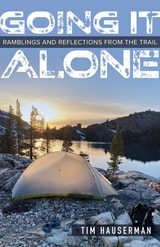
Going It Alone
Ramblings and Reflections from the TrailTim Hauserman
University of Nevada Press, 2022
Hauserman hikes the John Muir Trail through rainstorms and challenging climbs, explores the Tahoe Rim Trail on a fourteen-day excursion, and travels to Minnesota to conquer the Superior Hiking Trail, where he is inundated with bugs, faces drought, and is eerily alone on the trail with not a single other hiker in sight for days. Going It Alone combines his self-deprecating humor, what he identifies as “Stupid Tim Tricks,” and delightful descriptions of the natural surroundings.
Some might describe the wilderness as the middle of nowhere or as nothingness, but for Hauserman, it is everything. While his love for nature remains undaunted through these experiences, he also discovers that he has overly high expectations for his capabilities and that he cannot just wish his loneliness away. He eventually discovers that his long walks in the woods are less about hiking and more about learning how he wants to live his life.
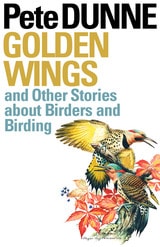
Golden Wings and Other Stories about Birders and Birding
By Pete Dunne
University of Texas Press, 2003
Dubbed the "Bard of America's Bird-Watchers" by the Wall Street Journal, Pete Dunne knows birders and birding—instinctively and completely. He understands the compulsion that drives other birders to go out at first light, whatever the weather, for a chance to maybe, just maybe, glimpse that rare migrant that someone might have spotted in a patch of woods the day before yesterday. And yet, he also knows how . . . well . . . strange the birding obsession becomes when viewed through the eyes of a nonbirder. His dual perspective—totally engrossed in birding, yet still aware of the "odd birdness" of some birders—makes reading his essays a pure pleasure whether you pursue "the feather quest" or not.
This book collects forty-one of Dunne's recent essays, drawn from his columns in Living Bird, Wild Bird News, the New Jersey Sunday section of the New York Times, Birder's World, and other publications. Written with his signature wit and insight, they cover everything from a moment of awed communion with a Wandering Albatross ("the most beautiful thing I'd ever seen") to Dunne's imagined "perfect bird" ("The Perfect Bird is the size of a turkey, has the wingspan of an eagle, the legs of a crane, the feet of a moorhen, and the talons of a great horned owl. It eats kudzu, surplus zucchini, feral cats, and has been known to predate upon homeowners who fire up their lawn mowers before 7:00 A.M. on the weekend."). The title essay pays whimsical, yet heartfelt tribute to Dunne's mentor, the late birding legend Roger Tory Peterson.
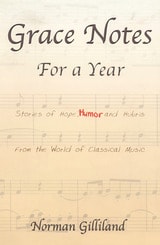
Grace Notes for a Year
Stories of Hope, Humor and Hubris from the World of Classical MusicNorman Gilliland
University of Wisconsin Press, 2003
This irresistible collection of stories is perfect for anyone interested in a fresh perspective on what it means to be a human being who creates art. Grace Notes for a Year sheds light on the fragile and perilous process of inspiration, composition, and performance required to create classical music, whether the final product is a masterpiece or a mess. Each page of the book corresponds to a different day of the year and features a true story about a famous figure in musical history. These delightful anecdotes—inspirational, informative, and often hilarious—disprove the myth of the artist as untouchable. Instead, Norman Gilliland exposes in them human vulnerability we can all relate to. From Beethoven to Wagner, these artists suffered from poverty, spent lazy days in bed, had scandalous love affairs, and often failed in their creative endeavors as often as they succeeded.
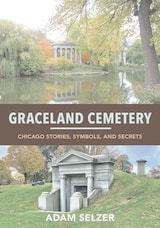
Graceland Cemetery
Chicago Stories, Symbols, and SecretsAdam Selzer
University of Illinois Press, 2022
Chosen for the 2024 Illinois Reads Program by the Illinois Reading Council
One of Chicago’s landmark attractions, Graceland Cemetery chronicles the city’s sprawling history through the stories of its people. Local historian and Graceland tour guide Adam Selzer presents ten walking tours covering almost the entirety of the cemetery grounds. While nodding to famous Graceland figures from Marshall Field to Ernie Banks to Ludwig Mies van der Rohe, Selzer also leads readers past the vaults, obelisks, and other markers that call attention to less recognized Chicagoans like:
- Jessie Williams de Priest, the Black wife of a congressman whose 1929 invitation to a White House tea party set off a storm of controversy;
- Engineer and architect Fazlur Khan, the Bangladeshi American who revived the city's skyscraper culture;
- The still-mysterious Kate Warn (listed as Warn on her tombstone), the United States’ first female private detective.
Filled with photographs and including detailed maps of each tour route, Graceland Cemetery is an insider's guide to one of Chicago's great outdoor destinations for city lore and history.
Gratitude
Affirming One Another Through StoriesLen Froyen
Parkhurst Brothers, Inc., 2013
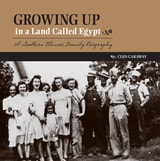
Growing Up in a Land Called Egypt
A Southern Illinois Family BiographyCleo Caraway
Southern Illinois University Press, 2010
In Growing Up in a Land Called Egypt: A Southern Illinois Family Biography,author Cleo Caraway fondly recalls how she and her siblings came of age on the family farm in the 1930s and 1940s. Like many others, the Caraways were affected by the economic hardships of the Great Depression, but Cleo’s parents strived to shelter her and her six siblings from the dire circumstances affecting the nation and their home and allowed them to bask in their idealistic existence. Her love for her family clearly shines from every page as she writes of a simpler time, before World War II divided the family.
Caraway revels in the life her family lived on a southern Illinois hilltop in Murphysboro township, marveling at the mix of commonplace and adventure she experienced in her childhood. She remembers her first day of school, walking three miles to the wondrous one-room building with her siblings; reminisces about strolling through the countryside with her mother, investigating the various plants and flowers, fruits and nuts; and recollects her fascination with the Indian relics she found buried near her home, a hobby she shared with her father. She also writes of seeing Gone with the Wind on the big screen at the Hippodrome in Murphysboro, of learning to sew dresses for her dolls, and of idyllic life on the farm—milking cows, hatching chicks, feeding pigs. Along with her personal memories Caraway includes interviews with neighbors and many fascinating photographs with detailed captions that make the images come alive.
A delightful follow-up to her father’s popular Foothold on a Hillside: Memories of a Southern Illinoisan,Caraway’s book is a pleasant change from the typical accounts of southern Illinois before, during, and after the Great Depression. Instead of hardscrabble grit, Growing Up in a Land Called Egypt offers a refreshingly different view of the period and is certain to be embraced by southern Illinois natives as well as anyone interested in the experiences of a rural family that thrived despite the difficult times. The author’s lighthearted prose, self-deprecating humor, and genuine affection for her family make reading this book a rich and memorable experience.