Results by title
299 books match the query 'Arizona' and 7 start with g
Gateways to the Southwest
The Story of Arizona State ParksJay M. Price
University of Arizona Press, 2004
Arizona is home to some of the region's most stunning national parks and monuments and has had a long tradition of strong federal agencies—along with effective local governments—developing and managing parklands. Before World War II, protecting sites from development seemed counterproductive to a state government dominated by extractive industries. By the late 1950s this state that prided itself on being a tourist destination found its lack of state parks to be an embarrassment. Gateways to the Southwest is a history of the creation of state parks in Arizona, examining the ways in which different types of parks were created in the face of changing social values. Jay Price tells how Arizona's parks emerged from the recreation and tourism boom of the 1950s and 1960s, were shaped by the environmental movement of the 1970s and 1980s, and have been affected by the financial challenges that arose in the 1990s. He also explains how changing political realities led to different methods of creating parks like Catalina, Homol'ovi Ruins, and Kartchner Caverns. In addition, places that did not become state parks have as much to tell us as those that did. By the time the need for state parks was recognized in Arizona, most choice sites had already been developed, and Price reveals how acquiring land often proved difficult and expensive. State parks were of necessity developed in cooperation with the federal government, other state agencies, community leaders, and private organizations. As a result, parks born from land exchanges, partnerships, conservation easements, and other cooperative ventures are more complicated entities than the "state park" designation might suggest. Price's study shows that the key issue for parks has not been who owns a place but who manages it, and today Arizona's state parks are a network of lake-based recreation, historic sites, and environmental education areas reflecting issues just as complex as those of the region's better-known national parks. Gateways to the Southwest is a case study of resource stewardship in the Intermountain West that offers new insights into environmental history as it illustrates the challenges and opportunities facing public lands all over America.
[more]

George Hunt
Arizona's Crusading Seven-Term GovernorDavid R. Berman
University of Arizona Press, 2015
George W. P. Hunt was a highly colorful Arizona politician. A territorial representative and seven-time Arizona state governor, Hunt joined Woodrow Wilson in making the Democratic Party the party of Progressive reform. This political biography follows Hunt through his years in the territorial legislature, and then as governor. Author David R. Berman’s well-researched and detailed work features Hunt’s battles to stem the powers of large corporations, democratize the political system, defend labor rights, reform the prison system, abolish the death penalty, and protect Arizona’s interests in the Colorado River. He had a special concern for the down and out. He found the "forgotten man" long before Franklin Roosevelt.
Hunt was proof that style and physical appearance neither guarantee nor preclude political success, for the three-hundred-pound man of odd dress and bumbling speech had a political career that spanned the state’s Populism of the 1890s to the 1930s New Deal. Driven by causes, he was very active in public office but took little pleasure in doing the job. Called names by opponents and embarrassed by his lack of formal education, Hunt sometimes showed rage, self-pity, and bitterness at what he saw as betrayals and conspiracies against him.
The author assesses Hunt’s successes and failings as a political leader and take-charge governor struggling to produce results in a political system hostile to executive authority. Berman offers a nuanced look at Arizona’s first governor, providing an important new understanding of Arizona’s complex political history.
[more]

God and Caesar at the Rio Grande
Sanctuary and the Politics of ReligionHilary Cunningham
University of Minnesota Press, 1995
[more]
Going Back to Bisbee
Richard Shelton
University of Arizona Press, 1992
One of America's most distinguished poets now shares his fascination with a distinctive corner of our country. Richard Shelton first came to southeastern Arizona in the 1950s as a soldier stationed at Fort Huachuca. He soon fell in love with the region and upon his discharge found a job as a schoolteacher in nearby Bisbee. Now a university professor and respected poet living in Tucson, still in love with the Southwestern deserts, Shelton sets off for Bisbee on a not-uncommon day trip. Along the way, he reflects on the history of the area, on the beauty of the landscape, and on his own life.
Couched within the narrative of his journey are passages revealing Shelton's deep familiarity with the region's natural and human history. Whether conveying the mystique of tarantulas or describing the mountain-studded topography, he brings a poet's eye to this seemingly desolate country. His observations on human habitation touch on Tombstone, "the town too tough to die," on ghost towns that perhaps weren't as tough, and on Bisbee itself, a once prosperous mining town now an outpost for the arts and a destination for tourists. What he finds there is both a broad view of his past and a glimpse of that city's possible future.
Going Back to Bisbee explores a part of America with which many readers may not be familiar. A rich store of information embedded in splendid prose, it shows that there are more than miles on the road to Bisbee.
[more]
Grand Canyon Birds
Historical Notes, Natural History and EcologyBryan T. Brown
University of Arizona Press, 1987
An essential book for all bird and wildlife buffs visiting the Grand Canyon. —Wildlife Book Review
"Will benefit all amateur naturalists because of its survey of the life zone patterns in [the] southwestern United States." —Science Books & Films
"The subtitle accurately reflects the contents of this excellent book on the birds of a unique natural wonder and national treasure. . . . An annotated checklist discusses the status and abundance of each of the over 300 species of birds known to have occurred in the Grand Canyon region, which is defined here as the river between Glen Canyon Dam and Lake Mead and the contiguous plateaus to the north and south." —Journal of Arizona History
[more]
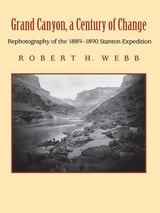
Grand Canyon, A Century of Change
Rephotography of the 1889-1890 Stanton ExpeditionRobert H. Webb
University of Arizona Press, 1996
Photographs made in Grand Canyon a century ago may provide us today with a sense of history; photographs made a century later from the same vantage points give us a more precise picture of change in this seemingly timeless place. Between 1889 and 1890, Robert Brewster Stanton made photographs every 1-2 miles through the river corridor for the purpose of planning a water-level railroad route and produced the largest collection of photographs of the Colorado River at one point in time. Robert Webb, a USGS hydrologist conducting research on debris flows in the Canyon, obtained the photographs and from 1989 to 1995 replicated all 445 of the views captured by Stanton, matching as closely as possible the original camera positions and lighting conditions.
Grand Canyon, a Century of Change assembles the most dramatic of these paired photographs to demonstrate both the persistence of nature and the presence of humanity. Unexpected longevity of some plant species, effects of animal grazing, and expansion of cacti are all captured by the replicate photographs. More telling is evidence of the impact of Glen Canyon Dam: increased riparian vegetation, new marshes, aggraded debris fans, and eroded sand bars. In the accompanying text, Webb provides a thorough analysis of what each pair of photographs shows and places the project in its historical context. Complementing his narrative are six sidebar articles by authorities on Canyon natural history that further attest to a century of change. The level of detail obtained from the photographs represents one of the most extensive long-term monitoring efforts ever conducted in a national park; it is the most detailed documentation effort ever performed using repeat photography.
Much more than simply a picture book, Grand Canyon, a Century of Change is an environmental history of the river corridor, a fascinating book that clearly shows the impact of human influence on Grand Canyon and warns us that its future is very much in our hands.
[more]
Green Band in a Parched and Burning Land
Sobaipuri O’odham Landscapesby Deni J. Seymour
University Press of Colorado, 2022
The result of decades of research, A Green Band in a Parched and Burning Land presents a thorough and detailed understanding of the Sobaipuri O’odham—arguably the most influential and powerful Indigenous group in southern Arizona in the terminal prehistoric and early historic periods, yet one of the least understood and under-studied to have occupied the region. Deni J. Seymour combines historical sources with fresh archaeological data and oral history to reveal an astonishingly different view of, and revise conventional wisdom around, the native history of the region.
First and foremost irrigation farmers, the Sobaipuri O’odham permanently occupied verdant strips along all the major rivers in the region—including the headwaters of the San Pedro and various other areas thought to be beyond their domain. Seymour draws on career-spanning fieldwork, conversations with direct descendants (the O’odham residents of Wa:k), and recent breakthroughs in archaeological, ethnographic, and ethnohistorical research to shed light on their unique forms of landscape use, settlement patterns, and way of life. She details the building materials, linear site layout, and other elements of their singular archaeological signature; newly established dating for individual sites, complex building episodes, and occupational sequences; and evidence of cumulative village occupation as well as the habitation of river valleys and other locales long after supposed abandonment. The book also explains the key relationships between site distributions and landscape characteristics.
Addressing some of the longest-standing archaeological and historical questions about the Sobaipuri O’odham, A Green Band in a Parched and Burning Land reorients the discussion of their crucial place in the history of the region in constructive new directions.
[more]