Results by title
490 books match the query 'Asian' and 13 start with g
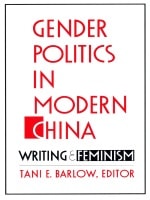
Gender Politics in Modern China
Writing and FeminismTani E. Barlow, ed.
Duke University Press, 1993
Ranging from interviews with contemporary writers, to historical accounts of gendered writing in Taiwan and semi-colonial China, to close feminist readings of individual authors, these essays confront the degree to which textual stategies construct notions of gender. Among the specific themes discussed are: how femininity is produced in texts by allocating women to domestic space; the extent to which textual production lies at the base of a changing, historically specific code of the feminine; the extent to which women in modern Chinese societies are products of literary canons; the ways in which the historical processes of gendering have operated in Chinese modernity vis à vis modernity in the West; the representation of feminists as avengers and as westernized women; and the meager recognition of feminism as a serious intellectual current and a large body of theory.
Originally published as a special issue of Modern Chinese Literature (Spring & Fall 1988), this expanded book represents some of the most compelling new work in post-Mao feminist scholarship and will appeal to all those concerned with understanding a revitalized feminism in the Chinese context.
Contributors. Carolyn Brown, Ching-kiu Stephen Chan, Sung-sheng Yvonne Chang, Yu-shih Chen, Rey Chow, Randy Kaplan, Richard King, Wolfgang Kubin, Wendy Larson, Lydia Liu, Seung-Yeun Daisy Ng, Jon Solomon, Meng Yue, Wang Zheng
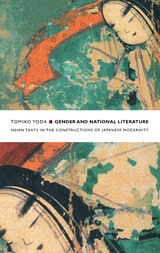
Gender and National Literature
Heian Texts in the Constructions of Japanese ModernityTomiko Yoda
Duke University Press, 2004
Moving back and forth between a critique of modern discourses on Heian literature and close analyses of the Heian texts themselves, Yoda sheds light on some of the most persistent interpretive models underwriting Japanese literary studies, particularly the modern paradigm of a masculine national subject. She proposes new directions for disciplinary critique and suggests that historicized understandings of premodern texts offer significant insights into contemporary feminist theories of subjectivity and agency.
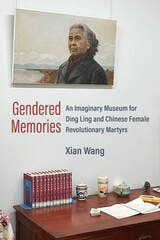
Gendered Memories
An Imaginary Museum for Ding Ling and Chinese Female Revolutionary MartyrsXian Wang
University of Michigan Press, 2025
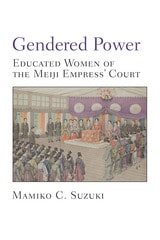
Gendered Power
Educated Women of the Meiji Empress' CourtMamiko C. Suzuki
University of Michigan Press, 2019
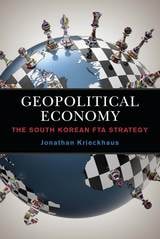
Geopolitical Economy
The South Korean FTA StrategyJonathan Krieckhaus
University of Michigan Press, 2018
Geopolitical Economy examines the significance and nature of free trade agreements (FTAs), the primary policy tool through which modern nations seek access to international markets and promote economic growth. The book focuses specifically on how South Korea, the world’s leader in the number and significance of FTAs as well as the world’s sixth largest export economy, uses FTAs.
Jonathan Krieckhaus argues that geopolitics—the struggle between powerful nations over specific geographic regions around the globe—influenced FTA strategy and economic policy in South Korea and beyond. This perspective illustrates the security approach to FTAs, but adds that the geographic specificity of security concerns deeply shape FTA policy.
Geopolitical Economy also looks at Korean FTAs through the lens of development strategy. South Korea is singularly successful in garnering FTAs with all three players in the global economy: the United States, the European Union, and China. This unprecedented success was built on a strong commitment from three consecutive Korean presidential administrations, each operating within a favorable state-society context that enjoyed the existence of a centralized and effective trade bureaucracy.
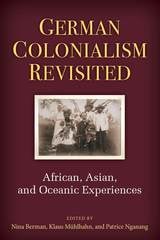
German Colonialism Revisited
African, Asian, and Oceanic ExperiencesNina Berman, Klaus Mühlhahn, and Patrice Nganang, editors
University of Michigan Press, 2018
German Colonialism Revisited brings together military historians, art historians, literary scholars, cultural theorists, and linguists to address a range of issues surrounding colonized African, Asian, and Oceanic people’s creative reactions to and interactions with German colonialism. This scholarship sheds new light on local power dynamics; agency; and economic, cultural, and social networks that preceded and, as some now argue, ultimately structured German colonial rule. Going beyond issues of resistance, these essays present colonialism as a shared event from which both the colonized and the colonizers emerged changed.

Ghosts in the Neighborhood
Why Japan Is Haunted by Its Past and Germany Is NotWalter F. Hatch
University of Michigan Press, 2023
Germany, which brutalized its neighbors in Europe for centuries, has mostly escaped the ghosts of the past, while Japan remains haunted in Asia. The most common explanation for this difference is that Germany knows better how to apologize; Japan is viewed as “impenitent.” Walter F. Hatch rejects the conventional wisdom and argues that Germany has achieved reconciliation with neighbors by showing that it can be a trustworthy partner in regional institutions like the European Union and NATO; Japan has never been given that opportunity (by its dominant partner, the U.S.) to demonstrate such an ability to cooperate. This book rigorously defends the argument that political cooperation—not discourse or economic exchange—best explains Germany’s relative success and Japan’s relative failure in achieving reconciliation with neighbors brutalized by each regional power in the past. It uses paired case studies (Germany-France and Japan-South Korea; Germany-Poland and Japan-China) to gauge the effect of these competing variables on public opinion over time. With numerous charts, each of the four empirical chapters illustrates the powerful causal relationship between institution building and interstate reconciliation.

Gods in the Bazaar
The Economies of Indian Calendar ArtKajri Jain
Duke University Press, 2007
Jain draws on interviews with artists, printers, publishers, and consumers as well as analyses of the prints themselves to trace the economies—of art, commerce, religion, and desire—within which calendar images and ideas about them are formulated. For Jain, an analysis of the bazaar, or vernacular commercial arena, is crucial to understanding not only the calendar art that circulates within the bazaar but also India’s postcolonial modernity and the ways that its mass culture has developed in close connection with a religiously inflected nationalism. The bazaar is characterized by the coexistence of seemingly incompatible elements: bourgeois-liberal and neoliberal modernism on the one hand, and vernacular discourses and practices on the other. Jain argues that from the colonial era to the present, capitalist expansion has depended on the maintenance of these multiple coexisting realms: the sacred, the commercial, and the artistic; the official and the vernacular.
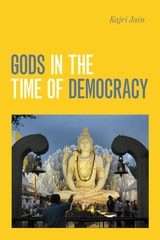
Gods in the Time of Democracy
Kajri Jain
Duke University Press, 2021

Goodbye iSlave
A Manifesto for Digital AbolitionJack Linchuan Qiu
University of Illinois Press, 2016
Focusing on the alliance between Apple and the notorious Taiwanese manufacturer Foxconn, Jack Linchuan Qiu examines how corporations and governments everywhere collude to build systems of domination, exploitation, and alienation. His interviews, news analysis, and first-hand observation show the circumstances faced by Foxconn workers--circumstances with vivid parallels in the Atlantic slave trade. Ironically, the fanatic consumption of digital media also creates compulsive free labor that constitutes a form of bondage for the user. Arguing as a digital abolitionist, Qiu draws inspiration from transborder activist groups and incidents of grassroots resistance to make a passionate plea aimed at uniting--and liberating--the forgotten workers who make our twenty-first-century lives possible.
Governance and Foreign Investment in China, India, and Taiwan
Credibility, Flexibility, and International BusinessYu Zheng
University of Michigan Press, 2014
Yu Zheng challenges the idea that democracy is the prerequisite for developing countries to attract foreign direct investment (FDI) and promote economic growth. He examines the relationship between political institutions and FDI through the use of cross-national analysis and case studies of three rapidly growing Asian economies with a focus on the role of microinstitutional “special economic zones” (SEZ).
China’s authoritarian system allows for bold, radical economic reform, but China has attracted FDI largely because of its increasingly credible investment environment as well as its central and local governments’ efforts to overcome constraints on investment. India’s democratic institutions provide more political assurance to foreign investors, but its market became conducive to FDI only when the government adopted more flexible investment policies. Taiwan’s democratic transition shifted its balance of policy credibility and flexibility, which was essential for the nation’s economic takeoff and sustained growth.
Zheng concludes that a more accurate understanding of the relationship between political institutions and FDI comes from careful analysis of institutional arrangements that entail a trade-off between credibility and flexibility of governance.
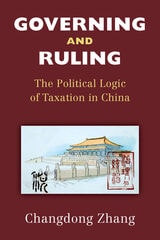
Governing and Ruling
The Political Logic of Taxation in ChinaChangdong Zhang
University of Michigan Press, 2021
Rapid social economic changes, the transition from a planned economy to a market economy, or even economic liberalization can lead to political instability and the collapse of authoritarian regimes. Despite experiencing all of these unprecedented changes in the past forty years, China under the Chinese Communist Party’s leadership has so far successfully transformed and improved both its governance capacity and its ruling capacity. Governing and Ruling: The Political Logic of Taxation in China addresses this regime resilience puzzle by examining the political logic of its taxation system, especially the ways in which taxation helps China handle three governance problems: maneuvering social control, improving agent discipline, and eliciting cooperation. Changdong Zhang argues that a taxation system plays an important role in sustaining authoritarian rule, in China and elsewhere, by combining co-optation and repression functions. The book collects valuable firsthand and secondhand data; studies China’s taxation system, intergovernmental fiscal relationships, composition of fiscal revenue sources, and tax administration; and discusses how each dimension influences the three governance problems.
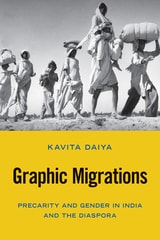
Graphic Migrations
Precarity and Gender in India and the DiasporaKavita Daiya
Temple University Press, 2020
In Graphic Migrations, Kavita Daiya provides a literary and cultural archive of refugee stories and experiences to respond to the question “What is created?” after decolonization and the 1947 Partition of India. She explores how stories of Partition migrations shape and influence the political and cultural imagination of secularism and contribute to gendered citizenship for South Asians in India and its diasporas.
Daiya analyzes modern literature, Bollywood films, Margaret Bourke-White’s photography, advertising, and print culture to show how they memorialize or erase refugee experiences. She also uses oral testimonies of Partition refugees from Hong Kong, South Asia, and North America to draw out the tensions of the nation-state, ethnic discrimination, and religious difference. Employing both Critical Refugee Studies and Feminist Postcolonial Studies frameworks, Daiya traces the cultural, affective, and political legacies of Partition migrations.
The precarity generated by modern migration and expressed through public culture prompts a rethinking of how dominant media represents gendered migrants and refugees. Graphic Migrations demands that we redraw the boundaries of how we tell the story of modern world history and the intricately interwoven, intimate production of statelessness and citizenship across the world’s communities.