Results by title
221 books match the query 'Beyond' and 3 start with g

Generational Politics in the United States
From the Silents to Gen Z and BeyondSally Friedman and David Schultz, Editors
University of Michigan Press, 2024
Generational Politics in the United States is the first comprehensive book that examines the concept of generations from a political science perspective. It defines what a generation is and how to sort out the differences between life cycle, cohort, and aging effect. The book then brings together chapters from an array of political science scholars that examine the role of generations in American politics and how it relates to other variables such as age, race, gender, and socioeconomic status. It discusses how politics in the United States are impacted by changes in generations, including how the passing of the Baby Boom generation and rise of the Millennials and Gen Z will change American politics. By examining the differences in political attitudes, engagement, and impact of recent generations, Generational Politics in the United States suggests how generational change will impact American politics in the future.
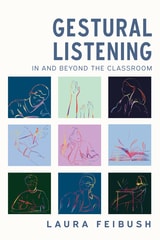
Gestural Listening In and Beyond the Classroom
Laura Feibush
Utah State University Press, 2026
Attuned to the subtle choreographies of the classroom, Gestural Listening In and Beyond the Classroom investigates how students and instructors show that they are listening to each other—and, sometimes, that they are not. While rhetorical scholarship traditionally focuses on speaking and writing, listening can also be understood as a rhetorical force that makes things happen. Listening has the power to move, bring about, cause, and catalyze. This conductive aspect of listening is its embodied manifestation—termed “gestural listening.”
Laura Feibush first traces the roots of embodied listening through cultural and rhetorical history and then uses findings from a classroom study to inform an insightful discussion of respect, resistance, and self-regulation as the key dynamics that characterize listening in contemporary educational spaces. She reveals how the gestures of listening refract across identity categories in ways that have surprising effects on how classroom participants respond to one another. This accessibly written book attends to hands and faces, nodding and note-taking, and the presence of phones and laptops, as well as other forms of nonverbal backchanneling, such as where people sit, when they interrupt, and when they engage in impactful quietness.
The power of gestural listening is not limited to the classroom. Its quiet yet profound influence can elucidate many sites of interaction: in-person and virtual academic settings as well as those far beyond the educational space, such as scenes of protest, worship, and performance. Gestural Listening In and Beyond the Classroom shows how, when understood as possessing its own repertoire of impressive and expressive capacities, listening emerges as a fascinating site of study and offers exercises, activities, and other materials to help educators, counselors, and all those engaging in communicative work enact a new awareness of gestural listening as a rhetorical force.
Growth Policy
Population, Environment, and BeyondKan Chen, Karl F. Lagler, and Mark R. Berg, E. Drannon Buskirk, Jr., Donald H. Gray, Karl Herpolsheimer, T. Jeffrey Jones, George Kral, J.C. Mathes, John McGuire, Donald N. Michael, Stephen M. Pollock, Ruth Rehfus
University of Michigan Press, 1974