Results by title
277 books match the query 'Biology' and 8 start with g
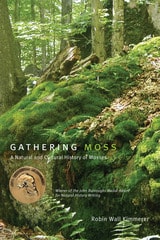
Gathering Moss
A Natural and Cultural History of MossesRobin Wall Kimmerer
Oregon State University Press, 2003
Winner of the 2005 John Burroughs Medal Award for Natural History Writing
Living at the limits of our ordinary perception, mosses are a common but largely unnoticed element of the natural world. Gathering Moss is a beautifully written mix of science and personal reflection that invites readers to explore and learn from the elegantly simple lives of mosses.
In this series of linked personal essays, Robin Wall Kimmerer leads general readers and scientists alike to an understanding of how mosses live and how their lives are intertwined with the lives of countless other beings. Kimmerer explains the biology of mosses clearly and artfully, while at the same time reflecting on what these fascinating organisms have to teach us.
Drawing on her diverse experiences as a scientist, mother, teacher, and writer of Native American heritage, Kimmerer explains the stories of mosses in scientific terms as well as in the framework of indigenous ways of knowing. In her book, the natural history and cultural relationships of mosses become a powerful metaphor for ways of living in the world.

Genetic Perspectives in Biology and Medicine
Edward Garber
University of Chicago Press, 1985
Geoffroy Saint-Hilaire
A Visionary NaturalistHerve Le Guyader
University of Chicago Press, 2003
This was a revolutionary idea—and one vigorously opposed by Geoffroy's colleague Georges Cuvier, a great anatomist and one of the giants of French science. In 1830, their long-running disagreement erupted into furious public debate. Geoffroy argued that all vertebrates shared the same basic body plan not just with each other but with insects as well. Cuvier strenuously disputed this idea, which he saw as tantamount to a belief in "transformism"—arguing instead that each species had its own special and permanent form.
With Geoffroy Saint-Hilaire, Hervé Le Guyader provides an analysis not only of that infamous debate but also of Geoffroy's bold intuitions about anatomy and development. Featuring Geoffroy's published version of the 1830 debates—translated into English for the first time—the book also illustrates how Geoffroy's prescient insights foreshadowed some of the most recent discoveries in evolutionary and developmental biology.

Global Environmental History
I. G. Simmons
University of Chicago Press, 2008
A far-reaching approach that considers the truly global picture and recognizes the contributions of many disciplines—including the natural sciences, the social sciences, and increasingly, the humanities—Global Environmental History focuses not only on the material world but also on humans’ ideas about the planet and their place on it. Taking as his starting point the major phases of human technological evolution of the last 12,000 years, Simmons considers how these changes have affected the natural world and goes on to assess the response to conditions such as climate change. By putting today’s environmental preoccupations into a long-term perspective, Simmons reveals the history of some current anxieties.
A timely examination of the interrelation of history and nature, Simmons’s book will be welcomed by any concerned reader interested in the origins of the modern environmental crisis.
Globalization and New Geographies of Conservation
Edited by Karl S. Zimmerer
University of Chicago Press, 2006
Globalization and New Geographies of Conservation makes four important arguments about the recent coupling of conservation and globalization that is reshaping the place of nature in human-environmental change. First, it has led to an unprecedented number of spatial arrangements whose environmental management goals and prescribed activities vary along a spectrum from strict biodiversity protection to sustainable utilization involving agriculture, food production, and extractive activities. Conservation and globalization are also leading, by necessity, to new scales of management in these activities that rely on environmental science, thus shifting the spatial patterning of humans and the environment. This interaction results, as well, in the unprecedented importance of boundaries and borders; transnational border issues pose both opportunities and threats to global conservation proposed by organizations and institutions that are themselves international. Lastly, Globalization and New Geographies of Conservation argues that the local level has been integral to globalization, while the regional level is often eclipsed at the peril of the successful implementation of conservation and management programs.
Bridging the gap between geography and life science, Globalization and New Geographies of Conservation will appeal to a broad range of students of the environment, conservation planning; biodiversity management, and development and globalization studies.
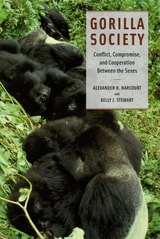
Gorilla Society
Conflict, Compromise, and Cooperation Between the SexesAlexander H. Harcourt and Kelly J. Stewart
University of Chicago Press, 2007
Societies develop as a result of the interactions of individuals as they compete and cooperate with one another in the evolutionary struggle to survive and reproduce successfully. Gorilla society is arranged according to these different and sometimes conflicting evolutionary goals of the sexes. In seeking to understand why gorilla society exists as it does, Alexander H. Harcourt and Kelly J. Stewart bring together extensive data on wild gorillas, collected over decades by numerous researchers working in diverse habitats across Africa, to illustrate how the social system of gorillas has evolved and endured.
Gorilla Society introduces recent theories explaining primate societies, describes gorilla life history, ecology, and social systems, and explores both sexes’ evolutionary strategies of survival and reproduction. With a focus on the future, Harcourt and Stewart conclude with suggestions for future research and conservation. An exemplary work of socioecology from two of the world’s best known gorilla biologists, Gorilla Society will be a landmark study on a par with the work of George Schaller—a synthesis of existing research on these remarkable animals and the societies in which they live.

Green Planet
How Plants Keep the Earth AliveRice, Stanley A
Rutgers University Press, 2012
Beginning with an overview of how human civilization has altered the face of the Earth, particularly by the destruction of forests, the book details the startling consequences of these actions. Rice provides compelling reasons for government officials, economic leaders, and the public to support efforts to save threatened and endangered plants. Global campaigns to solve environmental problems with plants, such as the development of green roofs and the Green Belt Movement—a women's organization in Kenya that empowers communities worldwide to protect the environment—show readers that efforts to save wild plants can be successful and beneficial to the economic well-being of nations.
Through current scientific evidence, readers see that plants are vital to the ecological health of our planet and understand what can be done to lead to a better—and greener—future
Benefits of plants:
- Help modulate greenhouse gases
- Produce almost all oxygen in the air
- Create cool shade that reduces energy costs
- Prevent floods, droughts, and soil erosion
- Produce all of the food in the world
- Create and preserve soil
- Create natural habitats
- Heal the landscape after natural and human disasters
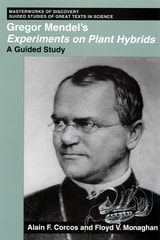
Gregor Mendel's Experiments on Plant Hybrids
Corcos, Alain F
Rutgers University Press, 1993