Results by title
81 books match the query 'Boston' and 3 start with g
Geography And Social Movement
Comparing Antinuclear Activism in the Boston AreaByron A. Miller
University of Minnesota Press, 2000
A comparative analysis of the implications of space, place, and scale in political mobilization.
A comparative analysis of the implications of space, place, and scale in political mobilization.
Context matters, as students of social movements increasingly agree, and yet very little attention has been paid to the role geography plays in activism. Geography and Social Movements corrects this oversight, bringing a geographical perspective to the study of social movements. Byron A. Miller directly addresses the implications of space, place, and scale in social movement mobilization, and then demonstrates their significance in a detailed comparative analysis of peace movements in three municipalities around Boston. In focusing on the Boston area-an old northeastern region, heavily industrialized with many companies working on military contracts, and also a center of education-Miller is able to explore how campaigns aimed at curbing nuclear arms operate within the cultural, political, social, and economic confines of particular places and spaces. He shows how the decisions and actions of local peace movement organizations played a central role in the movement’s successes and failures, and how local organizations had to respond to the differing class, race, and gender characteristics of different locales. Miller’s empirical analysis clearly demonstrates that geographic strategies for social movement organizations have direct consequences for the successes and failures of specific campaigns.[more]
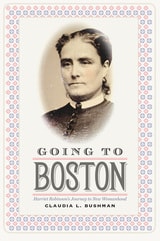
Going to Boston
Harriet Robinson's Journey to New WomanhoodClaudia L. Bushman
University Press of New England, 2017
As a poet, author, and keen observer of life in 1870s Boston, Harriet Robinson played an essential—if occasionally underappreciated—role in the women’s suffrage movement during Boston’s golden age. Robinson flourished after leaving behind her humble roots in the mill town of Lowell, Massachusetts, deciding to spend a year in Boston discovering the culture and politics of America’s Athens. An honest, bright, and perceptive witness, she meets with Emerson and Julia Ward Howe, with whom she organizes the New England Women’s Club, and drinks deeply of the city’s artistic and cultural offerings. Noted historian Claudia L. Bushman proves a wonderful guide as she weaves together Robinson’s journal entries, her own learned commentary, and selections from other nineteenth-century writers to reveal the impact of the industrial revolution and the rise of women’s suffrage as seen through the experience of one articulate, engaged participant. Going to Boston will appeal to readers interested in both the history of Boston and the history of American progress itself.
[more]
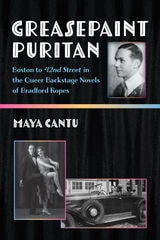
Greasepaint Puritan
Boston to 42nd Street in the Queer Backstage Novels of Bradford RopesMaya Cantu
University of Michigan Press, 2024
Greasepaint Puritan details the life and work of Bradford Ropes, author of the bawdy 1932 novel 42nd Street, on which the classic film and its stage adaptation are based. Each of Ropes’s long-forgotten novels was inspired by his own experiences as a performer, and focused on the lives of gay men in show business, offering rare glimpses into backstage Broadway. But why did Ropes’s body of work, and consequently his biographical footsteps, disappear into such obscurity?
Greasepaint Puritan aims to find out and reclaim his story. Descended from Mayflower Pilgrims, Ropes rebelled against the “Proper Bostonian” life, in a career that touched upon the Jazz Age, American vaudeville, and theater censorship. We follow Ropes’s successful career as both a performer and the author of the trilogy of backstage novels: 42nd Street, Stage Mother, and Go Into Your Dance. Populated by scheming stage mothers, precocious stage children, grandiose bit players, and tart-tongued chorines, these novels centered on the lives and relationships of gay men on Broadway during the Jazz Age and Prohibition era. Rigorously researched, Greasepaint Puritan chronicles Ropes’s career as a successful screenwriter in 1930s and ’40s Hollywood, where he continued to be a part of a dynamic gay subculture within the movie industry before returning to obscurity in the 1950s. His legacy lives on in the Hollywood and Broadway incarnations of 42nd Street—but Greasepaint Puritan restores the “forgotten melody” of the man who first envisioned its colorful characters.
Greasepaint Puritan aims to find out and reclaim his story. Descended from Mayflower Pilgrims, Ropes rebelled against the “Proper Bostonian” life, in a career that touched upon the Jazz Age, American vaudeville, and theater censorship. We follow Ropes’s successful career as both a performer and the author of the trilogy of backstage novels: 42nd Street, Stage Mother, and Go Into Your Dance. Populated by scheming stage mothers, precocious stage children, grandiose bit players, and tart-tongued chorines, these novels centered on the lives and relationships of gay men on Broadway during the Jazz Age and Prohibition era. Rigorously researched, Greasepaint Puritan chronicles Ropes’s career as a successful screenwriter in 1930s and ’40s Hollywood, where he continued to be a part of a dynamic gay subculture within the movie industry before returning to obscurity in the 1950s. His legacy lives on in the Hollywood and Broadway incarnations of 42nd Street—but Greasepaint Puritan restores the “forgotten melody” of the man who first envisioned its colorful characters.
[more]