501 books match the query 'Catholic Church' and 11 start with g
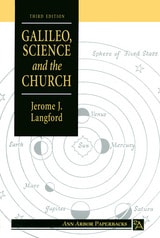
cover of Galileo, Science and the Church

Galileo, Science and the Church

Jerome J. Langford

University of Michigan Press, 1992

Jerome J. Langford's Galileo, Science, and the Church is widely recognized as a classic, balanced account of Galileo Galilei’s legendary 1633 confrontation with the Roman Catholic Inquisition. Moving past the overly polarized arguments of traditional polemicists and apologists, Langford contextualizes the "Galileo Affair" within its proper 17th-century historical, theological, and philosophical milieu. The book meticulously explores how the clash was less a fundamental war between science and faith, and more a complex dispute over scriptural interpretation, ecclesiastical authority, and the academic rigidities of Aristotelian philosophy. Through objective research, Langford demonstrates that this momentous historical drama still serves as a timeless case study on the enduring friction between institutional authority and the freedom of individual thought and expression.
[more]
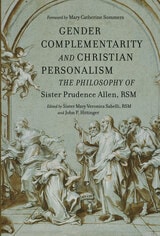
cover of Gender Complementarity and Christian Personalism: The Philosophy of Sister Prudence Allen, RSM

Gender Complementarity and Christian Personalism

The Philosophy of Sister Prudence Allen, RSM

Sister Mary Veronica Sabelli, RSM

Catholic University of America Press, 2025

When, in the 1970’s, Sister Prudence Allen, RSM began to investigate philosophical thought on woman, the question was considered to be, at best, a marginal area for philosophical research. Rather, it was seen as a sociological, anthropological, psychological, or political issue. This book confirms that today, partly due to Allen’s groundbreaking work, the complementarity of man and woman is an important and fruitful area of research in philosophy providing an evaluative framework that enriches and challenges many other disciplines. No one could have foreseen the centrality of her research for questions of gender theory that are, in the third decade of the 21st century, in the forefront of public attention. In the present volume, leading authors in the area of sex/gender complementarity reflect upon and further develop various aspects of Allen’s research. In 16 original, scholarly essays, some contributors build upon Allen’s project of exploring “the concept of woman” throughout the history of philosophy. Others explore the work of 20th century philosophers, most of them Christian Personalists, whom Allen credits with significant influence on the development of integral gender complementarity, such as Karol Wojtyła/ John Paul II, Jacques Maritain, Edith Stein, Emmanuel Mounier, W. Norris Clarke, SJ, and Bernard Lonergan, SJ. Still other contributors consider Marian spirituality, analogies between Benedictine spirituality and the physiological realities of a woman’s body during pregnancy, seminary education in the writings of Allen and others, and the impact of Allen’s work on the real lives of women in families, the Church, and professional life. Upon completing her magisterial, three-volume work, The Concept of Woman, Allen passed the baton to a new generation of scholars, stating, “The next phases will be developed by those who themselves take the argument further and deeper in their own research, writing, living, and lecturing.” The present volume takes up the baton, carrying Allen’s work forward and paying tribute to the lifetime achievement of a great scholar.
[more]
cover of Gender and Sexuality in Modern Ireland

Gender and Sexuality in Modern Ireland

Anthony Bradley

University of Massachusetts Press, 1997
This collection of stimulating essays focuses on issues of gender and sexuality in Irish history, biography, language, literature, and drama. While the contributors employ a variety of methodological and critical perspectives, they share the conviction that the gendering of Ireland--not only of the nation, but of actual Irish men and women--is a construction of culture and ideology and not simply one of nature.
[more]
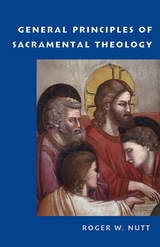
cover of General Principles of Sacramental Theology

General Principles of Sacramental Theology

Roger W. Nutt

Catholic University of America Press, 2017
General Principles of Sacramental Theology addresses a current lacuna in English language theological literature. Bernard Leeming’s highly respected book Principles of Sacramental Theology was published more than sixty years ago. Since that time, there has been a noted decrease, especially in English language sacramental theology, in treatments of the basic topics and principles – such as the nature of the sacraments of signs, sacramental grace, sacramental character, sacramental causality, sacramental intention, the necessity and number of the sacraments, sacramental matter and form, inter alia – which apply to all of the sacraments. This book will be of use in seminary, graduate, and undergraduate courses. The sacraments play an irreplaceable role in pursuing a Universal Call to Holiness that is so central to Vatican II’s teaching.
[more]
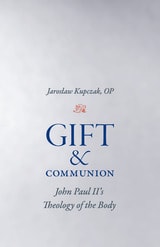
cover of Gift and Communion

Gift and Communion

Jaroslaw Kupczak

Catholic University of America Press, 2014
Gift and Communion offers a critical presentation of John Paul II's theology of the body, understood in the light of Christian theological tradition. The main thesis of the book is that John Paul II's theology of the body forms a new, inspiring approach to Christian ethics and the theology of marriage and family, as well as to theological anthropology. A central thrust of Gift and Communion is to treat theology of the body - as it deserves - in all its philosophical and theological seriousness and to present it as an important stage in the historical development of Catholic theology
[more]
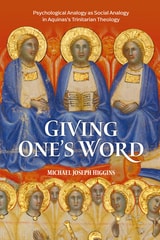
cover of Giving One's Word: Interpersonal Love, Knowledge, and Self-Giving in Aquinas's Psychological Analogy for the Trinity

Giving One's Word

Interpersonal Love, Knowledge, and Self-Giving in Aquinas's Psychological Analogy for the Trinity

Michael Joseph Higgins

Catholic University of America Press, 2025
According to the vast majority of recent Trinitarian theologians, to believe in the Trinity is to believe that God is Love: it is to believe in three divine Persons who know each other, love each other, and give themselves to each other. St. Thomas Aquinas is rarely invoked as a patron of such a social approach to the Trinity. Aquinas’s Trinitarian theology, after all, revolves around the immanent processions of a Word and Love within the unity of the divine essence. Many have assumed that this “psychological analogy” is removed from—or even incompatible with—interpersonal knowledge, love, and self-giving. Some have concluded that Aquinas is therefore unable to accommodate a social Trinity. Others have argued that he is open to a social Trinity, but that his psychological categories need to be complemented by a more overtly social framework. This study, however, shows that these psychological categories themselves are shot through with interpersonal knowledge, love, and self-giving. More specifically, Aquinas’s psychological analogy is often accused of emphasizing the unity of the divine essence at the expense of the distinction of the divine Persons. In fact, it emphasizes distinction just as basically as it emphasizes unity, and it ensures that the distinction between the divine Persons is a radical one. Similarly, it is criticized for being a matter of self-knowledge instead of interpersonal knowledge, self-love instead of interpersonal love, and self-regard instead of self-giving. In fact, it is a matter of self-knowledge as interpersonal knowledge, self-love as interpersonal love, and self-regard as self-giving: it ensures that there can be no self-knowledge or self-love in God that is not just as basically interpersonal knowledge, interpersonal love, and interpersonal self-giving. Aquinas’s psychological analogy, then, does not shut down the possibility of interpersonal Trinity. Nor does it need to be complemented from the outside by an interpersonal Trinity. Instead, it contains within itself an intensely interpersonal Trinity.
[more]
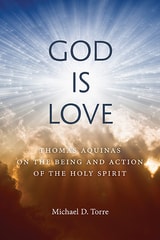
cover of God Is Love: Thomas Aquinas on the Being and Action of the Holy Spirit

God Is Love

Thomas Aquinas on the Being and Action of the Holy Spirit

Michael D. Torre

Catholic University of America Press, 2026
This book dedicates three essays each to three different theological problems regarding the Holy Spirit: In God and for Us (The "Filioque" and "Uncreated Grace"); Thomas's Understanding (Not His Commentators) of the Relation between nature and sanctifying grace; and our ability (and that of the angels at their creation) in fact to resist God' grace and thus be the first cause of sin. This later problem is developed in an "excursus" on the way God moves the free will, one that takes into consideration much recent work on this issue and situates the essays' position in relation to it. The book ends with a brief epilogue on the credibility of God, again giving Thomas's account of this. The principal aim throughout is to understand the doctrine of Thomas Aquinas. It places his views in relation to three audiences: chiefly to the orthodox regarding the first issue; to Catholics in relation to the second; and to Protestants in relation to the third. Thus, its second aim is to join "ecumenical debate" about these matters. The essays were mostly written to be delivered orally, to an informed audience of philosophers and theologians., but one that consisted of "generalists" and serious students of Thomas, as well as of "professional" philosophers and theologians. All three of the debated issues discussed have generated an enormous amount of disagreement and debate, not a little of it being quite "technical." Thus, each issue would easily require a long and significant book to be addressed as it deserves. The essays do not do this, but they do indicate what Torre holds is the "directive line" of Thomas's thought that deserves to be defended and developed in each case, and, in each case, this line is held to be markedly different than many have thought it to be.
[more]
cover of God Owes Us Nothing: A Brief Remark on Pascal's Religion and on the Spirit of Jansenism

God Owes Us Nothing

A Brief Remark on Pascal's Religion and on the Spirit of Jansenism

Leszek Kolakowski

University of Chicago Press, 1995

God Owes Us Nothing reflects on the centuries-long debate in Christianity: how do we reconcile the existence of evil in the world with the goodness of an omnipotent God, and how does God's omnipotence relate to people's responsibility for their own salvation or damnation. Leszek Kolakowski approaches this paradox as both an exercise in theology and in revisionist Christian history based on philosophical analysis. Kolakowski's unorthodox interpretation of the history of modern Christianity provokes renewed discussion about the historical, intellectual, and cultural omnipotence of neo-Augustinianism.

"Several books a year wrestle with that hoary conundrum, but few so dazzlingly as the Polish philosopher's latest."—Carlin Romano, Washington Post Book World

"Kolakowski's fascinating book and its debatable thesis raise intriguing historical and theological questions well worth pursuing."—Stephen J. Duffy, Theological Studies

"Kolakowski's elegant meditation is a masterpiece of cultural and religious criticism."—Henry Carrigan, Cleveland Plain Dealer
[more]
cover of God and Caesar: Selected Essays on Religion, Politics, & Society

God and Caesar

Selected Essays on Religion, Politics, & Society

George Pell

Catholic University of America Press, 2007
Drawing on a deep knowledge of history and human affairs, the essays pinpoint the key issues facing Christians and non-believers in determining the future of modern democratic life
[more]
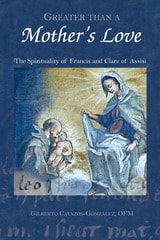
cover of Greater Than a Mother's Love: The Spirituality of Francis and Clare of Assisi

Greater Than a Mother's Love

The Spirituality of Francis and Clare of Assisi

Friar Gilberto Cavazos-González, OFM

University of Scranton Press, 2010

Although there are several studies dedicated to the lives of Francis and Clare of Assisi, Gilberto Cavazos-González’s Greater Than a Mother’s Love is the first to investigate their spirituality in the context of family relationships. He delves into the writings of Francis and Clare and illustrates how both used observations of their various human relationships to understand their experiences with God. Accompanying this study is an exhaustive bibliography and several appendices that enhance this unique treatment of these two beloved and admired religious figures.
[more]
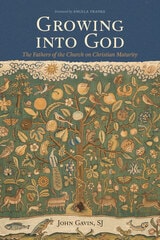
cover of Growing into God: The Fathers of the Church on Christian Maturity

Growing into God

The Fathers of the Church on Christian Maturity

John Gavin

Catholic University of America Press, 2025

Many studies of spiritual development exist under the heading of “Christian Perfection.” However, John Gavin revisits such topics as asceticism, prayer, sacraments, virtues, and spiritual combat through scriptural and patristic texts that present the Christian life as one of growth from spiritual infancy to a particular fulfillment or end (telos): divinized humanity as formed and revealed in Jesus Christ. Thus, though Christian maturity does incorporate such things as physical and cognitive development, its true distinction lies in its gifted, supernatural end that does not exclude human freedom. Part One establishes the pillars of Christian maturity – form and finality; virtue and character; vocation and mission – and explores the opposition to maturation in the form of demonic infantilism. Part Two examines the means of maturity given to us in the life of the Church: the Scriptures, the Mysteries (Sacraments), and asceticism. Finally, Part Three reviews four figures of Christian adulthood: the Witness, the Teacher, the Servant, and the Fool. A concluding chapter applies the insights from the previous chapters to our modern world to see in what ways our times need to “grow up.” Growing into God includes a variety of early Christian voices: Irenaeus of Lyons, Origen of Alexandria, Gregory of Nazianzus, Gregory of Nyssa, Basil of Caeserea, Augustine of Hippo, Ambrose of Milan, John Cassian, Dionysius the Areopagite, Mark the Monk, John Moschos, Maximus the Confessor, Symeon the Holy Fool, and others. Their collective insights, all the fruits of great learning and the contemplation of God’s Word, describe a wondrous figure: the mature saint transformed by union with the Father, Son, and Spirit.
[more]