Results by title
444 books match the query 'Chemistry' and 24 start with g
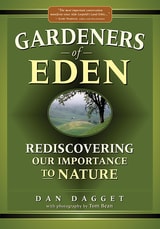
Gardeners of Eden
Rediscovering Our Importance to NatureDan Dagget
University of Nevada Press, 2005
Dagget recommends a new kind of environmentalism based on management, science, evolution, and holism, and served by humans who enrich the environment even as they benefit from it. His new environmentalism offers hopeful solutions to the current ecological crisis and a new purpose for our human energies and ideals. This book is essential reading for anyone concerned with the earth and anyone seeking a viable way for our burgeoning human population to continue to live upon it.
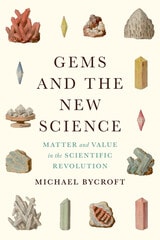
Gems and the New Science
Matter and Value in the Scientific RevolutionMichael Bycroft
University of Chicago Press, 2026
In Gems and the New Science, Michael Bycroft argues that gems were connected to major developments in the “new science” between the sixteenth and nineteenth centuries. As he explains, precious and semiprecious stones were at the center of dramatic shifts in natural knowledge in early modern Europe. They were used to investigate luminescence, electricity, combustion, chemical composition, and more. They were collected by naturalists; measured by mathematicians; and rubbed, burned, and dissolved by experimental philosophers. This led to the demise of the traditional way of classifying gems—which grouped them by transparency, color, and locality—and the turn to density, refraction, chemistry, and crystallography as more reliable guides for sorting these substances.
The science of gems shows that material evaluation was as important as material production in the history of science. It also shows the value of seeing science as the product of the interaction between different material worlds. The book begins by bringing these insights to bear on five themes of the Scientific Revolution. Each of the subsequent chapters deals with a major episode in early modern science, from the expansion of natural history in the sixteenth century to the emergence of applied science early in the nineteenth century. This important work is not only the first book-length history of the science of gems but also a fresh interpretation of the Scientific Revolution and an argument for using a new form of materialism to understand the evolution of science.
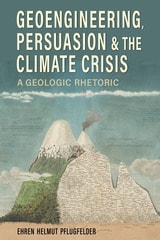
Geoengineering, Persuasion, and the Climate Crisis
A Geologic RhetoricEhren Helmut Pflugfelder
University of Alabama Press, 2023
A rhetorical exploration of an underexamined side of climate change—the ongoing research into and development of geoengineering strategies
Geoengineering, Persuasion, and the Climate Crisis: A Geologic Rhetoric exposes the deeply worrying state of discourse over geoengineering—the intentional manipulation of the earth’s climate as means to halt or reverse global warming. These climate-altering projects, which range from cloud-whitening to carbon dioxide removal and from stratospheric aerosol injection to enhanced weathering, are all technological solutions to more complex geosocial problems.
Geoengineering represents one of the most alarming forms of deliberative discourse in the twenty-first century. Yet geoengineering could easily generate as much harm as the environmental traumas it seeks to cure. Complicating these deliberations is the scarcity of public discussion. Most deliberations transpire within policy groups, behind the closed doors of climate-oriented startups, between subject-matter experts at scientific conferences, or in the disciplinary jargon of research journals. Further, much of this conversation occurs primarily in the West.
Ehren Helmut Pflugfelder makes clear how the deliberative rhetorical strategies coming from geoengineering advocates have been largely deceptive, hegemonic, deterministic, and exploitative. In this volume, he investigates how geoengineering proponents marshal geologic actors into their arguments—and how current discourse could lead to a greater exploitation of the earth in the future.
Pflugfelder’s goal is to understand the structure, content, purpose, and effect of these discourses, raise the alarm about their deliberative directions, and help us rethink our approach to the climate. In highlighting both the inherent problems of the discourses and the ways geologic rhetoric can be made productive, he attempts to give “the geologic” a place at the table to better understand the roles that all earth systems continue to play in our lives, now and for years to come.
Geography, Resources and Environment, Volume 1
Selected Writings of Gilbert F. WhiteEdited by Robert W. Kates and Ian Burton
University of Chicago Press, 1986
Geography, Resources and Environment, Volume 2
Themes from the Work of Gilbert F. WhiteEdited by Robert W. Kates and Ian Burton
University of Chicago Press, 1986
Geologic Life
Inhuman Intimacies and the Geophysics of RaceKathryn Yusoff
Duke University Press, 2024
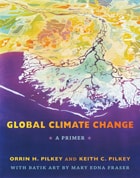
Global Climate Change
A PrimerOrrin H. Pilkey and Keith C. Pilkey
Duke University Press, 2011
After explaining the greenhouse effect, Pilkey, writing with son Keith, turns to the damage it is causing: sea level rise, ocean acidification, glacier and sea ice melting, changing habitats, desertification, and the threats to animals, humans, coral reefs, marshes, and mangroves. These explanations are accompanied by Mary Edna Fraser’s stunning batiks depicting the large-scale arenas in which climate change plays out.
The Pilkeys directly confront and rebut arguments typically advanced by global change deniers. Particularly valuable are their discussions of “Climategate,” a manufactured scandal that undermined respect for the scientific community, and the denial campaigns by the fossil fuel industry, which they compare to the tactics used by the tobacco companies a generation ago to obfuscate findings on the harm caused by cigarettes.
Global Warming and Political Intimidation
How Politicians Cracked Down on Scientists as the Earth Heated UpRaymond S. Bradley
University of Massachusetts Press, 2011
In this powerful book, highly respected climate scientist Raymond Bradley provides the inside story from the front lines of the debate. In clear and direct language, he describes the tactics those in power have used to intimidate him and his colleagues part of a larger pattern of governmental suppression of scientific information, politics at the expense of empirically based discourse.
Speaking from his experience, Bradley exposes the fault lines in the global warming debate, while providing a concise primer on climate change. The result is a cautionary tale of how politics and science can become fatally intertwined.
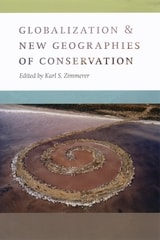
Globalization and New Geographies of Conservation
Edited by Karl S. Zimmerer
University of Chicago Press, 2006
Globalization and New Geographies of Conservation makes four important arguments about the recent coupling of conservation and globalization that is reshaping the place of nature in human-environmental change. First, it has led to an unprecedented number of spatial arrangements whose environmental management goals and prescribed activities vary along a spectrum from strict biodiversity protection to sustainable utilization involving agriculture, food production, and extractive activities. Conservation and globalization are also leading, by necessity, to new scales of management in these activities that rely on environmental science, thus shifting the spatial patterning of humans and the environment. This interaction results, as well, in the unprecedented importance of boundaries and borders; transnational border issues pose both opportunities and threats to global conservation proposed by organizations and institutions that are themselves international. Lastly, Globalization and New Geographies of Conservation argues that the local level has been integral to globalization, while the regional level is often eclipsed at the peril of the successful implementation of conservation and management programs.
Bridging the gap between geography and life science, Globalization and New Geographies of Conservation will appeal to a broad range of students of the environment, conservation planning; biodiversity management, and development and globalization studies.

Glyphosate and the Swirl
An Agroindustrial Chemical on the MoveVincanne Adams
Duke University Press, 2022

Going Wild
Hunting, Animal Rights, and the Contested Meaning of NatureJan E. Dizard
University of Massachusetts Press, 1999
A probing study of the way diverse conceptions of nature shape our responses to specific environmental issues, this book examines the recent clash over a proposed deer hunt on the largest public watershed in Massachusetts, the Quabbin reservoir. In analyzing this public dispute, Jan E. Dizard draws on a wide range of sources, including interviews with resource managers, animal rights advocates, hunters, and environmentalists. He shows how each faction, while sharing some common ground with the others, projects different meanings onto nature.
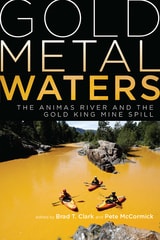
Gold Metal Waters
The Animas River and the Gold King Mine SpillBrad T. Clark
University Press of Colorado, 2022
This singular event is surveyed and interpreted from multiple diverse perspectives—college professors, students, and scientists and activists from a range of academic and epistemological backgrounds—with each chapter reflecting unique professional and personal experiences. Contributors examine both the context for this event and responses to it, embedding this discussion within the broader context of the tens of thousands of mines leaking pollutants into waterways and soils throughout Colorado and the failure to adequately mitigate the larger ongoing crisis.
The Gold King Mine spill was the catalyst that finally brought Superfund listing to the Silverton area; it was a truly sensational event in many respects. Gold Metal Waters will be of interest to students and scholars in all disciplines, but especially in environmental history, western history, mining history, politics, and communication, as well as general readers concerned with human relationships with the environment.
Contributors: Alane Brown, Brian L. Burke, Karletta Chief, Steven Chischilly, Becky Clausen, Michael A. Dichio, Betty Carter Dorr, Cynthia Dott, Gary Gianniny, David Gonzales, Andrew Gulliford, Lisa Marie Jacobs, Ashley Merchant, Teresa Montoya, Scott W. Roberts, Lorraine L. Taylor, Jack Turner, Keith D. Winchester, Megan C. Wrona, Janene Yazzie
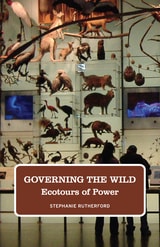
Governing the Wild
Ecotours of PowerStephanie Rutherford
University of Minnesota Press, 2011
Take four emblematic American scenes: the Hall of Biodiversity at the American Museum of Natural History in New York; Disney’s Animal Kingdom theme park in Orlando; an ecotour of Yellowstone and Grand Teton National Parks; the film An Inconvenient Truth. Other than expressing a common interest in the environment, they seem quite dissimilar.
And yet, as Governing the Wild makes clear, these sites are all manifestations of green governmentality, each seeking to define and regulate our understanding, experience, and treatment of nature. Stephanie Rutherford shows how the museum presents a scientized assessment of global nature under threat; the Animal Kingdom demonstrates that a corporation can successfully organize a biopolitical project; the ecotour, operating as a school for a natural aesthetic sensibility, provides a visual grammar of pristine national nature; and the film offers a toehold on a moral way of encountering nature. But one very powerful force unites the disparate “truths” of nature produced through these sites, and that, Rutherford tells us, is their debt to nature’s commodification.
Rutherford’s analysis reveals how each site integrates nature, power, and profit to make the buying and selling of nature critical to our understanding and rescuing of it. The combination, she argues, renders other ways of encountering nature—particularly more radically environmental ways—unthinkable.

Grasses of the Northeast
A Manual of the Grasses of New England and Adjacent New YorkDennis W. Magee
University of Massachusetts Press, 2014
This book is designed to serve as a reference work, classroom textbook, and field manual for botanists, naturalists, and students interested in learning to identify and learn about the distinguishing features of grasses of the northeastern United States. Included are more than 380 species of grasses that have been documented as occurring in the region. The volume contains 246 range maps and 269 line drawings that clarify descriptions used in the keys and illustrate characteristics of the various kinds of grasses. Dennis Magee also provides a description of each genus and species along with synonyms and habitats. For anyone interested in an up-to-date treatment of the grasses of greater New England, this volume will be an invaluable resource. It is the only comprehensive technical guide devoted exclusively to the grasses of this region and presents a wealth of information in a precise, clear format.
The geographic scope of the work extends from the Canadian border south through Long Island and west to the Hudson River. But given the considerable overlap with the grass flora to the adjacent north, south, and west, the book will also be useful beyond New England and the bordering New York counties.
The volume includes an illustrated glossary of essential terms and concepts and a “how to use this manual” section. A CD-ROM with a multiple-entry identification guide, and hundreds of accompanying photographic images of individual species, is provided in a sleeve inside the back cover of the book.
Great Lakes Fisheries Policy and Management
A Binational PerspectiveWilliam W. Taylor
Michigan State University Press, 2012
To maintain thriving, sustainable fisheries in the Laurentian Great Lakes, an understanding of the numerous and complex ecological, societal, economic, management, and policy issues surrounding them is critical. This incisive study provides a collaborative, interjurisdictional, and multi-use perspective that is shaped by the United states and Canada together as part of their shared governance of these waters. This book offers an informed look at the Great Lakes fisheries and their ecosystems, as the contributors examine both the threats they have faced and the valuable opportunities they provide for basin citizens and industries. Divided into four sections—the Great Lakes region, Great Lakes Fisheries, Fisheries case studies, and outlook for the Future—this is a valuable and up-to-date tool for students, researchers, policymakers, and managers alike.
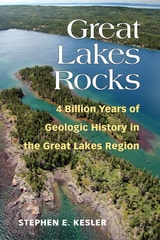
Great Lakes Rocks
4 Billion Years of Geologic History in the Great Lakes RegionStephen E. Kesler
University of Michigan Press, 2019

Green Delusions
An Environmentalist Critique of Radical EnvironmentalismMartin W. Lewis
Duke University Press, 1994
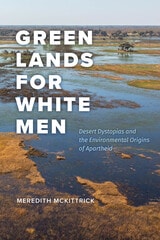
Green Lands for White Men
Desert Dystopias and the Environmental Origins of ApartheidMeredith McKittrick
University of Chicago Press, 2024
In 1918, South Africa’s climate seemed to be drying up. White farmers claimed that rainfall was dwindling, while nineteenth-century missionaries and explorers had found riverbeds, seashells, and other evidence of a verdant past deep in the Kalahari Desert. Government experts insisted, however, that the rains weren’t disappearing; the land, long susceptible to periodic drought, had been further degraded by settler farmers’ agricultural practices—an explanation that white South Africans rejected. So when the geologist Ernest Schwarz blamed the land itself, the farmers listened. Schwarz held that erosion and topography had created arid conditions, that rainfall was declining, and that agriculture was not to blame. As a solution, he proposed diverting two rivers to the Kalahari’s basins, creating a lush country where white South Africans could thrive. This plan, which became known as the Kalahari Thirstland Redemption Scheme, was rejected by most scientists. But it found support among white South Africans who worried that struggling farmers undermined an image of racial superiority.
Green Lands for White Men explores how white agriculturalists in southern Africa grappled with a parched and changing terrain as they sought to consolidate control over a Black population. Meredith McKittrick’s timely history of the Redemption Scheme reveals the environment to have been central to South African understandings of race. While Schwarz’s plan was never implemented, it enjoyed sufficient support to prompt government research into its feasibility, and years of debate. McKittrick shows how white farmers rallied around a plan that represented their interests over those of the South African state and delves into the reasons behind this schism between expert opinion and public perception. This backlash against the predominant scientific view, McKittrick argues, displayed the depth of popular mistrust in an expanding scientific elite.
A detailed look at the intersection of a settler society, climate change, white nationalism, and expert credibility, Green Lands for White Men examines the reverberations of a scheme that ultimately failed but influenced ideas about race and the environment in South Africa for decades to come.
Green Victorians
The Simple Life in John Ruskin's Lake DistrictVicky Albritton and Fredrik Albritton Jonsson
University of Chicago Press, 2016
At the center of their social experiment was the charismatic art critic and political economist John Ruskin. Albritton and Albritton Jonsson show how Ruskin’s followers turned his theory into practice in a series of ambitious local projects ranging from hand spinning and woodworking to gardening, archaeology, and pedagogy. This is a lively yet unsettling story, for there was a dark side to Ruskin’s community as well—racist thinking, paternalism, and technophobia. Richly illustrated, Green Victorians breaks new ground, connecting the ideas and practices of Ruskin’s utopian community with the problems of ethical consumption then and now.
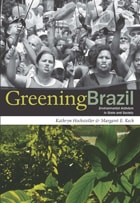
Greening Brazil
Environmental Activism in State and SocietyKathryn Hochstetler and Margaret E. Keck
Duke University Press, 2007
The authors present a multilevel analysis encompassing institutions and individuals within the government—at national, state, and local levels—as well as the activists, interest groups, and nongovernmental organizations that operate outside formal political channels. They emphasize the importance of networks linking committed actors in the government bureaucracy with activists in civil society. Portraying a gradual process marked by periods of rapid advance, Hochstetler and Keck show how political opportunities have arisen from major political transformations such as the transition to democracy and from critical events, including the well-publicized murders of environmental activists in 1988 and 2004. Rather than view foreign governments and organizations as the instigators of environmental policy change in Brazil, the authors point to their importance at key moments as sources of leverage and support.
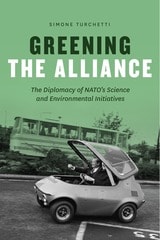
Greening the Alliance
The Diplomacy of NATO's Science and Environmental InitiativesSimone Turchetti
University of Chicago Press, 2018
Drawing on previously unseen documents from NATO’s own archives, Simone Turchetti reveals how its investments were rooted in the alliance’s defense and surveillance needs, needs that led it to establish a program prioritizing environmental studies. A long-overlooked and effective diplomacy exercise, NATO’s “greening” at one point constituted the organization’s chief conduit for negotiating problematic relations between allies. But while Greening the Alliance explores this surprising coevolution of environmental monitoring and surveillance, tales of science advisers issuing instructions to bomb oil spills with napalm or Dr. Strangelove–like experts eager to divert the path of hurricanes with atomic weapons make it clear: the coexistence of these forces has not always been harmonious. Reflecting on this rich, complicated legacy in light of contemporary global challenges like climate change, Turchetti offers both an eye-opening history of international politics and environmental studies and a thoughtful assessment of NATO’s future.
Growth Triumphant
The Twenty-first Century in Historical PerspectiveRichard A. Easterlin
University of Michigan Press, 1998
Guide to Sustainable Development and Environmental Policy
Natalia Mirovitskaya and William L. Ascher, eds.
Duke University Press, 2001
The guide combines formal, objective entries with critical commentaries that emphasize different opinions and controversies. With succinct explanations of more than a thousand terms, thoughtful interpretations by international experts, and helpful cross-referencing, this resource is designed to serve as a roadmap for understanding the issues and debates in the overlapping fields of environment and development. Intended for use by activists, journalists, policymakers, students, scholars, and interested citizens, the Guide to Sustainable Development and Environmental Policy will be a helpful tool for anyone trying to get a comprehensive look at the many environmental organizations, schools of thought, development programs, international environmental treaties, conventions, and strategies that have proliferated in the past few decades.
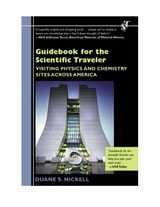
Guidebook for the Scientific Traveler
Visiting Physics and Chemistry Sites Across AmericaNickell, Duane S
Rutgers University Press, 2010
Are you in the mood for a trip to the Titan Missile Museum in Tucson? Want to spend some time at the Fermi National Accelerator Center near Chicago? Perhaps quench your thirst for knowledge and discovery at the Anheuser-Busch Brewery in St. Louis, where brewers are chemists at heart? Set your own pace. As an active participant or living room traveler, you'll be mesmerized as Nickell leads you on a tour of physics and chemistry sites.
Written in an easy-to-read and accessible style, this comprehensive guide is a practical and fun way to promote scientific literacy. You'll meet some of the world's great physicists, engineers, and chemists as you turn pages filled with more than fifty photographs. Organized into chapters on individuals, places, and sites--from universities of science to national laboratories, particle accelerators to energy labs and beyond--Nickell illuminates the history of each topic and paints a panorama of stunning achievements in physics and chemistry.
Whether you're traveling in California or Maine, or taking to the road in Texas or Illinois, Nickell helps complete your trip with a state-by-state list of monumental sites and resources. From the east coast to the west, north by northwest, or south in search of the Florida Solar Power Energy Center, you'll enjoy all your scientific travels with Visiting Physics and Chemistry Sites across America.