Results by title
662 books match the query 'China' and 25 start with g
Gathering Medicines
Nation and Knowledge in China’s Mountain SouthJudith Farquhar and Lili Lai
University of Chicago Press, 2021
Over a period of six years, Judith Farquhar and Lili Lai worked with seven minority nationality groups in China’s southern mountains, observing how medicines were gathered and local healing systems codified. Gathering Medicines shares their intimate view of how people understand ethnicity, locality, the body, and nature. This ethnography of knowledge diversities in multiethnic China is a testament to the rural wisdom of mountain healers, one that theorizes, from the ground up, the dynamic encounters between formal statist knowledge and the popular authority of the wild.
Gender Politics in Modern China
Writing and FeminismTani E. Barlow, ed.
Duke University Press, 1993
Ranging from interviews with contemporary writers, to historical accounts of gendered writing in Taiwan and semi-colonial China, to close feminist readings of individual authors, these essays confront the degree to which textual stategies construct notions of gender. Among the specific themes discussed are: how femininity is produced in texts by allocating women to domestic space; the extent to which textual production lies at the base of a changing, historically specific code of the feminine; the extent to which women in modern Chinese societies are products of literary canons; the ways in which the historical processes of gendering have operated in Chinese modernity vis à vis modernity in the West; the representation of feminists as avengers and as westernized women; and the meager recognition of feminism as a serious intellectual current and a large body of theory.
Originally published as a special issue of Modern Chinese Literature (Spring & Fall 1988), this expanded book represents some of the most compelling new work in post-Mao feminist scholarship and will appeal to all those concerned with understanding a revitalized feminism in the Chinese context.
Contributors. Carolyn Brown, Ching-kiu Stephen Chan, Sung-sheng Yvonne Chang, Yu-shih Chen, Rey Chow, Randy Kaplan, Richard King, Wolfgang Kubin, Wendy Larson, Lydia Liu, Seung-Yeun Daisy Ng, Jon Solomon, Meng Yue, Wang Zheng
Gender, Health, and History in Modern East Asia
Edited by Angela Ki Che Leung and Izumi Nakayama
Hong Kong University Press, 2017
Gendered Memories
An Imaginary Museum for Ding Ling and Chinese Female Revolutionary MartyrsXian Wang
University of Michigan Press, 2025
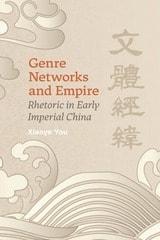
Genre Networks and Empire
Rhetoric in Early Imperial ChinaXiaoye You
Southern Illinois University Press, 2023
In Genre Networks and Empire, Xiaoye You integrates a decolonial and transnational approach to construct a rhetorical history of early imperial China. You centers ancient Chinese rhetoric by focusing on how an imperial matrix of power was established in the Han Dynasty through genres of rhetoric and their embodied circulation, and through epistemic constructs such as the Way, heaven, ritual, and yin-yang.
Through the concept of genre networks, derived from both ancient Chinese and Western scholarship, You unlocks the mechanisms of early Chinese imperial bureaucracy and maps their far-reaching influence. He considers the communication of governance, political issues, court consultations, and the regulation of the inner quarters of empire. He closely reads debates among government officials, providing insight into their efforts to govern and legitimize the regime and their embodiment of different schools of thought. Genre Networks and Empire embraces a variety of rhetorical forms, from edicts, exam essays, and commentaries to instruction manuals and memorials. It captures a range of literary styles serving the rhetorical purposes of praise and criticism. In the context of court documentation, these genre networks reflect systems of words in motion, mediated governmental decisions and acts, and forms of governmental logic, strategy, and reason.
A committed work of decolonial scholarship, Genre Networks and Empire shows, through Chinese words and writing, how the ruling elites of Han China forged a linguistic matrix of power, a book that bears implications for studies of rhetoric and empire in general.
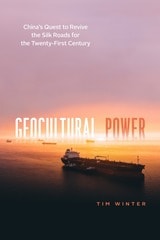
Geocultural Power
China's Quest to Revive the Silk Roads for the Twenty-First CenturyTim Winter
University of Chicago Press, 2019
Geocultural Power explores this question by considering how China is couching its strategy for building trade, foreign relations, and energy and political security in an evocative topography of history. Until now Belt and Road has been discussed as a geopolitical and geoeconomic project. This book introduces geocultural power to the analysis of international affairs. Tim Winter highlights how many countries—including Iran, Sri Lanka, Kenya, Malaysia, Indonesia, Pakistan, and others—are revisiting their histories to find points of diplomatic and cultural connection. Through the revived Silk Roads, China becomes the new author of Eurasian history and the architect of the bridge between East and West. In a diplomatic dance of forgetting, episodes of violence, invasion, and bloodshed are left behind for a language of history and heritage that crosses borders in ways that further the trade ambitions of an increasingly networked China-driven economy.
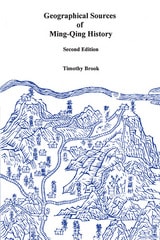
Geographical Sources of Ming-Qing History
Timothy Brook
University of Michigan Press, 2002

Geopolitical Exotica
Tibet in Western ImaginationDibyesh Anand
University of Minnesota Press, 2008
Geopolitical Exotica examines exoticized Western representations of Tibet and Tibetans and the debate over that land’s status with regard to China. Concentrating on specific cultural images of the twentieth century—promulgated by novels, popular films, travelogues, and memoirs—Dibyesh Anand lays bare the strategies by which “Exotica Tibet” and “Tibetanness” have been constructed, and he investigates the impact these constructions have had on those who are being represented.
Although images of Tibet have excited the popular imagination in the West for many years, Geopolitical Exotica is the first book to explore representational practices within the study of international relations. Anand challenges the parochial practices of current mainstream international relations theory and practice, claiming that the discipline remains mostly Western in its orientation. His analysis of Tibet’s status with regard to China scrutinizes the vocabulary afforded by conventional international relations theory and considers issues that until now have been undertheorized in relation to Tibet, including imperialism, history, diaspora, representation, and identity.
In this masterfully synthetic work, Anand establishes that postcoloniality provides new insights into themes of representation and identity and demonstrates how IR as a discipline can meaningfully expand its focus beyond the West.
Dibyesh Anand is a reader in international relations at the University of Westminster, London.
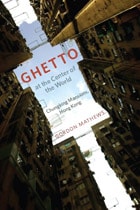
Ghetto at the Center of the World
Chungking Mansions, Hong KongGordon Mathews
University of Chicago Press, 2011
But as Ghetto at the Center of the World shows us, a trip to Chungking Mansions reveals a far less glamorous side of globalization. A world away from the gleaming headquarters of multinational corporations, Chungking Mansions is emblematic of the way globalization actually works for most of the world’s people. Gordon Mathews’s intimate portrayal of the building’s polyethnic residents lays bare their intricate connections to the international circulation of goods, money, and ideas. We come to understand the day-to-day realities of globalization through the stories of entrepreneurs from Africa carting cell phones in their luggage to sell back home and temporary workers from South Asia struggling to earn money to bring to their families. And we see that this so-called ghetto—which inspires fear in many of Hong Kong’s other residents, despite its low crime rate—is not a place of darkness and desperation but a beacon of hope.
Gordon Mathews’s compendium of riveting stories enthralls and instructs in equal measure, making Ghetto at the Center of the World not just a fascinating tour of a singular place but also a peek into the future of life on our shrinking planet.
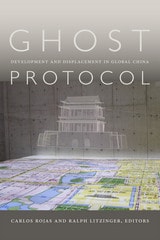
Ghost Protocol
Development and Displacement in Global ChinaCarlos Rojas and Ralph A. Litzinger, editors
Duke University Press, 2016
Contributors. Yomi Braester, Alexander Des Forges, Kabzung, Rachel Leng, Ralph A. Litzinger, Lisa Rofel, Carlos Rojas, Bryan Tilt, Robin Visser, Biao Xiang, Emily T. Yeh

Global Technological Change
From Hard Technology to Soft Technology - Second EditionZhouying Jin
Intellect Books, 2011
This updated second edition of Global Technological Change reconsiders how we make and use technology in the twenty-first century. With human-centered "soft technology" driving machine-based "hard technology" in ever more complex ways, Zhouying Jin provides an understanding of the human dimension of technological advancement. Through a theoretical framework that incorporates elements of both Eastern and Western philosophy, she offers insight into the dynamic between the two as it relates to a variety of technological innovation. More relevant than ever, Global Technological Change continues to challenge assumptions about technology and the gap between the developed and developing countries in the twenty-first century.
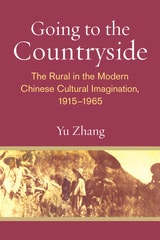
Going to the Countryside
The Rural in the Modern Chinese Cultural Imagination, 1915-1965Yu Zhang
University of Michigan Press, 2020
Since the beginning of the twentieth century, modern Chinese intellectuals, reformers, revolutionaries, leftist journalists, and idealistic youth had often crossed the increasing gap between the city and the countryside, which made the act of “going to the countryside” a distinctively modern experience and a continuous practice in China. Such a spatial crossing eventually culminated in the socialist state program of “down to the villages” movements during the 1960s and 1970s. What, then, was the special significance of “going to the countryside” before that era? Going to the Countryside deals with the cultural representations and practices of this practice between 1915 and 1965, focusing on individual homecoming, rural reconstruction, revolutionary journeys to Yan’an, the revolutionary “going down to the people” as well as going to the frontiers and rural hometowns for socialist construction. As part of the larger discourses of enlightenment, revolution, and socialist industrialization, “going to the countryside” entailed new ways of looking at the world and ordinary people, brought about new experiences of space and time, initiated new means of human communication and interaction, generated new forms of cultural production, revealed a fundamental epistemic shift in modern China, and ultimately created a new aesthetic, social, and political landscape.
As a critical response to the “urban turn” in the past few decades, this book brings the rural back to the central concern of Chinese cultural studies and aims to bridge the city and the countryside as two types of important geographical entities, which have often remained as disparate scholarly subjects of inquiry in the current state of China studies. Chinese modernity has been characterized by a dual process that created problems from the vast gap between the city and the countryside but simultaneously initiated constant efforts to cope with the gap personally, collectively, and institutionally. The process of “crossing” two distinct geographical spaces was often presented as continuous explorations of various ways of establishing the connectivity, interaction, and relationship of these two imagined geographical entities. Going to the Countryside argues that this new body of cultural productions did not merely turn the rural into a constantly changing representational space; most importantly, the rural has been constructed as a distinct modern experiential and aesthetic realm characterized by revolutionary changes in human conceptions and sentiments.

Good-Bye to Old Peking
The Wartime Letters Of U.S. Marine Captain John Seymour Letcher, 1937-1939John Seymour Letcher
Ohio University Press, 1998
Captain Letcher describes the flavor of life in pre-Communist China — the food, servants, cold Peking winters and torrid summers, hunting, and excursions to the major tourist sites.
But his letters also tell of the Japanese slaughter of Chinese troops in the opening days of the Sino-Japanese War. He wrote about life in a city under Japanese occupation and the stirring story of the Chinese guerrillas rebounding from devastating defeat.
These letters and accompanying introduction, preface, and notes, draw attention to the Western experience in a place and time largely overlooked by military historians and modern China specialists.
Goodbye iSlave
A Manifesto for Digital AbolitionJack Linchuan Qiu
University of Illinois Press, 2016
Focusing on the alliance between Apple and the notorious Taiwanese manufacturer Foxconn, Jack Linchuan Qiu examines how corporations and governments everywhere collude to build systems of domination, exploitation, and alienation. His interviews, news analysis, and first-hand observation show the circumstances faced by Foxconn workers--circumstances with vivid parallels in the Atlantic slave trade. Ironically, the fanatic consumption of digital media also creates compulsive free labor that constitutes a form of bondage for the user. Arguing as a digital abolitionist, Qiu draws inspiration from transborder activist groups and incidents of grassroots resistance to make a passionate plea aimed at uniting--and liberating--the forgotten workers who make our twenty-first-century lives possible.
Governance and Foreign Investment in China, India, and Taiwan
Credibility, Flexibility, and International BusinessYu Zheng
University of Michigan Press, 2014
Yu Zheng challenges the idea that democracy is the prerequisite for developing countries to attract foreign direct investment (FDI) and promote economic growth. He examines the relationship between political institutions and FDI through the use of cross-national analysis and case studies of three rapidly growing Asian economies with a focus on the role of microinstitutional “special economic zones” (SEZ).
China’s authoritarian system allows for bold, radical economic reform, but China has attracted FDI largely because of its increasingly credible investment environment as well as its central and local governments’ efforts to overcome constraints on investment. India’s democratic institutions provide more political assurance to foreign investors, but its market became conducive to FDI only when the government adopted more flexible investment policies. Taiwan’s democratic transition shifted its balance of policy credibility and flexibility, which was essential for the nation’s economic takeoff and sustained growth.
Zheng concludes that a more accurate understanding of the relationship between political institutions and FDI comes from careful analysis of institutional arrangements that entail a trade-off between credibility and flexibility of governance.
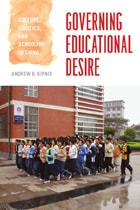
Governing Educational Desire
Culture, Politics, and Schooling in ChinaAndrew B. Kipnis
University of Chicago Press, 2011
Parents in China greatly value higher education for their children, but the intensity and effects of their desire to achieve this goal have largely gone unexamined—until now. Governing Educational Desire explores the cultural, political, and economic origins of Chinese desire for a college education as well as its vast consequences, which include household and national economic priorities, birthrates, ethnic relations, and patterns of governance.
Where does this desire come from? Andrew B. Kipnis approaches this question in four different ways. First, he investigates the role of local context by focusing on family and community dynamics in one Chinese county, Zouping. Then, he widens his scope to examine the provincial and national governmental policies that affect educational desire. Next, he explores how contemporary governing practices were shaped by the Confucian examination system, uncovering the historical forces at work in the present. Finally, he looks for the universal in the local, considering the ways aspects of educational desire in Zouping spread throughout China and beyond. In doing so, Kipnis provides not only an illuminating analysis of education in China but also a thought-provoking reflection on what educational desire can tell us about the relationship between culture and government.
Governing and Ruling
The Political Logic of Taxation in ChinaChangdong Zhang
University of Michigan Press, 2021
Rapid social economic changes, the transition from a planned economy to a market economy, or even economic liberalization can lead to political instability and the collapse of authoritarian regimes. Despite experiencing all of these unprecedented changes in the past forty years, China under the Chinese Communist Party’s leadership has so far successfully transformed and improved both its governance capacity and its ruling capacity. Governing and Ruling: The Political Logic of Taxation in China addresses this regime resilience puzzle by examining the political logic of its taxation system, especially the ways in which taxation helps China handle three governance problems: maneuvering social control, improving agent discipline, and eliciting cooperation. Changdong Zhang argues that a taxation system plays an important role in sustaining authoritarian rule, in China and elsewhere, by combining co-optation and repression functions. The book collects valuable firsthand and secondhand data; studies China’s taxation system, intergovernmental fiscal relationships, composition of fiscal revenue sources, and tax administration; and discusses how each dimension influences the three governance problems.
Grains of Gold
Tales of a Cosmopolitan TravelerGendun Chopel
University of Chicago Press, 2013
Green Communication and China
On Crisis, Care, and Global FuturesJingfang Liu
Michigan State University Press, 2020

Green Politics in China
Environmental Governance and State-Society RelationsJoy Y Zhang and Michael Barr
Pluto Press, 2013
Joy Y. Zhang and Michael Barr explain how environmental problems are transforming Chinese society through new developments such as the struggle for clean air, low-carbon conspiracy theories, new forms of public fund raising and the international tactics of grassroots NGOs. In doing so, they challenge static understandings of state-society relations in China.
Green Politics in China is an illuminating and detailed investigation which provides crucial insights into how China is both changing internally and emerging as a powerful player in global environmental politics.
Greenback Empire
Global Dollar Dominance and the New Cold WarHo-fung Hung
University of Chicago Press, 2026
A critical history of the US dollar’s dominance in the world economy—and what has kept China’s currency from overtaking it.
The dollar is the primary currency of the world economy. With China now rivaling the United States on the world stage, a critical question hangs in the balance: will the Chinese renminbi challenge the status of the dollar and, in doing so, deprive America of its “exorbitant privilege”?
In GreenbackEmpire, Ho-fung Hung offers a powerful account of why, even as American shares of global production, ownership, and trade continue to decline, its currency has retained the support of governments and investors around the world. For six decades, Hung shows, the dominance of the dollar has rested on the security umbrella that the US offers to the world’s wealthiest countries—including oil producers. To these countries, support for the value of the dollar is tantamount to maintaining US protection. While China has become a serious geopolitical and economic rival to the US, the Chinese state’s airtight control of its financial system has delayed the free trading of the renminbi, limiting the currency’s internationalization. In short, the same strategy that engineered growth in China’s economy is restraining its currency's rise in opposition to the dollar. Hung’s Greenback Empire is an essential history of the dollar’s prowess, indispensable for understanding the future of the global monetary system.
Greening China
The Benefits of Trade and Foreign Direct InvestmentKa Zeng and Joshua Eastin
University of Michigan Press, 2011
“The authors make some very critical interventions in this debate and scholars engaged in the environmental ‘pollution haven’ and ‘race to the bottom’ debates will need to take the arguments made here seriously, re-evaluating their own preferred theories to respond to the insightful theorizing and empirically rigorous testing that Zeng and Eastin present in the book.”
—Ronald Mitchell, University of Oregon
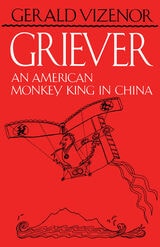
Griever
An American Monkey King in ChinaGerald Vizenor Vizenor
University of Minnesota Press, 1990
Griever de Hocus, accompanied by his rooster, Matteo Ricci, plays havoc with the monolithic institutions of the People’s Republic of China in Vizenor’s inspired retelling of the classic Chinese Journey to the West. Fiction.
Griever de Hocus, accomopanied by his rooster, Matteo Ricci, plays havoc with the monolithic institutions of the People's Republic of China in Vizenor's inspired retelling of the classic Chinese Journey to the West.
"Much of the American experience of the New Post-Cultural Revolution in China is related with devastating comic irony. The sights, sounds, and smells of the land are often unerringly captured by the author's lean, laconic prose." Los Angeles Times
Growing Old in a New China
Transitions in Elder CareRose K. Keimig
Rutgers University Press, 2021

Guide to the Flowers of Western China
Christopher Grey-Wilson and Phillip Cribb
Royal Botanic Gardens, Kew, 2023
Since the publication of the first edition of Guide to the Flowers of Western China in 2011, there have been great strides in knowledge of the flora of China through international collaboration. Many plants included in the first edition have been revisited in the wild, while areas hitherto inaccessible have opened up, if sometimes only temporarily. Great advances in systematic botany have occurred since the publication of the first edition, particularly with the widespread availability of rapid DNA analysis. The result of this has been an influx of new photographs and data, and the need for a second edition of Guide to the Flowers of Western China.