134 books match the query 'Chinese' and 3 start with g

cover of Gastrodiplomacy: Chinese Exclusion and the Ascent of Chinese Restaurants in New York City, 1870–1943

Gastrodiplomacy

Chinese Exclusion and the Ascent of Chinese Restaurants in New York City, 1870–1943

Heather Ruth Lee

University of Chicago Press, 2027

Traces how Chinese migrants challenged racialization and disenfranchisement by establishing Chinese restaurants during the Gilded Age. 

In Gastrodiplomacy, Heather Ruth Lee dives deep into not just the history of Chinese restaurants in early twentieth-century New York City but the delicate, inchoate, and constantly evolving dynamics among their owners, workers, and their predominantly white clientele. Lee argues that the stylistic and capitalist choices made by restaurateurs (“gastrodiplomats”) had outsized political effects on paternalistic white diners (“gastroliberals”) who patronized their establishments, particularly when it came to racial relations in cities that were growing and diversifying. Lee is not starry-eyed—satisfying white tongues and stomachs didn’t lead to an urban utopia of peace, harmony, and brotherhood—but she shows the great and subtle influences of Chinese migrants on American urban space, culture, and metropolitan identity in a defining time.

In Lee’s capable and compelling telling, the Chinese restaurant becomes a distinctive locus for the negotiation of political power, cultural influence, urban identity, and more. Gastrodiplomacy reveals much about burgeoning and increasingly cosmopolitan American cities, as well as about their dynamic relationships with the fluidities of the American character.
[more]
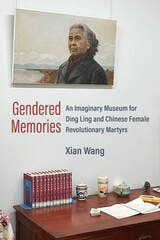
cover of Gendered Memories: An Imaginary Museum for Ding Ling and Chinese Female Revolutionary Martyrs

Gendered Memories

An Imaginary Museum for Ding Ling and Chinese Female Revolutionary Martyrs

Xian Wang

University of Michigan Press, 2025

Gendered Memories: An Imaginary Museum for Ding Ling and Chinese Female Revolutionary Martyrs takes readers on a journey through the lives and legacies of Chinese female revolutionary martyrs, revealing how their sacrifices have been remembered, commemorated, and manipulated throughout history. This innovative book blends historical narratives with personal narratives, creating an “imaginary museum” where the stories of these women are brought to life. Author Xian Wang employs this imaginary museum to create a conceptual space mirroring an actual museum that juxtaposes historical narratives with countermemories of Chinese female revolutionaries, such as the prominent writer Ding Ling. Exploring Ding’s experiences with martyrdom and the commemoration of female revolutionary martyrs associated with her, the book provides a compelling argument that female revolutionary martyrdom reinforces, rather than rejects, the traditional concept of female chastity martyrdom. Narratives that challenge established gender norms, particularly those surrounding female chastity, have often been silenced or overlooked in the collective memory of these female revolutionary martyrs. By delving into these countermemories, Wang provides fresh insights into gendered violence, memories, and politics in modern Chinese literature and culture.
[more]
cover of Getting Around in Chinese: Chinese Skits for Beginners

Getting Around in Chinese

Chinese Skits for Beginners

Hilda H. Tao

University of Michigan Press, 2000

This video-and-text teaching program focuses on building the practical spoken skills of beginning students. The video, produced by the Language Resource Center at the University of Michigan, features thirty skits that cover a wide range of daily activities such as introducing yourself, inviting a friend to the movies, asking for directions, talking about your family, and shopping. The skits provide a model for students to learn and then improvise on. Each segment introduces new vocabulary and reviews grammatical structures. Excellent for improving pronunciation, tones, and listening comprehension, as well as providing an opportunity for beginning students to learn Chinese body language and gestures. The accompanying textbook includes the dialogues in English and pinyin along with character text in both simplified and traditional characters, vocabulary lists with sample sentences to clarify proper use of key expressions, and discussion questions.
[more]