Results by title
206 books match the query 'City Planning & Urban Development' and 5 start with g
Ghosts of Organizations Past
Communities of Organizations as Settings for ChangeDan Ryan
Temple University Press, 2015
In Ghosts of Organizations Past, Dan Ryan asks, “Why are urban communities such hard places to implement community improvement programs?” Looking at New Haven, Connecticut, and a now-defunct program called Fighting Back, which was created to build community coalitions against the abuse of alcohol and other drugs, Ryan shows how the normal properties of organizations generate apparent pathologies. He shows how the “ghosts,” or artifacts, of past organizations, both inhibited and enhanced Fighting Back's chances of success.
Ryan draws on concepts from the study of organizations, social capital, and social networks to re-think questions such as “What kind of thing is a community?” and “Why is it so difficult to build community initiatives out of organizations?” He provides a social organizational explanation for problems familiar to anyone who has been involved in community programs, issues that are usually understood as personal incompetence, turf wars, greed, or corruption.
Ghosts of Organizations Past describes the challenges of using organizations to create change in places in dire need of it.
[more]
Global Urban Policy
A Framework for Analyzing State and SocietyEdited by David Kaufmann and Mara Sidney
University of Michigan Press, 2026
Cities are active policy innovators of global importance, whether responding to climate change, migration, poverty, or health disparities, or aiming to generate growth. Since cities adapt to the needs and interests of global capital, they may implement policies that slight the well-being of everyday residents and the most vulnerable. How cities choose to contribute to a democratic and sustainable future reveals dimensions of political life playing out in society at large.
Global Urban Policy suggests that to understand contemporary societal transformation—and political and policy processes more generally—we need to study the policies that cities create and implement. Going beyond thinking of “urban” as a physical site, the authors show that an urban mode of life is one marked by diversity, complexity, chaos, flexibility, and ongoing change. With eleven empirical case studies, the authors examine issues including housing and urban development, migration, climate change, and crime in cities as varied as Berlin, Medellín, Chicago, Accra, Guangzhou, São Paulo, Mumbai, and Saint Etienne. The studies show how contemporary confrontations between public and private property, power and justice, participation and exclusion, wealth and poverty, and emerging technology and existing economic, social, and political structures take physical form in cities. Global Urban Policy engages with theoretical developments in public policy, urban politics, and urban studies to develop and demonstrate a framework for urban policy analysis.
Global Urban Policy suggests that to understand contemporary societal transformation—and political and policy processes more generally—we need to study the policies that cities create and implement. Going beyond thinking of “urban” as a physical site, the authors show that an urban mode of life is one marked by diversity, complexity, chaos, flexibility, and ongoing change. With eleven empirical case studies, the authors examine issues including housing and urban development, migration, climate change, and crime in cities as varied as Berlin, Medellín, Chicago, Accra, Guangzhou, São Paulo, Mumbai, and Saint Etienne. The studies show how contemporary confrontations between public and private property, power and justice, participation and exclusion, wealth and poverty, and emerging technology and existing economic, social, and political structures take physical form in cities. Global Urban Policy engages with theoretical developments in public policy, urban politics, and urban studies to develop and demonstrate a framework for urban policy analysis.
[more]
Governing American Cities
Inter-Ethnic Coalitions, Competition, and ConflictMichael Jones-Correa
Russell Sage Foundation, 2001
The new immigrants who have poured into the United States over the past thirty years are rapidly changing the political landscape of American cities. Like their predecessors at the turn of the century, recent immigrants have settled overwhelmingly in a few large urban areas, where they receive their first sustained experience with government in this country, including its role in policing, housing, health care, education, and the job market. Governing American Cities brings together the best research from both established and rising scholars to examine the changing demographics of America's cities, the experience of these new immigrants, and their impact on urban politics. Building on the experiences of such large ports of entry as Los Angeles, New York, Miami, Houston, Chicago, and Washington D.C., Governing American Cities addresses important questions about the incorporation of the newest immigrants into American political life. Are the new arrivals joining existing political coalitions or forming new ones? Where competition exists among new and old ethnic and racial groups, what are its characteristics and how can it be harnessed to meet the needs of each group? How do the answers to these questions vary across cities and regions? In one chapter, Peter Kwong uses New York's Chinatown to demonstrate how divisions within immigrant communities can cripple efforts to mobilize immigrants politically. Sociologist Guillermo Grenier uses the relationship between blacks and Latinos in Cuban-American dominated Miami to examine the nature of competition in a city largely controlled by a single ethnic group. And Matthew McKeever takes the 1997 mayoral race in Houston as an example of the importance of inter-ethnic relations in forging a successful political consensus. Other contributors compare the response of cities with different institutional set-ups; some cities have turned to the private sector to help incorporate the new arrivals, while others rely on traditional political channels. Governing American Cities crosses geographic and disciplinary borders to provide an illuminating review of the complex political negotiations taking place between new immigrants and previous residents as cities adjust to the newest ethnic succession. A solution-oriented book, the authors use concrete case studies to help formulate suggestions and strategies, and to highlight the importance of reframing urban issues away from the zero-sum battles of the past.
[more]
Governing New York City
Politics in the MetropolisWallace Sayre
Russell Sage Foundation, 1960
This widely acclaimed study of political power in a metropolitan community portrays the political system in its entirety and in balance—and retains much of the drama, the excitement, and the special style of New York City. It discusses the stakes and rules of the city's politics, and the individuals, groups, and official agencies influencing government action.
[more]
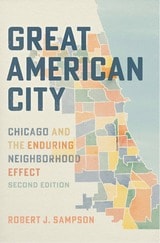
Great American City
Chicago and the Enduring Neighborhood EffectRobert J. Sampson
University of Chicago Press, 2024
Great American City demonstrates the powerfully enduring impact of place.
Based on one of the most ambitious studies in the history of social science, Robert J. Sampson’s Great American City presents the fruits of over a decade’s research to support an argument that we all feel and experience every day: life is decisively shaped by your neighborhood.
Engaging with the streets and neighborhoods of Chicago, Sampson, in this new edition, reflects on local and national changes that have transpired since his book’s initial publication, including a surge in gun violence and novel forms of segregation despite an increase in diversity. New research, much of it a continuation of the influential discoveries in Great American City, has followed, and here, Sampson reflects on its meaning and future directions. Sampson invites readers to see the status of the research initiative that serves as the foundation of the first edition—the Project on Human Development in Chicago Neighborhoods (PHDCN)—and outlines the various ways other scholars have continued his work. Both accessible and incisively thorough, Great American City is a must-read for anyone interested in cutting-edge urban sociology and the study of crime.
[more]