Results by title
212 books match the query 'Colonial Period (1600-1775)' and 2 start with g
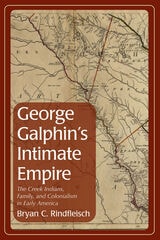
George Galphin's Intimate Empire
The Creek Indians, Family, and Colonialism in Early AmericaBryan C. Rindfleisch
University of Alabama Press, 2019
A revealing saga detailing the economic, familial, and social bonds forged by Indian trader George Galphin in the early American South
A native of Ireland, George Galphin arrived in South Carolina in 1737 and quickly emerged as one of the most proficient deerskin traders in the South. This was due in large part to his marriage to Metawney, a Creek Indian woman from the town of Coweta, who incorporated Galphin into her family and clan, allowing him to establish one of the most profitable merchant companies in North America. As part of his trade operations, Galphin cemented connections with Indigenous and European peoples across the South, while simultaneously securing links to merchants and traders in the British Empire, continental Europe, and beyond.
In George Galphin’s Intimate Empire: The Creek Indians, Family, and Colonialism in Early America, Bryan C. Rindfleisch presents a complex narrative about eighteenth-century cross-cultural relationships. Reconstructing the multilayered bonds forged by Galphin and challenging scholarly understandings of life in the Native South, the American South more broadly, and the Atlantic World, Rindfleisch looks simultaneously at familial, cultural, political, geographical, and commercial ties—examining how eighteenth-century people organized their world, both mentally and physically. He demonstrates how Galphin’s importance emerged through the people with whom he bonded. At their most intimate, Galphin’s multilayered relationships revolved around the Creek, Anglo-French, and African children who comprised his North American family, as well as family and friends on the other side of the Atlantic.
Through extensive research in primary sources, Rindfleisch reconstructs an expansive imperial world that stretches across the American South and reaches into London and includes Indians, Europeans, and Africans who were intimately interconnected and mutually dependent. As a whole, George Galphin’s Intimate Empire provides critical insights into the intensely personal dimensions and cross-cultural contours of the eighteenth-century South and how empire-building and colonialism were, by their very nature, intimate and familial affairs.
[more]
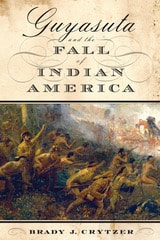
Guyasuta and the Fall of Indian America
Brady J. Crytzer
Westholme Publishing, 2013
A History of the Influential Seneca Leader Who Fought to Maintain Indian Sovereignty During the Bitter Wars for North America
Nearly a century before the United States declared the end of the Indian Wars, the fate of Native Americans was revealed in the battle of Fallen Timbers. In 1794, General Anthony Wayne led the first American army— the Legion of the United States—against a unified Indian force in the Ohio country. The Indians were routed and forced to vacate their lands. It was the last of a series of Indian attempts in the East to retain their sovereignty and foreshadowed what would occur across the rest of the continent. In Guyasuta and the Fall of Indian America, historian Brady J. Crytzer traces how American Indians were affected by the wars leading to American Independence through the life of one of the period’s most influential figures. Born in 1724, Guyasuta is perfectly positioned to understand the emerging political landscape of America in the tumultuous eighteenth century. As a sachem of the vaunted Iroquois Confederacy, for nearly fifty years Guyasuta dedicated his life to the preservation and survival of Indian order in a rapidly changing world, whether it was on the battlefield, in the face of powerful imperial armies, or around a campfire negotiating with his French, British, and American counterparts. Guyasuta was present at many significant events in the century, including George Washington’s expedition to Fort Le Boeuf, the Braddock disaster of 1755, Pontiac’s Rebellion and the Battle of Bushy Run in 1763, and the Battle of Oriskany during the American Revolution. Guyasuta’s involvement in the French and British wars and the American War for Independence were all motivated by a desire to retain relevance for Indian society. It was only upon the birth of the United States of America that Guyasuta finally laid his rifle down and watched as his Indian world crumbled beneath his feet. A broken man, debilitated by alcoholism, he died near Pittsburgh in 1794.
Supported by extensive research and full of compelling drama, Guyasuta and the Fall of Indian America unravels the tangled web of alliances, both white and native, and explains how the world of the American Indians could not survive alongside the emergent United States.
[more]