440 books match the query 'Colonialism & Post-Colonialism' and 8 start with g
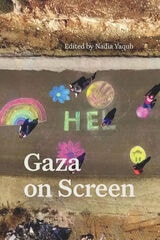
cover of Gaza on Screen

Gaza on Screen

Nadia Yaqub, editor

Duke University Press, 2023

Gaza’s long association with resistance and humanitarian need has generated a complex and ever shifting range of visual material, comprising not just news reports and documentaries, but also essay, experimental, and fiction films, militant videos, and solidarity images. Contributors to Gaza on Screen, who include scholars and Gazan filmmakers, explore the practice, production, and impact of film and videos from and about the Gaza Strip. Conceptualizing screens—both large and small—as tools for mediation that are laden with power, the volume explores Gazan film and video in relation to humanitarianism and human rights, care, community, environment, mobility and confinement, and decolonization. The volume includes visual material ranging from solidarity broadcasts on Lebanese television, mid-twentieth-century British Pathé newsreels, and fiction films to breaking news, visuals of contemporary militant resistance, documentaries, and found footage films, arguing for a visual ecosystem in which differing types of film and video affect and inform each other. Throughout, Gaza on Screen demonstrates that screens shape and sustain relationships between Gaza and the world, and help to sustain the possibility of a different future.

Contributors. Nayrouz Abu Hatoum, Shahd Abusalama, Samirah Alkassim, Basma Alsharif, Hadeel Assali, Azza El-Hassan, Hatim El-Hibri, Mohamed Jabaly, Ahmed Mansour, Arab Nasser, Tarzan Nasser, Kamran Rastegar, Viviane Saglier, Abdelsalam Shehada, Yaron Shemer, Rebecca L. Stein, Helga Tawil-Souri, Shaira Vadasaria, Nadia Yaqub
[more]
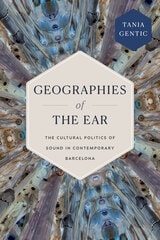
cover of Geographies of the Ear: The Cultural Politics of Sound in Contemporary Barcelona

Geographies of the Ear

The Cultural Politics of Sound in Contemporary Barcelona

Tania Gentic

Duke University Press, 2025
In Geographies of the Ear, Tania Gentic examines the language and soundscape of post-Franco Barcelona to listen for the remnants of a globalized colonial ear. She theorizes “echoic memory” to understand how sound circulates from the past to the present—and from neighborhood to nation to globe—to trace how sonic practices produce and contest modernity, community identity, and democracy. Focusing on migrant and tourist accents, free radio stations, punk music, drag performances, and antigentrification protests, Gentic shows how the underground sounds in Barcelona complicate a modernizing aural imaginary of place. By thinking through the auralities present in literature, fanzines, comic books, documentary films, television and print media, popular music, public protests, and even everyday conversation, Gentic outlines the difficulties of considering the contemporary city as either the product of a monolingual national identity or a lived space easily circumscribed by geographical categories such as North, South, East, or West.
[more]
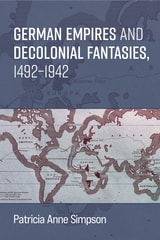
cover of German Empires and Decolonial Fantasies, 1492–1942

German Empires and Decolonial Fantasies, 1492–1942

Patricia Anne Simpson

University of Michigan Press, 2025

2026 DAAD/GSA Prize for the Best Book in History and Social Sciences Winner

German Empires and Decolonial Fantasies, 1492–1942 investigates the ways German-speaking Europe’s cultural narratives reflect histories of entanglement with the colonial world. Drawing from an impressive range of sources, Patricia Anne Simpson decodes the ironclad colonial logic that reproduces and inflects tropes of the conquistador, scientific explorer, and pioneers. She brings them into dialogue with a cast of historical agents who reimagine the cannibal, the enslaved, the conquered, Indigenous interlocutors, and the ungovernable. Throughout, intersectional attributes of race, gender, ethnicity, and religion reconfigure around shades of European whiteness. Individual chapters explore the Hohenzollern legacy in early modernity; debates about sovereignty and enslavement; recruitment literature, prose and fiction about migration and colonization in Africa and the Americas; and colonial memoirs driven by recolonial fantasies after 1918. German Empires and Decolonial Fantasies advances efforts to decolonize the multiple disciplines that intersect the field of German studies, including literary criticism, history, philosophy, art history, and anthropology.

German Empires and Decolonial Fantasies, 1492–1942 draws from a wide range of sources, from a seventeenth-century Brandenburg fort on the coast of Ghana to a novella about a beleaguered colonial administrator in German East Africa, to advance an interdisciplinary discourse at the nexus of colonial narratives and national imaginaries. Through detailed case studies, Simpson argues for the inclusion of voices that pushed back against imperialist expansion or intervention, as well as those historical actors who disputed the supremacy of whiteness and the persuasive power of German-centric national history.

[more]
cover of German Women for Empire, 1884-1945

German Women for Empire, 1884-1945

Lora Wildenthal

Duke University Press, 2001

When Germany annexed colonies in Africa and the Pacific beginning in the 1880s, many German women were enthusiastic. At the same time, however, they found themselves excluded from what they saw as a great nationalistic endeavor. In German Women for Empire, 1884–1945 Lora Wildenthal untangles the varied strands of racism, feminism, and nationalism that thread through German women’s efforts to participate in this episode of overseas colonization.

In confrontation and sometimes cooperation with men over their place in the colonial project, German women launched nationalist and colonialist campaigns for increased settlement and new state policies. Wildenthal analyzes recently accessible Colonial Office archives as well as mission society records, periodicals, women’s memoirs, and fiction to show how these women created niches for themselves in the colonies. They emphasized their unique importance for white racial “purity” and the inculcation of German culture in the family. While pressing for career opportunities for themselves, these women also campaigned against interracial marriage and circulated an image of African and Pacific women as sexually promiscuous and inferior. As Wildenthal discusses, the German colonial imaginary persisted even after the German colonial empire was no longer a reality. The women’s colonial movement continued into the Nazi era, combining with other movements to help turn the racialist thought of the late-nineteenth and early-twentieth centuries into the hierarchical evaluation of German citizens as well as colonial subjects.

Students and scholars of women’s history, modern German history, colonial politics and culture, postcolonial theory, race/ethnicity, and gender will welcome this groundbreaking study.
[more]
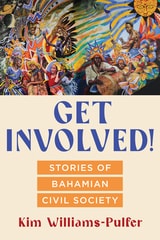
cover of Get Involved!: Stories of Bahamian Civil Society

Get Involved!

Stories of Bahamian Civil Society

Kim Williams-Pulfer

Rutgers University Press, 2024

Philanthropy is commonly depicted as a universal practice and is either valued for supporting community transformation or critiqued for limiting social justice. However, dominant definitions and even popular connotations tend to privilege wealthy Western approaches. Using the Caribbean as a rich site of observance and concentrating on the island nation-state of The Bahamas, Get Involved! uncovers the hidden and under-documented activities of “philanthropy from below,” revealing a broader conception of philanthropy and civil society, especially within Black and other historically marginalized populations. Kim Williams-Pulfer draws on narrative analysis from enslavement to the current post-post-colonial moment, depicting the repertoires and practices of primarily Afro-Bahamians through the stories emerging from history (including the transnational observations of Zora Neale Hurston, social movements, and political and social institution building), the arts (from Junkanoo, literature, and visual practices), to the lived experiences of contemporary civil society leaders. Get Involved! shows the long history and continued significance of civil society and philanthropic engagement in The Bahamas, the circum-Caribbean, and the wider African Diaspora.

Junkanoo is the national cultural festival of The Bahamas.  It fosters a sense of community pride, identity, companionship, spirituality and unity. Watch a video about Junknoo:
https://www.youtube.com/watch?v=tnMpMesNb1Q&t=14s
[more]
cover of Ghostly Past, Capitalist Presence: A Social History of Fear in Colonial Bengal

Ghostly Past, Capitalist Presence

A Social History of Fear in Colonial Bengal

Tithi Bhattacharya

Duke University Press, 2024

In Ghostly Past, Capitalist Presence, Tithi Bhattacharya maps the role that Bengali ghosts and ghost stories played in constituting the modern Indian nation, and the religious ideas seeded therein, as it emerged in dialogue with European science. Bhattacharya introduces readers to the multifarious habits and personalities of Bengal’s traditional ghosts and investigates and mourns their eventual extermination. For Bhattacharya, British colonization marked a transition from the older, multifaith folk world of traditional ghosts to newer and more frightening specters. These "modern" Bengali ghosts, borne out of a new rationality, were homogeneous specters amenable to "scientific" speculation and invoked at séance sessions in elite drawing rooms. Reading literature alongside the colonial archive, Bhattacharya uncovers a new reordering of science and faith from the middle of the nineteenth century. She argues that these shifts cemented the authority of a rising upper-caste colonial elite who expelled the older ghosts in order to recast Hinduism as the conscience of the Indian nation. In so doing, Bhattacharya reveals how capitalism necessarily reshaped Bengal as part of the global colonial project.
[more]
cover of Global Rivalries From the Cold War to Iraq

Global Rivalries From the Cold War to Iraq

Kees van der Pijl

Pluto Press, 2006

This book offers a highly original analysis of world events in the light of the Iraq War. It explores the history and development of relations between major countries in the international community and the impact that successive wars and changes in the global political economy have had on the way states relate to each other today.

Tracing the liberal state structure back to the closing stages of the English Civil War and settlement in North America, it argues that the rise of the English-speaking West has created rivalries between contender states that are never entirely put to rest. With each round of Western expansion, new rivalries are created.

Offering a truly global analysis that covers every area of the world - from Europe and America to China, the Middle East, Latin America and Russia -- he analyses the development of international relations post WWII, and questions whether the neoliberal project and its human rights ideology have collapsed back into authoritarianism under the guise of the 'war on terror'.
[more]
cover of Global White Supremacy: Anti-Blackness and the University as Colonizer

Global White Supremacy

Anti-Blackness and the University as Colonizer

Christopher S. Collins

Rutgers University Press, 2023

Knowledge is more expansive than the boundaries of the Western university model and its claim to be the dominant—or only—rigorous house of knowledge. In the former colonies of Europe (e.g., South Africa, Brazil, and Oceania), the curriculum, statues, architectures, and other aspects of the university demonstrate the way in which it is a fixture in empire maintenance. The trajectory of global White supremacy is deeply historical and contemporary—it is a global, transnational, and imperial phenomenon. White supremacy is sustained through the construction of inferiority and anti-Blackness. The context, history, and perspective offered by Collins, Newman, and Jun should serve as an introduction to the disruption of the ways in which university and academic dispositions have and continue to serve as sites of colonial and White supremacist preservation—as well as sites of resistance. 
 
[more]