Results by title
324 books match the query 'Comparative literature' and 2 start with g

Globalizing Race
Antisemitism and Empire in French and European CultureDorian Bell
Northwestern University Press, 2018
Globalizing Race explores how intersections between French antisemitism and imperialism shaped the development of European racial thought. Ranging from the African misadventures of the antisemitic Marquis de Morès to the Parisian novels and newspapers of late nineteenth-century professional antisemites, Dorian Bell argues that France’s colonial expansion helped antisemitism take its modern, racializing form—and that, conversely, antisemitism influenced the elaboration of the imperial project itself.
Globalizing Race radiates from France to place authors like Guy de Maupassant and Émile Zola into sustained relation with thinkers from across the ideological spectrum, including Hannah Arendt, Friedrich Nietzsche, Frantz Fanon, Karl Marx, Max Horkheimer, and Theodor Adorno. Engaging with what has been called the “spatial turn” in social theory, the book offers new tools for thinking about how racisms interact across space and time. Among these is what Bell calls racial scalarity. Race, Bell argues, did not just become globalized when European racism and antisemitism accompanied imperial penetration into the farthest reaches of the world. Rather, race became most thoroughly global as a method for constructing and negotiating the different scales (national, global, etc.) necessary for the development of imperial capitalism.
As France, Europe, and the world confront a rising tide of Islamophobia, Globalizing Race also brings into fascinating focus how present-day French responses to Muslim antisemitism hark back to older, problematic modes of representing the European colonial periphery.
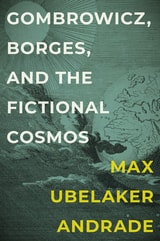
Gombrowicz, Borges, and the Fictional Cosmos
Max Ubelaker Andrade
Bucknell University Press, 2027
Polish author Witold Gombrowicz’s famously chaotic masterpiece, Cosmos, was profoundly influenced by Jorge Luis Borges—particularly by three key stories from Ficciones. Drawing on evidence that Gombrowicz read Ficciones in 1960, as well as handwritten marginalia in Gombrowicz’s copy of Adolfo Bioy Casares’s La invención de Morel, this groundbreaking study argues that Cosmos responded to Borges’s literary transformations of cartography, mathematical combinatorics, and Miguel de Cervantes’s Don Quijote. Along the way, it introduces the concept of “immaterial bibliography” to analyze imaginary texts appearing in literary works. Finally, it examines the tension between Borges’s explicit racism and the ethical and aesthetic vision suggested by his fiction, revealing how rumor, rebellion, and literary inheritance shaped Gombrowicz’s reading of Borges, which in turn influenced the composition of his prizewinning last novel.
Published by Bucknell University Press. Distributed worldwide by Rutgers University Press.