Results by title
77 books match the query 'Congress' and 2 start with g

Gaining Access
Congress and the Farm Lobby, 1919-1981John Mark Hansen
University of Chicago Press, 1991
Through a comprehensive analysis of American agricultural politics in the past half-century, Gaining Access shows when, how, and why interest groups gain and lose influence in the policy deliberations of the United States Congress. By consulting with policy advocates, John Mark Hansen argues, lawmakers offset their uncertainty about the policy stands that will bolster or impede their prospects for reelection. The advocates provide legislators with electoral intelligence in Washington and supportive propaganda at home, earning serious consideration of their policy views in return. From among a multitude of such informants, representatives must choose those they will most closely consult.
With evidence from congressional hearings, personal interviews, oral histories, farm and trade journals, and newspapers, Hansen traces the evolution of farm lobby access in Congress. He chronicles the rise and fall of the American Farm Bureau, the surge and decline of party politics, the incoporation of the commodity lobbies, the exclusion of the consumer lobbies, and the accommodation of urban interests in food stamps.
Brilliantly combining insights from rational choice theory with historical data, Gaining Access is an essential guide for anyone interested in the dynamics of interest group influence.
[more]
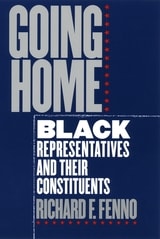
Going Home
Black Representatives and Their ConstituentsRichard F. Fenno
University of Chicago Press, 2003
Thirty years ago there were nine African Americans in the U.S. House of Representatives. Today there are four times that number. In Going Home, the dean of congressional studies, Richard F. Fenno, explores what representation has meant—and means today—to black voters and to the politicians they have elected to office.
Fenno follows the careers of four black representatives—Louis Stokes, Barbara Jordan, Chaka Fattah, and Stephanie Tubbs Jones—from their home districts to the halls of the Capitol. He finds that while these politicians had different visions of how they should represent their districts (in part based on their individual preferences, and in part based on the history of black politics in America), they shared crucial organizational and symbolic connections to their constituents. These connections, which draw on a sense of "linked fates," are ones that only black representatives can provide to black constituents.
His detailed portraits and incisive analyses will be important for anyone interested in the workings of Congress or in black politics.
[more]