Results by title
365 books match the query 'Correspondence' and 8 start with g
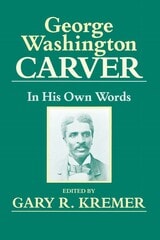
George Washington Carver
In His Own WordsEdited by Gary R. Kremer
University of Missouri Press, 1987
George Washington Carver (1864-1943), best known for his work as a scientist and a botanist, was an anomaly in his own time—a black man praised by white America.
This selection of his letters and other writings reveals both the human side of Carver and the forces that shaped his creative genius. They show us a Carver who was both manipulated and manipulative who had inner tensions and anxieties. But perhaps more than anything else, these letters allow us to see Carver's deep love for his fellow man, whether manifested in his efforts to treat polio victims in the 1930s or in his incredibly intense and emotionally charged friendships that lasted a lifetime.
The editor has furnished commentary between letters to set them in context.
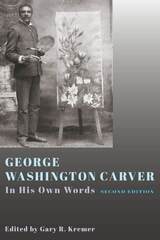
George Washington Carver
In His Own Words, Second EditionGary R. Kremer
University of Missouri Press, 2017
With a new chapter on the oral history interviews Dr. Kremer conducted (several years after publication of the first edition) with people who knew Carver personally, and the addition of newly uncovered documents and a bank of impressive photographs of Carver and some of his friends, this second edition of our classic title commemorates the 75th anniversary of Carver’s death on January 5, 2018.
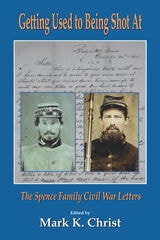
Getting Used to Being Shot At
Mark K. Christ
University of Arkansas Press, 2002
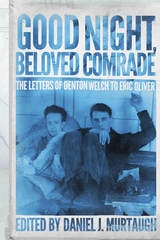
Good Night, Beloved Comrade
The Letters of Denton Welch to Eric OliverEdited and with an introduction by Daniel J. Murtaugh
University of Wisconsin Press, 2017
Though German bombs were ravaging Britain, Welch wrote in his published work about the idyllic landscapes and local people he observed in Kent. There, in 1943, he met and fell in love with Eric Oliver, a handsome, intelligent, but rather insecure "landboy"—an agricultural worker with the wartime Land Army. Oliver would become a companion, comrade, lover, and caretaker during the last six years of Welch's life. All fifty-one letters that Welch wrote to Oliver are collected and annotated here for the first time. They offer a historical record of life amidst the hardship, deprivation, and fear of World War II, and also are a timeless testament of one young man's tender and intimate emotions, his immense courage in adversity, and his continual struggle for love and creative existence.

Good-Bye to Old Peking
The Wartime Letters Of U.S. Marine Captain John Seymour Letcher, 1937-1939John Seymour Letcher
Ohio University Press, 1998
Captain Letcher describes the flavor of life in pre-Communist China — the food, servants, cold Peking winters and torrid summers, hunting, and excursions to the major tourist sites.
But his letters also tell of the Japanese slaughter of Chinese troops in the opening days of the Sino-Japanese War. He wrote about life in a city under Japanese occupation and the stirring story of the Chinese guerrillas rebounding from devastating defeat.
These letters and accompanying introduction, preface, and notes, draw attention to the Western experience in a place and time largely overlooked by military historians and modern China specialists.

Gravity
Selected Letters of Olivia Langdon ClemensEdited by Barbara E. Snedecor
University of Missouri Press, 2023
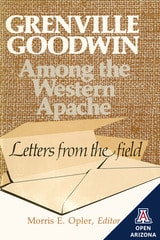
Grenville Goodwin Among the Western Apache
Letters from the FieldEdited by Morris E. Opler
University of Arizona Press, 1973
During this same period, Morris Opler was studying the Chiricahua and Mescalero Apache in New Mexico. In order to exchange information about their studies, Goodwin and Opler began corresponding. Both men were convinced that a long-overdue, systematic comparison of Apachean cultures would yield significant results.
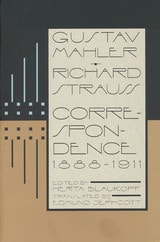
Gustav Mahler--Richard Strauss
Correspondence 1888-1911Gustav Mahler and Richard Strauss
University of Chicago Press, 1984
This first publication of their correspondence, which includes twenty-five previously unknown Strauss letters, offers a portrait of two men who were as antithetical in their musical means and goals as in their temperaments and personalities, but who exercised a strong fascination for one another. These sixty-three letters show both composers advancing in their careers as they battled against adverse conditions in the musical world at the turn of the century. They present Mahler's energetic support of Strauss's Symphonia Domestica, which Mahler conducted in 1904 and, in turn, Strauss's championing of Mahler's music, especially the Second and Third Symphonies.
The correspondence is fully annotated and is supplemented with a major essay by Herta Blaukopf.
"Unfailingly absorbing. . . . An indispensable addition to the literature on these composers."—Norman Del Mar, Times Literary Supplement