Results by title
190 books match the query 'Critical theory' and 4 start with g
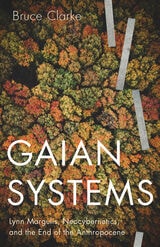
Gaian Systems
Lynn Margulis, Neocybernetics, and the End of the AnthropoceneBruce Clarke
University of Minnesota Press, 2020
A groundbreaking look at Gaia theory’s intersections with neocybernetic systems theory
Often seen as an outlier in science, Gaia has run a long and varied course since its formulation in the 1970s by atmospheric chemist James Lovelock and microbiologist Lynn Margulis. Gaian Systems is a pioneering exploration of the dynamic and complex evolution of Gaia’s many variants, with special attention to Margulis’s foundational role in these developments.
Bruce Clarke assesses the different dialects of systems theory brought to bear on Gaia discourse. Focusing in particular on Margulis’s work—including multiple pieces of her unpublished Gaia correspondence—he shows how her research and that of Lovelock was concurrent and conceptually parallel with the new discourse of self-referential systems that emerged within neocybernetic systems theory. The recent Gaia writings of Donna Haraway, Isabelle Stengers, and Bruno Latour contest its cybernetic status. Clarke engages Latour on the issue of Gaia’s systems description and extends his own systems-theoretical synthesis under what he terms “metabiotic Gaia.” This study illuminates current issues in neighboring theoretical conversations—from biopolitics and the immunitary paradigm to NASA astrobiology and the Anthropocene. Along the way, he points to science fiction as a vehicle of Gaian thought.
Delving into many issues not previously treated in accounts of Gaia, Gaian Systems describes the history of a theory that has the potential to help us survive an environmental crisis of our own making.
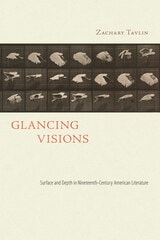
Glancing Visions
Surface and Depth in Nineteenth-Century American LiteratureZachary Tavlin
University of Alabama Press, 2023
How the “glance” rather than the “gaze” in nineteenth-century literature and art anticipates the turn to modernism
The sweeping vantages that typify American landscape painting from the nineteenth century by Thomas Cole and other members of the Hudson River School are often interpreted for their geopolitical connotations, as visual attempts to tame the wild, alleviating fears of a savage frontier through views that subdue the landscape to the eye. But many literary figures of the era display a purposeful disdain for the “possessive gaze,” signaling a preference for subtle glances, often informed by early photography, Impressionism, new techniques in portraiture, and, soon after, the dawn of cinema. The visual subjectivities and contingencies introduced by these media made room for a visual counternarrative, one informed by a mode of seeing that moves fast and lightly across the surface of things.
Tavlin probes Nathaniel Hawthorne’s theory of the imagination at a turning point in the history of photography, when momentary glances take on new narrative potentials. The poetry of Frances Ellen Watkins Harper toggles between gazes and glances, unsettling two competing forms of racialized seeing as they pertain to nineteenth-century Black life and racial hierarchies—the sentimental gaze and the slave trader’s glance—highlighting the life-and-death stakes of looking and looking away. Emily Dickinson’s syntactical oddities and her lifelong process of stitching and unstitching the poems that constitute her corpus all derive from a commitment to immanence associated with animal perception. Tavlin investigates, as well, Henry James’s vexed relationship to painterly Impressionism and William Carlos Williams’s imagist poetics as a response to early cinema’s use of the cut as the basis for a new visual grammar.
Each of these literary artists—via their own distinctive sensibilities and the artistic or technological counterparts that informed them—refuse the authoritative, all-possessive gaze in favor of the glance, a mode of seeing, thinking, and being that made way for the twentieth century’s twist on modernity. Glancing Visions will be of interest to scholars and teachers of American literature and literary history, visual culture, visual theory, aesthetic philosophy, and phenomenology.
Good Vibes Only
Phenomenology and the Biopolitics of Algorithmic LegitimationRobin James
Duke University Press, 2026
Guerrilla Theory
Political Concepts, Critical Digital HumanitiesMatthew Applegate
Northwestern University Press, 2019
In this penetrating study, Matthew Applegate uses the guerrilla to connect popular iterations of digital humanities’ practice to its political rhetoric and infrastructure. By doing so, he reorients DH’s conceptual lexicon around practices of collective becoming, mediated by claims to conflict, antagonism, and democratic will.
Applegate traces Michael Hardt and Antonio Negri’s radical democratic ingresses into network theory, the guerrilla’s role in its discourse, and concerns for the digital humanities’ own invocation of the figure. The book also connects post- and decolonial, feminist, and Marxist iterations of DH praxis to the aesthetic histories of movements such as Latin American Third Cinema and the documentary cinema of the Black Panther Party. Concluding with a meditation on contemporary political modalities inherent in DH’s disciplinary expansion, Guerrilla Theory challenges the current political scope of the digital humanities and thus its future institutional impact.