Results by title
51 books match the query 'Cultural Politics' and 2 start with g

Glorious Battle
The Cultural Politics of Victorian Anglo-CatholicismJohn Shelton Reed
Vanderbilt University Press, 1970
A thorough, compelling, and often amusing account of how the Anglo-Catholic movement in the Victorian Church of England overcame vehement opposition to establish itself as a legitimate form of Anglicanism.
From working class tenements to the pages of Punch to the very Houses of Parliament, the Victorian Anglo-Catholic movement provoked bitter debate and even violence throughout Victorian times. Rotten vegetables were thrown at priests as they spoke from their pulpits, and fistfights broke out among families over whether dear departed ones would be buried "High Church" or "Low Church." In this innovative critical study, John Shelton Reed provides the first comprehensive treatment of the rise, growth, and eventual consolidation of this controversial movement within the Victorian Church of England.
Reed identifies Anglo-Catholicism as a countercultural movement, in some ways not unlike the counterculture of the 1960s, one that championed practices that were symbolic affronts to some of the central values of the dominant middle-class culture of its time. He identifies certain members of the clergy (including John Henry Newman and his circle), the urban poor, women, and youth of both sexes, expecially those who were put off by "muscular Christianity," as those most attracted both to what the movement had to offer and to the shock value it gave to the institutions, classes, and individuals whom they despised. Each of these component groups can be seen as culturally subordinate or in decline--threatened, oppressed, or at least bored by the Victorian values that the movement challenged--and thus ready to hear subversive messages.
A distinguished sociologist, best known as a major interpreter of the American South, Reed here explores new ground with characteristic scholarly acumen, thorough and meticulous research, fresh perspective and insight, and a remarkably engaging literary style. He has uncovered and taken full advantage of a wealth of largely untapped archival material, from the library of Pusey House, Oxford, as well as the Bodleian Library and the British Library, and has fashioned this into a cogent analysis that will enhance understanding of the subject for both scholars and general readers. His conclusions will shed light on many aspects of Victorian studies and the related disciplines of history (social, cultural, political, intellectual, and ecclesiastical), literary studies, women's studies, and the study of social movements. All future work on Anglo-Catholicism and related subjects will be indebted to Reed's Glorious Battle.
This book has been supported by a grant from the National Endowment for the Humanities.
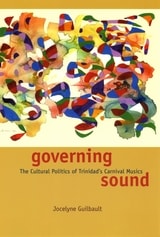
Governing Sound
The Cultural Politics of Trinidad's Carnival MusicsJocelyne Guilbault
University of Chicago Press, 2007
Calypso music is an integral part of Trinidad’s national identity. When, for instance, Franklin D. Roosevelt asked the great Trinidadian musician Roaring Lion where he was from, Lion famously replied “the land of calypso.” But in a nation as diverse as Trinidad, why is it that calypso has emerged as the emblematic music?
In Governing Sound, Jocelyne Guilbault examines the conditions that have enabled calypso to be valorized, contested, and targeted as a field of cultural politics in Trinidad. The prominence of calypso, Guilbault argues, is uniquely enmeshed in projects of governing and in competing imaginations of nation, race, and diaspora. During the colonial regime, the period of national independence, and recent decades of neoliberal transformation, calypso and its musical offshoots have enabled new cultural formations while simultaneously excluding specific social expressions, political articulations, and artistic traditions. Drawing on over a decade of ethnographic work, Guilbault maps the musical journeys of Trinidad’s most prominent musicians and arrangers and explains the distinct ways their musical sensibilities became audibly entangled with modes of governing, audience demands, and market incentives.
Generously illustrated and complete with an accompanying CD, Governing Sound constitutes the most comprehensive study to date of Trinidad’s carnival musics.