158 books match the query 'Cultural assimilation' and 6 start with g
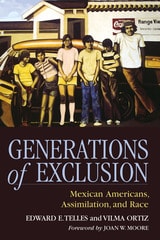
cover of Generations of Exclusion: Mexican-Americans, Assimilation, and Race

Generations of Exclusion

Mexican-Americans, Assimilation, and Race

Edward E. Telles

Russell Sage Foundation, 2008
Foreword by Joan W. Moore When boxes of original files from a 1965 survey of Mexican Americans were discovered behind a dusty bookshelf at UCLA, sociologists Edward Telles and Vilma Ortiz recognized a unique opportunity to examine how the Mexican American experience has evolved over the past four decades.  Telles and Ortiz located and re-interviewed most of the original respondents and many of their children.  Then, they combined the findings of both studies to construct a thirty-five year analysis of Mexican American integration into American society.  Generations of Exclusion is the result of this extraordinary project. Generations of Exclusion measures Mexican American integration across a wide number of dimensions: education, English and Spanish language use, socioeconomic status, intermarriage, residential segregation, ethnic identity, and political participation. The study contains some encouraging findings, but many more that are troubling. Linguistically, Mexican Americans assimilate into mainstream America quite well—by the second generation, nearly all Mexican Americans achieve English proficiency. In many domains, however, the Mexican American story doesn't fit with traditional models of assimilation. The majority of fourth generation Mexican Americans continue to live in Hispanic neighborhoods, marry other Hispanics, and think of themselves as Mexican. And while Mexican Americans make financial strides from the first to the second generation, economic progress halts at the second generation, and poverty rates remain high for later generations. Similarly, educational attainment peaks among second generation children of immigrants, but declines for the third and fourth generations. Telles and Ortiz identify institutional barriers as a major source of Mexican American disadvantage. Chronic under-funding in school systems predominately serving Mexican Americans severely restrains progress. Persistent discrimination, punitive immigration policies, and reliance on cheap Mexican labor in the southwestern states all make integration more difficult. The authors call for providing Mexican American children with the educational opportunities that European immigrants in previous generations enjoyed. The Mexican American trajectory is distinct—but so is the extent to which this group has been excluded from the American mainstream. Most immigration literature today focuses either on the immediate impact of immigration or what is happening to the children of newcomers to this country. Generations of Exclusion shows what has happened to Mexican Americans over four decades. In opening this window onto the past and linking it to recent outcomes, Telles and Ortiz provide a troubling glimpse of what other new immigrant groups may experience in the future.
[more]
cover of Germans in Illinois

Germans in Illinois

Miranda E. Wilkerson and Heather Richmond

Southern Illinois University Press, 2019

This engaging history of one of the largest ethnic groups in Illinois explores the influence and experiences of German immigrants and their descendants from their arrival in the middle of the nineteenth century to their heritage identity today. Coauthors Miranda E. Wilkerson and Heather Richmond examine the primary reasons that Germans came to Illinois and describe how they adapted to life and distinguished themselves through a variety of occupations and community roles.
 
The promise of cheap land and fertile soil in rural areas and emerging industries in cities attracted three major waves of German-speaking immigrants to Illinois in search of freedom and economic opportunities. Before long the state was dotted with German churches, schools, cultural institutions, and place names. German churches served not only as meeting places but also as a means of keeping language and culture alive. Names of Illinois cities and towns of German origin include New Baden, Darmstadt, Bismarck, and Hamburg. In Chicago, many streets, parks, and buildings bear German names, including Altgeld Street, Germania Place, Humboldt Park, and Goethe Elementary School. Some of the most lively and ubiquitous organizations, such as Sängerbunde, or singer societies, and the Turnverein, or Turner Society, also preserved a bit of the Fatherland.
 
Exploring the complex and ever-evolving German American identity in the growing diversity of Illinois’s linguistic and ethnic landscape, this book contextualizes their experiences and corrects widely held assumptions about assimilation and cultural identity. Federal census data, photographs, lively biographical sketches, and newly created maps bring the complex story of German immigration to life. The generously illustrated volume also features detailed notes, suggestions for further reading, and an annotated list of books, journal articles, and other sources of information.
 
[more]
cover of Germans in Michigan

Germans in Michigan

Jeremy W. Kilar

Michigan State University Press, 2002

Germans are the largest ancestral group in Michigan, representing over 2.6 million descendants or 22% of the state’s population. Yet, unlike other immigrant groups, Germans have not retained their linguistic and cultural traditions as part of a distinct ethnic identity. The Bavarian villages of Frankenmuth and Gaylord stand as testaments to the once proud and vigorous German communities that dotted both rural and urban Michigan landscapes. Jeremy W. Kilar explores the social forces that transformed Germans from inward-looking immigrants to citizens in the cultural mainstream. Germans in Michigan is a story of assimilation and renewal and as such reveals the complexities of Americanization and immigration as social forces.

[more]
cover of Good-bye, Piccadilly: BRITISH WAR BRIDES IN AMERICA

Good-bye, Piccadilly

BRITISH WAR BRIDES IN AMERICA

Jenel Virden

University of Illinois Press, 1996

As much of the world tried to return to normal living and working patterns after World War II, some 70,000 British women chose to be uprooted from the homeland they knew and loved. These were British war brides, a uniformly young group who by marrying American servicemen became part of the largest single group of female immigrants to the United States.
    
Though the women came to the U.S. from all parts of the British Isles, they were an unusually homogeneous group, averaging 23 years of age, from working- or lower-middle-class families and having completed mandatory schooling to the age of fourteen. For the most part they emigrated alone and didn't move into an existing immigrant population.
    
Jenel Virden draws on records in the National Archives in Washington, D.C., and the Public Record Office in London, as well as questionnaires and personal interviews, in relating the women's story. Virden finds that the marriages actually took place in spite of, rather than because of, the war.
     
And, while the women benefited from special nonrestrictive immigration legislation--and found public welcomes and a good deal of favorable publicity when they arrived--they also had much in common with other immigrant groups, including a strong sense of ethnic identity.
 
[more]
cover of Growing Up American: How Vietnamese Children Adapt to Life in the United States

Growing Up American

How Vietnamese Children Adapt to Life in the United States

Min Zhou

Russell Sage Foundation, 1998

Vietnamese Americans form a unique segment of the new U.S. immigrant population. Uprooted from their homeland and often thrust into poor urban neighborhoods, these newcomers have nevertheless managed to establish strong communities in a short space of time. Most remarkably, their children often perform at high academic levels despite difficult circumstances. Growing Up American tells the story of Vietnamese children and sheds light on how they are negotiating the difficult passage into American society. Min Zhou and Carl Bankston draw on research and insights from many sources, including the U.S. census, survey data, and their own observations and in-depth interviews. Focusing on the Versailles Village enclave in New Orleans, one of many newly established Vietnamese communities in the United States, the authors examine the complex skein of family, community, and school influences that shape these children's lives. With no ties to existing ethnic communities, Vietnamese refugees had little control over where they were settled and no economic or social networks to plug into. Growing Up American describes the process of building communities that were not simply transplants but distinctive outgrowths of the environment in which the Vietnamese found themselves. Family and social organizations re-formed in new ways, blending economic necessity with cultural tradition. These reconstructed communities create a particular form of social capital that helps disadvantaged families overcome the problems associated with poverty and ghettoization. Outside these enclaves, Vietnamese children faced a daunting school experience due to language difficulties, racial inequality, deteriorating educational services, and exposure to an often adversarial youth subculture. How have the children of Vietnamese refugees managed to overcome these challenges? Growing Up American offers important evidence that community solidarity, cultural values, and a refugee sensibility have provided them with the resources needed to get ahead in American society. Zhou and Bankston also document the price exacted by the process of adaptation, as the struggle to define a personal identity and to decide what it means to be American sometimes leads children into conflict with their tight-knit communities. Growing Up American is the first comprehensive study of the unique experiences of Vietnamese immigrant children. It sets the agenda for future research on second generation immigrants and their entry into American society.
[more]
cover of Gudrun’s Kitchen: Recipes from a Norwegian Family

Gudrun’s Kitchen

Recipes from a Norwegian Family

Irene O. Sandvold

Wisconsin Historical Society Press, 2011

The youngest of a large Norwegian immigrant family, Gudrun Thue Sandvold was known for her beaming blue eyes and a reserve that gave way to laughter whenever she got together with her sisters. She took immeasurable pride in her children and grandchildren, kept an exquisite home, and turned the most mundane occasion into a party. And to all who knew her, Gudrun’s cooking was the stuff of legend.

Part cookbook, part immigrant story, and part family memoir, Gudrun's Kitchen features hundreds of Gudrun Sandvold’s recipes for comfort food from a time when families and friends gathered at the table and connected with one another every single day. But this book is much more than a guide to Norwegian culinary traditions; it is an important contribution to immigrant history and a vital documentation of our nation’s multicultural heritage.

[more]