Results by title
744 books match the query 'Culture' and 10 start with g
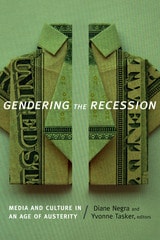
Gendering the Recession
Media and Culture in an Age of AusterityDiane Negra and Yvonne Tasker, eds.
Duke University Press, 2014
Contributors. Sarah Banet-Weiser, Hamilton Carroll, Hannah Hamad, Anikó Imre, Suzanne Leonard, Isabel Molina-Guzmán, Sinéad Molony, Elizabeth Nathanson, Diane Negra, Tim Snelson, Yvonne Tasker, Pamela Thoma

Generous Betrayal
Politics of Culture in the New EuropeUnni Wikan
University of Chicago Press, 2002
Comparing her native Norway to Western Europe and the United States, Wikan focuses on people caught in turmoil, how institutions function, and the ways in which public opinion is shaped and state policies determined. Contradictions arise between policies of respect for minority cultures, welfare, and freedom, but the goal is the same: to create a society committed to both social justice and respect for human rights.
Writing with power and grace, Wikan makes a plea for a renewed moral vitality and human empathy that can pave the way for more effective social policies and create change.
Genre Fission
A New Discourse Practice for Culture StudiesMarleen S. Barr
University of Iowa Press, 2000
Barr expands postmodern assumptions about cultural studies by suggesting that "genre fission" is occurring among discrete literary and cultural "types" of events--mainstream novels, science fiction, historical narratives, film, paintings, and museum displays. For her literary insights, Barr turns her attention to such mainstream authors as Saul Bellow, John Updike, Marge Piercy, and John Barth as well as science fiction writers Ursula Le Guin and Octavia Butler and Hispanic American writers Julia Alvarez, Ana Castillo, and Cristina García, among others.
Barr moves from literary to culture studies by addressing such phenomena from contemporary mass culture as the urban landscapes of New York and Los Angeles, Jackie Kennedy, the Star Trek industry, Lynn Redgrave, Amsterdam's red light district, Lorena Bobbitt, and the Apollo astronauts--to provide only a few of the relevant examples. Thus Genre Fission attains what Barr herself designates (in describing the art of Judy Chicago and Lee Bontecou) as "utopian interweavings of difference," crossing numerous boundaries in order to frame a larger territory for exploration.

Genus Cyclamen
In Science, Cultivation, Art and CultureEdited by Brian Mathew
Royal Botanic Gardens, Kew, 2013
Genus Cyclamen is a celebration of this remarkable plant. Its science-based emphasis on botany and cultivation is complemented by sections on art and history, including twenty-five newly commissioned paintings and over seven hundred photographs. It provides a wealth of information, including taxonomic descriptions, flowering periods, distribution, and habitat, all based on the deep knowledge and practical experiences of the Cyclamen Society and other cyclamen experts. This book will find a wide audience of growers, gardeners, botanists, and enthusiasts, thanks to its all-encompassing coverage of the cyclamen and its informative, but accessible style.
Globalization and Culture
John Tomlinson
University of Chicago Press, 1999
Tomlinson begins this ambitious project by studying the relationship between globalization and contemporary culture, explaining the importance of time and space concerns, cultural imperialism, "deterritorialization," the impact of the media and communication technologies, and the possible growth of more cosmopolitan culture. We come to understand how someone may face unemployment as a result of downsizing decisions made at a company's head office on another continent, or how the food we find in our grocery stores is radically different today from twenty years ago. He discusses the uneven nature of the experience of global modernity in relation to first and third world countries, and concludes that a genuinely cosmopolitan culture is unlikely to emerge unless we respect cultural differences and share a common sense of commitment about the world.
Globalizations and Social Movements
Culture, Power, and the Transnational Public SphereJohn A. Guidry, Michael D. Kennedy, and Mayer N. Zald, Editors
University of Michigan Press, 2000
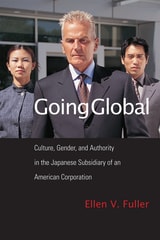
Going Global
Culture, Gender, and Authority in the Japanese Subsidiary of an American CorporationEllen V. Fuller
Temple University Press, 2009
In this intriguing ethnography, Ellen Fuller investigates how issues of gender and identity as they relate to authority are addressed in a globalizing corporate culture. Going Global goes behind the office politics, turf wars and day-to-day workings of a transnational American company in Japan in the late 1990s as employees try to establish a comfortable place within the company.
Fuller looks at how relationships among Asians and between Asians and Americans are tested as individuals are promoted to positions of power and authority. Is there pressure for the Japanese to be more “American” to get ahead in business? Do female employees have to subscribe to certain stereotypes to be promoted or respected? How these American and Japanese workers assess one another raises important questions about international business management and human resources.
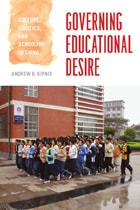
Governing Educational Desire
Culture, Politics, and Schooling in ChinaAndrew B. Kipnis
University of Chicago Press, 2011
Parents in China greatly value higher education for their children, but the intensity and effects of their desire to achieve this goal have largely gone unexamined—until now. Governing Educational Desire explores the cultural, political, and economic origins of Chinese desire for a college education as well as its vast consequences, which include household and national economic priorities, birthrates, ethnic relations, and patterns of governance.
Where does this desire come from? Andrew B. Kipnis approaches this question in four different ways. First, he investigates the role of local context by focusing on family and community dynamics in one Chinese county, Zouping. Then, he widens his scope to examine the provincial and national governmental policies that affect educational desire. Next, he explores how contemporary governing practices were shaped by the Confucian examination system, uncovering the historical forces at work in the present. Finally, he looks for the universal in the local, considering the ways aspects of educational desire in Zouping spread throughout China and beyond. In doing so, Kipnis provides not only an illuminating analysis of education in China but also a thought-provoking reflection on what educational desire can tell us about the relationship between culture and government.

Gramsci, Culture and Anthropology
Kate Crehan
Pluto Press, 2003
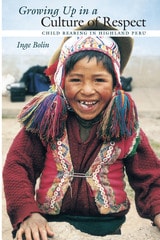
Growing Up in a Culture of Respect
Child Rearing in Highland PeruBy Inge Bolin
University of Texas Press, 2006
Far from the mainstream of society, the pastoral community of Chillihuani in the high Peruvian Andes rears children who are well-adjusted, creative, and curious. They exhibit superior social and cognitive skills and maintain an attitude of respect for all life as they progress smoothly from childhood to adulthood without a troubled adolescence. What makes such child-rearing success even more remarkable is that "childhood" is not recognized as a distinct phase of life. Instead, children assume adult rights and responsibilities at an early age in order to help the community survive in a rugged natural environment and utter material poverty.
This beautifully written ethnography provides the first full account of child-rearing practices in the high Peruvian Andes. Inge Bolin traces children's lives from birth to adulthood and finds truly amazing strategies of child rearing, as well as impressive ways of living that allow teenagers to enjoy the adolescent stage of their lives while contributing significantly to the welfare of their families and the community. Throughout her discussion, Bolin demonstrates that traditional practices of respect, whose roots reach back to pre-Columbian times, are what enable the children of the high Andes to mature into dignified, resilient, and caring adults.