289 books match the query 'Dance' and 6 start with g

cover of Gendering Bodies/Performing Art: Dance and Literature in Early Twentieth-Century British Culture

Gendering Bodies/Performing Art

Dance and Literature in Early Twentieth-Century British Culture

Amy Koritz

University of Michigan Press, 1995
Gendering Bodies / Performing Art is the first book that attempts a conceptual integration of dance and literary history in British culture. It attempts to make visible the role of dance in creating, reinforcing, and challenging developments in aesthetic practice and ideology in which both dance and literature participated. Koritz integrates chapters on dance and dancers- from music hall ballet girls of the 1890s to the prestigious season of Diaghilev's Russian Ballet- with discussions on how major literary figures such as Oscar Wilde, W.B. Yeats, George Bernard Shaw, and T.S. Eliot used dance to further their own aesthetic agendas. In doing so, she provides an illuminating analysis of the connections between literature and dance, and explores the ways in which these two arts actively engaged in cultural processes encompassing both. ". . . provocative and stimulating . . . an invaluable addition to the work that is already available on turn-of-century theater/culture. . . ."--Vivien Gardner, Manchester University "Reaching between the poles of popular music hall and the Ballet Russe, Koritz addresses a series of interrelated, mutually informing discourses in which we overhear the language of the literary community in its accolades and in its outcries. Koritz's book will prove useful to a wide variety of readers; many scholars of English literature will undoubtedly use this book to the fullest, turning to it again and again as a contextual primer for performance issues in their field."--Cheryl Herr, University of Iowa Amy Koritz is Co-Director of the Cultural Studies Program and Assistant Professor of English, Tulane University.
[more]
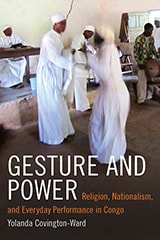
cover of Gesture and Power: Religion, Nationalism, and Everyday Performance in Congo

Gesture and Power

Religion, Nationalism, and Everyday Performance in Congo

Yolanda Covington-Ward

Duke University Press, 2016
In Gesture and Power Yolanda Covington-Ward examines the everyday embodied practices and performances of the BisiKongo people of the Lower Congo to show how their gestures, dances, and spirituality are critical in mobilizing social and political action. Conceiving of the body as the center of analysis, a catalyst for social action, and as a conduit for the social construction of reality, Covington-Ward focuses on specific flash points in the last ninety years of Congo's troubled history, when embodied performance was used to stake political claims, foster dissent, and enforce power. In the 1920s Simon Kimbangu started a Christian prophetic movement based on spirit-induced trembling, which swept through the Lower Congo, subverting Belgian colonial authority. Following independence, dictator Mobutu Sese Seko required citizens to dance and sing nationalist songs daily as a means of maintaining political control. More recently, embodied performance has again stoked reform, as nationalist groups such as Bundu dia Kongo advocate for a return to precolonial religious practices and non-Western gestures such as traditional greetings. In exploring these embodied expressions of Congolese agency, Covington-Ward provides a framework for understanding how embodied practices transmit social values, identities, and cultural history throughout Africa and the diaspora.
 
[more]
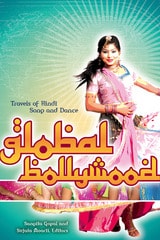
cover of Global Bollywood: Travels of Hindi Song and Dance

Global Bollywood

Travels of Hindi Song and Dance

Sangita Gopal

University of Minnesota Press, 2008

Bollywood movies and their signature song-and-dance spectacles are an aesthetic familiar to people around the world, and Bollywood music now provides the rhythm for ads marketing goods such as computers and a beat for remixes and underground bands. These musical numbers have inspired scenes in Western films such as Vanity Fair and Moulin Rouge.

Global Bollywood shows how this currency in popular culture and among diasporic communities marks only the latest phase of the genre’s world travels. This interdisciplinary collection describes the many roots and routes of the Bollywood song-and-dance spectacle. Examining the reception of Bollywood music in places as diverse as Indonesia and Israel, the essays offer a stimulating redefinition of globalization, highlighting the cultural influence of Hindi film music from its origins early in the twentieth century to today.

Contributors: Walter Armbrust, Oxford U; Anustup Basu, U of Illinois, Urbana-Champaign; Nilanjana Bhattacharjya, Colorado College; Edward K. Chan, Kennesaw State U; Bettina David, Hamburg U; Rajinder Dudrah, U of Manchester; Shanti Kumar, U of Texas, Austin; Monika Mehta, Binghamton U; Anna Morcom, Royal Holloway College; Ronie Parciack, Tel Aviv U; Biswarup Sen, U of Oregon; Sangita Shrestova; Richard Zumkhawala-Cook, Shippensburg U.

Sangita Gopal is assistant professor of English at the University of Oregon. Sujata Moorti is professor of women’s and gender studies at Middlebury College.
[more]
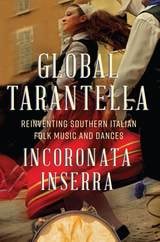
cover of Global Tarantella: Reinventing Southern Italian Folk Music and Dances

Global Tarantella

Reinventing Southern Italian Folk Music and Dances

Incoronata Inserra

University of Illinois Press, 2017
Tarantella, a genre of Southern Italian folk music and dance, is an international phenomenon--seen and heard in popular festivals, performed across the Italian diaspora, even adapted for New Age spiritual practices. The boom in popularity has diversified tarantella in practice while setting it within a host of new, unexpected contexts. Incoronata Inserra ventures into the history, global circulation, and recontextualization of this fascinating genre. Examining tarantella's changing image and role among Italians and Italian Americans, Inserra illuminates how factors like tourism, translation, and world music venues have shifted the ethics of place embedded in the tarantella cultural tradition. Once rural, religious, and rooted, tarantella now thrives in settings urban, secular, migrant, and ethnic. Inserra reveals how the genre's changing dynamics contribute to reimagining Southern Italian identity. At the same time, they translate tarantella into a different kind of performance that serves new social and cultural groups and purposes. Indeed, as Inserra shows, tarantella's global growth promotes a reassessment of gender relations in the Italian South and helps create space for Italian and Italian-American women to reclaim gendered aspects of the genre.
[more]
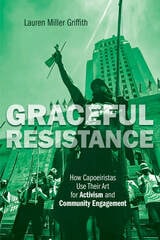
cover of Graceful Resistance: How Capoeiristas Use Their Art for Activism and Community Engagement

Graceful Resistance

How Capoeiristas Use Their Art for Activism and Community Engagement

Lauren Miller Griffith

University of Illinois Press, 2023

Capoeira began as a martial art developed by enslaved Afro-Brazilians. Today, the practice incorporates song, dance, acrobatics, and theatrical improvisation—and leads many participants into activism.

Lauren Miller Griffith’s extensive participant observation with multiple capoeira groups informs her ethnography of capoeiristas--both individuals and groups--in the United States. Griffith follows practitioners beyond their physical training into social justice activities that illuminate capoeira’s strong connection to resistance and subversion. As both individuals and communities of capoeiristas, participants march against racial discrimination, celebrate Martin Luther King Jr. Day and Juneteenth, organize professional clothing drives for job seekers, and pursue economic and environmental justice in their neighborhoods. For these people, capoeira becomes a type of serious leisure that contributes to personal growth, a sense of belonging, and an overall sense of self, while also imposing duties and obligations.

An innovative look at capoeira in America, Graceful Resistance reveals how the practicing of an art can catalyze action and transform communities.

[more]
cover of Grounding Practice: Dancing Haiti on Tè Glise

Grounding Practice

Dancing Haiti on Tè Glise

Dasha A. Chapman

University of Michigan Press, 2027

Grounding Practice: Dancing Haiti on Tè Glise tracks the responsive physical techniques Haitian dancers devised for navigating precarity, making place, and igniting repair in the decade following the 2010 earthquake. Via the concept “grounding practice,” which connotes the powerful community building and placemaking made possible by the teaching and practice of Haitian folkloric dance, this interdisciplinary study illustrates how the embodied labor of revitalizing traditions took on increasing relevance as vital reparative worldmaking amidst instability, or tè glise–—Haitian Creole for sliding land or slippery ground.

The dancers in Grounding Practice regenerate understandings of Haitian dance’s potential for fomenting decolonial consciousness, meaningfully sustaining African-derived culture, birthing new social relations, activating the queer potentials of tradition, and ultimately making place. Through ethnography and vivid descriptions, Dasha A. Chapman’s attention to embodied knowledge illuminates how movement practice operates as a site of theorization—wherein not just subjectivity, but also concepts of sovereignty, relation, and futurity, are articulated through the body. Paying homage to important forebears yet moving us beyond static narratives, this study brings our understanding of Haitian dance—and Haiti—through expansive landscapes into the contemporary.

[more]