Results by title
176 books match the query 'Deaf' and 4 start with g
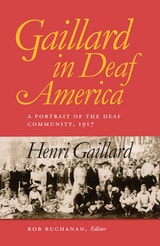
Gaillard in Deaf America
A Portrait of the Deaf Community, 1917, Henri GaillardHenri Gaillard
Gallaudet University Press, 2002
In 1917, Henri Gaillard led a delegation of deaf French men to the United States for the centennial celebration of the American School for the Deaf (ASD). The oldest school for deaf students in America, ASD had been cofounded by renowned deaf French teacher Laurent Clerc, thus inspiring Gaillard’s invitation. Gaillard visited deaf people everywhere he went and recorded his impressions in a detailed journal. His essays present a sharply focused portrait of the many facets of Deaf America during a pivotal year in its history.
Gaillard crossed the Atlantic only a few weeks after the United States entered World War I. In his writings, he reports the efforts of American deaf leaders to secure employment for deaf workers to support the war effort. He also witnesses spirited speeches at the National Association of the Deaf convention decrying the replacement of sign language by oral education. Gaillard also depicts the many local institutions established by deaf Americans, such as Philadelphia’s All Souls Church, founded in 1888 by the country’s first ordained deaf pastor, and the many deaf clubs established by the first wave of deaf college graduates in their communities. His journal stands as a unique chronicle of the American Deaf community during a remarkable era of transition.

Get Your Elbow Off the Horn
Stories through the YearsJack R. Gannon
Gallaudet University Press, 2020
Many of his recollections are brief sketches that reveal much about being Deaf—and about being human. From reflecting on the difficult choices parents must make for their children, to recounting awkward communication exchanges, Gannon marries good humor with a poignant advocacy for sign language rights. His stories preserve and share Deaf American life and culture as he experienced it.

God Knows His Name
The True Story of John Doe No. 24David Bakke. Foreword by Mary Chapin Carpenter
Southern Illinois University Press, 2000
Police found John Doe No. 24 in the early morning hours of October 11, 1945, in Jacksonville, Illinois. Unable to communicate, the deaf and mute teenager was labeled “feeble minded” and sentenced by a judge to the nightmarish jumble of the Lincoln State School and Colony in Jacksonville. He remained in the Illinois mental health care system for over thirty years and died at the Sharon Oaks Nursing Home in Peoria on November 28, 1993.
Deaf, mute, and later blind, the young black man survived institutionalized hell: beatings, hunger, overcrowding, and the dehumanizing treatment that characterized state institutions through the 1950s. In spite of his environment, he made friends, took on responsibilities, and developed a sense of humor. People who knew him found him remarkable.
Award-winning journalist Dave Bakke reconstructs the life of John Doe No. 24 through research into a half-century of the state mental health system, personal interviews with people who knew him at various points during his life, and sixteen black-and-white illustrations. After reading a story about John Doe in the New York Times, acclaimed singer-songwriter Mary Chapin Carpenter wrote and recorded “John Doe No. 24” and purchased a headstone for his unmarked grave. She contributes a foreword to this book.
As death approached for the man known only as John Doe No. 24, his one-time nurse Donna Romine reflected sadly on his mystery. “Ah, well,” she said, “God knows his name.”
Guidelines for Multilingual Deaf Education Teacher Preparation Programs
Christopher Kurz
Gallaudet University Press, 2021
The key goals and anticipated outcomes of this volume are:
- to increase the number of multilingual Deaf education teacher preparation programs;
- to increase the number of fluent language and cultural models for Deaf children in varying educational environments;
- to increase the number of high quality teachers with competencies in multilingual strategies;
- to increase collaboration between teacher training programs; and
- to increase research and professional development focused in multilingual pedagogies.