Results by title
105 books match the query 'Deconstruction' and 4 start with g
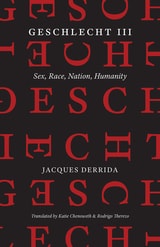
Geschlecht III
Sex, Race, Nation, HumanityJacques Derrida
University of Chicago Press, 2020
Amid new revelations about Heidegger’s anti-Semitism and the contemporary context of nationalist resurgence, this third piece of the Geschlecht series is timelier and more necessary than ever. Meticulously edited and expertly translated, this volume brings Derrida’s mysterious and much awaited text to light.
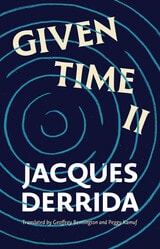
Given Time II
Jacques Derrida
University of Chicago Press, 2026
The long-awaited conclusion to Derrida’s seminar on the gift and time.
In 1991, Jacques Derrida published the first half of a seminar delivered from 1978 to 1979 on gifts and time, but the second installment (though expected) was not completed in his lifetime. Given Time II completes the seminar with eight sessions that showcase Derrida’s most advanced work on the problematic of the gift in Heidegger, with deep dives into some of the most difficult texts in the Heideggerian corpus, including “The Origin of the Work of Art,” “The Thing,” and “On Time and Being.”
Beyond Heidegger, Derrida engages Claude Lévi-Strauss, Marcel Mauss, Maurice Blanchot, Jacques Lacan, and others on the act of giving and receiving, the sacrificial gift, and more. Throughout, Derrida identifies a paradox of gift giving: for the gift to be received as a gift, it must not appear as such, since gifts often involve a cycle of debt and repayment. Given Time II is a uniquely Derridean treatment of an important subject in the work of Heidegger and beyond.
Given Time
I. Counterfeit MoneyJacques Derrida
University of Chicago Press, 1992
Derrida reads the relation of time to gift through a number of texts: Heidegger's Time and Being, Mauss's The Gift, as well as essays by Benveniste and Levi-Strauss that assume Mauss's legacy. It is, however, a short tale by Baudelaire, "Counterfeit Money," that guides Derrida's analyses throughout. At stake in his reading of the tale, to which the second half of this book is devoted, are the conditions of gift and forgiveness as essentially bound up with the movement of dissemination, a concept that Derrida has been working out for many years.
For both readers of Baudelaire and students of literary theory, this work will prove indispensable.
Given Time
I. Counterfeit MoneyJacques Derrida
University of Chicago Press, 1992
Derrida reads the relation of time to gift through a number of texts: Heidegger's Time and Being, Mauss's The Gift, as well as essays by Benveniste and Levi-Strauss that assume Mauss's legacy. It is, however, a short tale by Baudelaire, "Counterfeit Money," that guides Derrida's analyses throughout. At stake in his reading of the tale, to which the second half of this book is devoted, are the conditions of gift and forgiveness as essentially bound up with the movement of dissemination, a concept that Derrida has been working out for many years.
For both readers of Baudelaire and students of literary theory, this work will prove indispensable.