Results by title
59 books match the query 'Detective and mystery stories, American' and 2 start with g

Good Knights
Ralph McInerny
St. Augustine's Press, 2010
These stories represent an intermediate stage in the evolution of the Knight brothers in Ralph McInerny’s fiction. In The Noonday Devil, Phil, in his capacity as private detective, was fairly close to the action, but by no means the major character. Roger, his blimp-sized brother, entered obliquely into the story but ended by starring in the finale.
Readers liked them, in particular Roger. So McInerny brought them back in Easeful Death, where they are far more central and Roger occupies much space, physically and narratively. And so it might have remained. When McInerny was asked to do a Notre Dame series of mysteries, he decided to bring Roger to South Bend as the Huneker Professor of Catholic Studies, accompanied by the semi-retired Phil, who has the full menu of Notre Dame sports to keep him occupied. Prior to starting the series, McInerny wanted to reacquaint himself with the Knights and hit upon the idea of doing a series of Knight brothers stories in Crisis, a magazine he founded with Michael Novak. Before moving them to South Bend, he wanted to see them in action, working out of New York, always driving in the specially designed van, never flying, to the cities were their client lived.
Good Knights is the result of putting these eight Knights brothers’ stories together. Call them finger exercises in character. The response to them in the magazine was gratifying, and with them behind him, McInerny launched the Notre Dame series, with On This Rockne in 1996, thirteen years and thirteen novels ago. But the origins of that successful series is seen here.
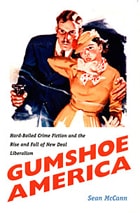
Gumshoe America
Hard-Boiled Crime Fiction and the Rise and Fall of New Deal LiberalismSean McCann
Duke University Press, 2000
Gumshoe America traces the way those problems surfaced in hard-boiled crime fiction from the1920s through the 1960s. Beginning by using a forum on the KKK in the pulp magazine Black Mask to describe both the economic and political culture of pulp fiction in the early twenties, McCann locates the origins of the hard-boiled crime story in the genre’s conflict with the racist antiliberalism prominent at the time. Turning his focus to Dashiell Hammett’s career, McCann shows how Hammett’s writings in the late 1920s and early 1930s moved detective fiction away from its founding fables of social compact to the cultural alienation triggered by a burgeoning administrative state. He then examines how Raymond Chandler’s fiction, unlike Hammett’s, idealized sentimental fraternity, echoing the communitarian appeals of the late New Deal. Two of the first crime writers to publish original fiction in paperback—Jim Thompson and Charles Willeford—are examined next in juxtaposition to the popularity enjoyed by their contemporaries Mickey Spillane and Ross Macdonald. The stories of the former two, claims McCann, portray the decline of the New Deal and the emergence of the rights-based liberalism of the postwar years and reveal new attitudes toward government: individual alienation, frustration with bureaucratic institutions, and dissatisfaction with the growing vision of America as a meritocracy. Before concluding, McCann turns to the work of Chester Himes, who, in producing revolutionary hard-boiled novels, used the genre to explore the changing political significance of race that accompanied the rise of the Civil Rights movement in the late 1950s and the 1960s.
Combining a striking reinterpretation of the hard-boiled crime story with a fresh view of the political complications and cultural legacies of the New Deal, Gumshoe America will interest students and fans of the genre, and scholars of American history, culture, and government.