Results by title
54 books match the query 'Diaspora' and 5 start with g
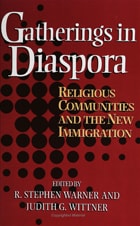
Gatherings In Diaspora
Religious Communities and the New Immigrationedited by Stephen R. Warner and Judith G. Wittner
Temple University Press, 1998
This book explores and analyzes the diverse religious communities of post-1965 diasporas: Christians, Hews, Muslims, Hindus, Rastafarians, and practitioners of Vodou, from countries such as China, Guatemala, Haiti, India, Iran, Jamaica, Korea, and Mexico. The contributors explore how, to a greater or lesser extent, immigrants and their offspring adapt their religious institutions to American conditions, often interacting with religious communities already established. The religious institutions they build, adapt, remodel, and adopt become worlds unto themselves, congregations, where new relations are forged within the community -- between men and women, parents and children, recent arrival and those longer settled.
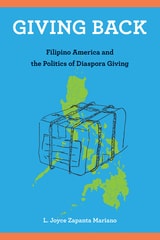
Giving Back
Filipino America and the Politics of Diaspora GivingL. Joyce Zapanta Mariano
Temple University Press, 2021
Many Filipino Americans feel obligated to give charitably to their families, their communities, or social development projects and organizations back home. Their contributions provide relief to poor or vulnerable Filipinos, and address the forces that maintain poverty, vulnerability, and exploitative relationships in the Philippines. This philanthropy is a result of both economic globalization and the migration of Filipino professionals to the United States. But it is also central to the moral economies of Filipino migration, immigration, and diasporic return. Giving-related practices and concerns—and the bonds maintained through giving—infuse what it means to be Filipino in America.
Giving Back shows how integral this system is for understanding Filipino diaspora formation. Joyce Mariano “follows the money” to investigate the cultural, social, economic, and political conditions of diaspora giving. She takes an interdisciplinary approach to reveal how power operates through this charity and the ways the global economic and cultural dimensions of this practice reinforce racial subordination and neocolonialism. Giving Back explores how this charity can stabilize overlapping systems of inequality as well as the contradictions of corporate social responsibility programs in diaspora.
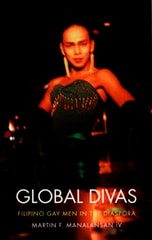
Global Divas
Filipino Gay Men in the DiasporaMartin F. Manalansan IV
Duke University Press, 2003
Manalansan locates diasporic, transnational, and global dimensions of gay and other queer identities within a framework of quotidian struggles ranging from everyday domesticity to public engagements with racialized and gendered images to life-threatening situations involving AIDS. He reveals the gritty, mundane, and often contradictory deeds and utterances of Filipino gay men as key elements of queer globalization and transnationalism. Through careful and sensitive analysis of these men’s lives and rituals, he demonstrates that transnational gay identity is not merely a consumable product or lifestyle, but rather a pivotal element in the multiple, shifting relationships that queer immigrants of color mobilize as they confront the tribulations of a changing world.
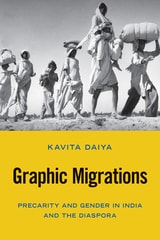
Graphic Migrations
Precarity and Gender in India and the DiasporaKavita Daiya
Temple University Press, 2020
In Graphic Migrations, Kavita Daiya provides a literary and cultural archive of refugee stories and experiences to respond to the question “What is created?” after decolonization and the 1947 Partition of India. She explores how stories of Partition migrations shape and influence the political and cultural imagination of secularism and contribute to gendered citizenship for South Asians in India and its diasporas.
Daiya analyzes modern literature, Bollywood films, Margaret Bourke-White’s photography, advertising, and print culture to show how they memorialize or erase refugee experiences. She also uses oral testimonies of Partition refugees from Hong Kong, South Asia, and North America to draw out the tensions of the nation-state, ethnic discrimination, and religious difference. Employing both Critical Refugee Studies and Feminist Postcolonial Studies frameworks, Daiya traces the cultural, affective, and political legacies of Partition migrations.
The precarity generated by modern migration and expressed through public culture prompts a rethinking of how dominant media represents gendered migrants and refugees. Graphic Migrations demands that we redraw the boundaries of how we tell the story of modern world history and the intricately interwoven, intimate production of statelessness and citizenship across the world’s communities.

Growing Up in the Gutter
Diaspora and ComicsRicardo Quintana-Vallejo; Foreword by Frederick Luis Aldama
University of Arizona Press, 2024
While the most traditional iteration of the bildungsroman—the coming-of-age story—follows middle-class male heroes who forge their identities in a process of complex introspection, contemporary graphic coming-of-age narratives represent formative processes that fit into, resist, or even disregard narratives of socialization under capitalism, of citizenship, and of nationhood.
Quintana-Vallejo delves into several important themes: how the coming-of-age genre can be used to study adulthood, how displacement and international or global heritage are fundamental experiences, how multidiasporic approaches foreground lived experiences, and how queerness opens narratives of development to the study of adulthood as fundamentally diverse and nonconforming to social norms. Quintana-Vallejo shows how openness enables belonging among chosen families and, perhaps most importantly, freedom to disidentify. And, finally, how contemporary authors writing for the instruction of BIPOC children (and children otherwise affected by diaspora and displacement) use the didactic power of the coming-of-age genre, combined with the hybrid language of graphic narratives, to teach difficult topics in accessible ways.