Results by title
106 books match the query 'Dictionaries' and 3 start with g
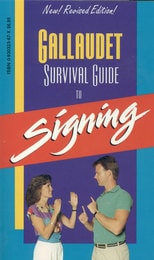
Gallaudet Survival Guide to Signing
Leonard Lane
Gallaudet University Press, 1987
Now the standard sign language book for more than 200,000 people has been completely revised and updated! American Sign Language (ASL) experts updated this brand-new edition to present more than 500 of the most current ASL signs in use today, including cross-references for multiple words expressed by a single sign. The Gallaudet Survival Guide to Signing also offers tips on ASL usage, plus the American Manual Alphabet and manual numbers.
[more]
Glossary of Typesetting Terms
Richard Eckersley, Richard Angstadt, Charles M. Ellertson, and Richard Hendel
University of Chicago Press, 1994
Glossary of Typesetting Terms is an up-to-date reference book on the craft of typography. It organizes a dictionary and a style guide into a single, one-stop resource.
Prepared by a team of leading professionals—a designer, an editor, compositors, and production managers—this glossary will be valuable to anyone who works in publishing or printing for its definitions of typographical terms and concise treatment of typographical style.
The glossary adds important details to discussions of typography that are covered more generally in editorial style guides such as The Chicago Manual of Style. It is indispensable to anyone who prepares text for a living, including those who implement their own typesetting decisions with the aid of word-processing and page-layout software.
This manual furnishes a common technical vocabulary for specialists and nonspecialists alike. More than 900 entries provide up-to-date meanings for traditional terms like kerning,bleed, and thumbnail and definitions of new phrases like global search and replace,H & J (hyphenation and justification), and idiot file that have been developed to describe the role of computer technology in typesetting.
Eight appendixes offer additional guidance. The house style sheets of a major typesetter provide a sample checklist of items that affect the way in which words are composed into professional-quality type. Other appendixes cover families of type, the parts of a book, diagrams of the parts of a letter, coding and marking a manuscript in the precise language of typesetters, writing specifications for tables, proofreaders’ marks, and special characters.
No other reference book makes the vocabulary and practices of contemporary typesetting so accessible.
[more]

Greek Grammar of the New Testament and Other Early Christian Literature
Edited by Robert W. Funk
University of Chicago Press, 1961
The fully up-to-date classic reference and guide for anyone studying the New Testament in the original Greek
This work was created by Friedrich Blass, professor of classical philology at the University of Halle-Wittenberg, and was continued after his death by Albert Debrunner, professor of Indo-European and classical philology at the University of Bern until his retirement in 1954. The grammar has passed through ten editions from 1896 to 1960.
Robert W. Funk, in translating this long-established classic, has also revised it and, in doing so, has incorporated the notes which Professor Debrunner had prepared for a new German edition on which he was working at the time of his death in 1958. Dr. Funk has also had the co-operation of leading British, Continental, and American scholars. The translation places in the hands of English-speaking students a book that belongs in their libraries and in the libraries of every theologian, philologist and pastor alongside the Gingrich-Danker Greek-English Lexicon.
This grammar sets the Greek of the New Testament in the context of Hellenistic Greek and compares and contrasts it with the classical norms. It relates to the New Testament language to its Semitic background, to Greek dialects, and to Latin and has been kept fully abreast of latest developments and manuscript discoveries. It is at no point exclusively dependent on modern editions of the Greek New Testament text but considers variant readings wherever they are significant. It is designed to compress the greatest amount of information into the smallest amount of space consistent with clarity. There are subsections discussing difficult or disputed points and copious citations of primary texts in addition to generous bibliographies for those who wish to pursue specific items further.
[more]