Results by title
281 books match the query 'Disease & Health Issues' and 6 start with g
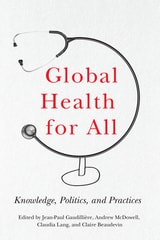
Global Health for All
Knowledge, Politics, and PracticesJean-Paul Gaudillière
Rutgers University Press, 2022
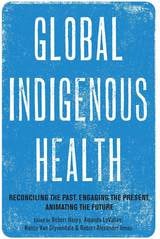
Global Indigenous Health
Reconciling the Past, Engaging the Present, Animating the FutureEdited by Robert Henry, Amanda LaVallee, Nancy Van Styvendale, and Robert Alexander Innes
University of Arizona Press, 2018
Building on Indigenous knowledge systems of health and critical decolonial theories, the volume’s contributors—who are academic and community researchers from Canada, the United States, Sweden, and New Zealand—weave a narrative to explore issues of Indigenous health within four broad themes: ethics and history, environmental and ecological health, impacts of colonial violence on kinship, and Indigenous knowledge and health activism. Chapters also explore how Indigenous peoples are responding to both the health crises in their communities and the ways for non-Indigenous people to engage in building positive health outcomes with Indigenous communities.
Global Indigenous Health is unique and timely as it deals with the historical and ongoing traumas associated with colonization and colonialism, understanding Indigenous concepts of health and healing, and ways of moving forward for health equity.
Contributors:
Sharon Leslie Acoose
Seth Adema
Peter Butt
John E. Charlton
Colleen Anne Dell
Debra Dell
Paul DePasquale
Judy A. Dow
C. Randy Duncan
Carina Fiedeldey-Van Dijk
Barbara Fornssler
Chelsea Gabel
Eleanor Louise Hadden
Laura Hall
Robert Henry
Carol Hopkins
Robert Alexander Innes
Simon Lambert
Amanda LaVallee
Josh Levy
Rachel Loewen Walker
David B. MacDonald
Peter Menzies
Christopher Mushquash
David Mykota
Nancy Poole
Alicia Powell
Ioana Radu
Margo Rowan
Mark F. Ruml
Caroline L. Tait
Lisa Tatonetti
Margaretha Uttjek
Nancy Van Styvendale

God's Businessmen
Entrepreneurial Evangelicals in Depression and WarSarah Ruth Hammond
University of Chicago Press, 2017
The evangelical embrace of conservatism is a familiar feature of the contemporary political landscape. What’s less well-known, however, is that the connection predates the Reagan revolution, going all the way back to the Depression and World War II. Evangelical businessmen at the time were quite active in opposing the New Deal—on both theological and economic grounds—and in doing so claimed a place alongside other conservatives in the public sphere. Like previous generations of devout laymen, they self-consciously merged their religious and business lives, financing and organizing evangelical causes with the kind of visionary pragmatism that they practiced in the boardroom.
In God’s Businessmen, Sarah Ruth Hammond explores not only these men’s personal trajectories but also those of the service clubs and other institutions that, like them, believed that businessmen were God’s instrument for the Christianization of the world. Hammond presents a capacious portrait of the relationship between the evangelical business community and the New Deal—and in doing so makes important contributions to American religious history, business history, and the history of the American state.
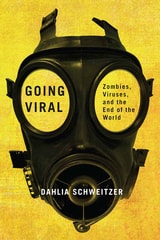
Going Viral
Zombies, Viruses, and the End of the WorldSchweitzer, Dahlia
Rutgers University Press, 2018
In Going Viral, Dahlia Schweitzer probes outbreak narratives in film, television, and a variety of other media, putting them in conversation with rhetoric from government authorities and news organizations that have capitalized on public fears about our changing world. She identifies three distinct types of outbreak narrative, each corresponding to a specific contemporary anxiety: globalization, terrorism, and the end of civilization. Schweitzer considers how these fears, stoked by both fictional outbreak narratives and official sources, have influenced the ways Americans relate to their neighbors, perceive foreigners, and regard social institutions.
Looking at everything from I Am Legend to The X Files to World War Z, this book examines how outbreak narratives both excite and horrify us, conjuring our nightmares while letting us indulge in fantasies about fighting infected Others. Going Viral thus raises provocative questions about the cost of public paranoia and the power brokers who profit from it.
Supplemental Study Materials for "Going Viral": https://www.rutgersuniversitypress.org/going-viral-dahlia-schweitzer
Dahlia Schweitzer- Going Viral: https://www.youtube.com/watch?v=5xF0V7WL9ow
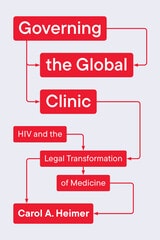
Governing the Global Clinic
HIV and the Legal Transformation of MedicineCarol A. Heimer
University of Chicago Press, 2025
A deep examination of how new, legalistic norms affected the trajectory of global HIV care and altered the practice of medicine.
HIV emerged in the world at a time when medicine and healthcare were undergoing two major transformations: globalization and a turn toward legally inflected, rule-based ways of doing things. It accelerated both trends. While pestilence and disease are generally considered the domain of biological sciences and medicine, social arrangements—and law in particular—are also crucial.
Drawing on years of research in HIV clinics in the United States, Thailand, South Africa, and Uganda, Governing the Global Clinic examines how growing norms of legalized accountability have altered the work of healthcare systems and how the effects of legalization vary across different national contexts. A key feature of legalism is universalistic language, but, in practice, rules are usually imported from richer countries (especially the United States) to poorer ones that have less adequate infrastructure and fewer resources with which to implement them. Challenging readers to reconsider the impulse to use law to organize and govern social life, Governing the Global Clinic poses difficult questions: When do rules solve problems, and when do they create new problems? When do rules become decoupled from ethics, and when do they lead to deeper moral commitments? When do rules reduce inequality? And when do they reflect, reproduce, and even amplify inequality?
Gray Matters
Finding Meaning in the Stories of Later LifeEllyn Lem
Rutgers University Press, 2020
Finalist for the 2021 American Book Fest Best Book Awards
Aging is one of the most compelling issues today, with record numbers of seniors over sixty-five worldwide. Gray Matters: Finding Meaning in the Stories of Later Life examines a diverse array of cultural works including films, literature, and even art that represent this time of life, often made by people who are seniors themselves. These works, focusing on important topics such as housing, memory loss, and intimacy, are analyzed in dialogue with recent research to explore how “stories” illuminate the dynamics of growing old by blending fact with imagination. Gray Matters also incorporates the life experiences of seniors gathered from over two hundred in-depth surveys with a range of questions on growing old, not often included in other age studies works. Combining cultural texts, gerontology research, and observations from older adults will give all readers a fuller picture of the struggles and pleasures of aging and avoids over-simplified representations of the process as all negative or positive.