Results by title
154 books match the query 'East' and 6 start with g
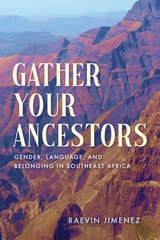
Gather Your Ancestors
Gender, Language, and Belonging in Southeast AfricaRaevin Jimenez
University of Wisconsin Press, 2026
Historically, southeasternmost Africa has been home to a large variety of speech communities, including Nguni, East Bantu, Khoi, and San—the legacy of a long and complicated history of migration, interaction, assimilation, and disaggregation between many peoples. With detailed, careful analysis, Raevin Jimenez guides readers through a thousand years of human movement, cultural contact, and social development in this region. Taking a historical linguistics approach, she sheds new light on this history by focusing on Nguni speakers’ use of gendered practices—including initiation, marriage, and avoidant speech known as hlónipha—to blend multilingual and diverse communities.
Use of gendered institutions inaugurated variable social spaces that could either elide or accommodate difference and thus enabled a multiplicity of community types. Contrary to previous assumptions about the roles of men and women in precolonial southeasternmost Africa, Jimenez shows that gender impacted life and social interactions across a large variety of important domains and became a way of forming, negotiating, and maintaining community. These developments shaped and remain visible in southeastern African speech communities today, and understanding them is vital to understanding the region’s long history and current linguistic society.
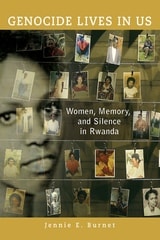
Genocide Lives in Us
Women, Memory, and Silence in RwandaJennie E. Burnet
University of Wisconsin Press, 2012
In the aftermath of the 1994 genocide, Rwandan women faced the impossible—resurrecting their lives amidst unthinkable devastation. Haunted by memories of lost loved ones and of their own experiences of violence, women rebuilt their lives from “less than nothing.” Neither passive victims nor innate peacemakers, they traversed dangerous emotional and political terrain to emerge as leaders in Rwanda today. This clear and engaging ethnography of survival tackles three interrelated phenomena—memory, silence, and justice—and probes the contradictory roles women played in postgenocide reconciliation.
Based on more than a decade of intensive fieldwork, Genocide Lives in Us provides a unique grassroots perspective on a postconflict society. Anthropologist Jennie E. Burnet relates with sensitivity the heart-wrenching survival stories of ordinary Rwandan women and uncovers political and historical themes in their personal narratives. She shows that women’s leading role in Rwanda’s renaissance resulted from several factors: the dire postgenocide situation that forced women into new roles; advocacy by the Rwandan women’s movement; and the inclusion of women in the postgenocide government.
Honorable Mention, Aidoo-Snyder Book Prize, Women’s Caucus of the African Studies Association
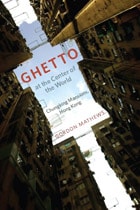
Ghetto at the Center of the World
Chungking Mansions, Hong KongGordon Mathews
University of Chicago Press, 2011
But as Ghetto at the Center of the World shows us, a trip to Chungking Mansions reveals a far less glamorous side of globalization. A world away from the gleaming headquarters of multinational corporations, Chungking Mansions is emblematic of the way globalization actually works for most of the world’s people. Gordon Mathews’s intimate portrayal of the building’s polyethnic residents lays bare their intricate connections to the international circulation of goods, money, and ideas. We come to understand the day-to-day realities of globalization through the stories of entrepreneurs from Africa carting cell phones in their luggage to sell back home and temporary workers from South Asia struggling to earn money to bring to their families. And we see that this so-called ghetto—which inspires fear in many of Hong Kong’s other residents, despite its low crime rate—is not a place of darkness and desperation but a beacon of hope.
Gordon Mathews’s compendium of riveting stories enthralls and instructs in equal measure, making Ghetto at the Center of the World not just a fascinating tour of a singular place but also a peek into the future of life on our shrinking planet.
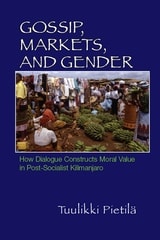
Gossip, Markets, and Gender
How Dialogue Constructs Moral Value in Post-Socialist KilimanjaroTuulikki Pietilä
University of Wisconsin Press, 2007
"All traders are thieves, especially women traders," people often assured social anthropologist Tuulikki Pietilä during her field work in Kilimanjaro, Tanzania, in the mid-1990s. Equally common were stories about businessmen who had "bought a spirit" for their enrichment. Pietilä places these and similar comments in the context of the liberalization of the Tanzanian economy that began in the 1980s, when many men and women found themselves newly enmeshed in the burgeoning market economy. Even as emerging private markets strengthened the position of enterprising people, economic resources did not automatically lead to heightened social position. Instead, social recognition remained tied to a complex cultural negotiation through stories and gossip in markets, bars, and neighborhoods.
With its rich ethnographic detail, Gossip, Markets, and Gender shows how gossip and the responses to it form an ongoing dialogue through which the moral reputations of trading women and businessmen, and cultural ideas about moral value and gender, are constructed and rethought. By combining a sociolinguistic study of talk, storytelling, and conversation with analysis of gender, the political economy of trading, and the moral economy of personhood, Pietilä reveals a new perspective on the globalization of the market economy and its meaning and impact on the local level.
Winner, Aidoo-Snyder Prize, African Studies Association Women’s Caucus
Greek Gods in the East
Hellenistic Iconographic Schemes in Central AsiaLadislav Stanco
Karolinum Press, 2012

Guide to the Flowers of Western China
Christopher Grey-Wilson and Phillip Cribb
Royal Botanic Gardens, Kew, 2023
Since the publication of the first edition of Guide to the Flowers of Western China in 2011, there have been great strides in knowledge of the flora of China through international collaboration. Many plants included in the first edition have been revisited in the wild, while areas hitherto inaccessible have opened up, if sometimes only temporarily. Great advances in systematic botany have occurred since the publication of the first edition, particularly with the widespread availability of rapid DNA analysis. The result of this has been an influx of new photographs and data, and the need for a second edition of Guide to the Flowers of Western China.