110 books match the query 'Education (Higher)' and 4 start with g
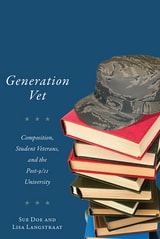
cover of Generation Vet: Composition, Student Veterans, and the Post-9/11 University

Generation Vet

Composition, Student Veterans, and the Post-9/11 University

Sue Doe

Utah State University Press, 2014

Institutions of higher education are experiencing the largest influx of enrolled veterans since World War II, and these student veterans are transforming post-secondary classroom dynamics. While many campus divisions like admissions and student services are actively moving to accommodate the rise in this demographic, little research about this population and their educational needs is available, and academic departments have been slower to adjust. In Generation Vet, fifteen chapters offer well-researched, pedagogically savvy recommendations for curricular and programmatic responses to student veterans for English and writing studies departments.

In work with veterans in writing-intensive courses and community contexts, questions of citizenship, disability, activism, community-campus relationships, and retention come to the fore. Moreover, writing-intensive courses can be sites of significant cultural exchanges—even clashes—as veterans bring military values, rhetorical traditions, and communication styles that may challenge the values, beliefs, and assumptions of traditional college students and faculty.

This classroom-oriented text addresses a wide range of issues concerning veterans, pedagogy, rhetoric, and writing program administration. Written by diverse scholar-teachers and written in diverse genres, the essays in this collection promise to enhance our understanding of student veterans, composition pedagogy and administration, and the post-9/11 university.
[more]
cover of Giants Among Us: First-Generation College Graduates Who Lead Activist Lives

Giants Among Us

First-Generation College Graduates Who Lead Activist Lives

Sandria Rodriguez

Vanderbilt University Press, 2001

How do children from undereducated and impoverished backgrounds get to college? What are the influences that lead them to overcome their socioeconomic disadvantages and sometimes the disapproval of families and friends to succeed in college? These are the basic questions Sandria Rodriguez posed to seventeen first-generation college graduates, and their compelling life stories make important contributions to what little is known about this phenomenon.

The daughter of parents who didn't finish elementary school, Rodriguez uses many examples from her own life in the course of examining the participants' experiences before, during, and after college that directed them toward social or educational activism. Together, the seventeen represent a wide range of diversity in terms of race, ethnicity, age, geographical area of childhood, and profession. Twelve of the seventeen hold advanced degrees, all are working professionals, and all come from families who were poor. Jerry, the son of German immigrants, owns an engineering company in Chicago; Chang, a native of China, is the first from his village to go to college; Grant, a sharecropper's son, is a lawyer with a nationally prominent law firm in Washington, D.C., and patron of fine arts; Arlene, a Mohawk Indian, is a storyteller and social activist; Alex, from Spanish Harlem, is an elementary school principal.

The book is divided into four parts. In the first two chapters, we meet the participants. In the three chapters that follow, Rodriguez examines how the participants as children perceived themselves within their families, schools, and communities. Chapters four and five focus on the campus life and the participants' activist experiences. Finally, chapter six offers recommendations for mentoring disadvantaged children, so that they can successfully "switch the track" and aim for something better.

Giants Among Us is an essential resource for college administrators, faculty, counselors, and student support-services staff--as well as K-12 educators--concerned with preparing, retaining and mentoring first-generation students.
[more]
cover of Going North Thinking West: The Intersections of Social Class, Critical Thinking, and Politicized Writing Instruction

Going North Thinking West

The Intersections of Social Class, Critical Thinking, and Politicized Writing Instruction

Irvin Peckham

Utah State University Press, 2010
A long-time writing program administrator and well-respected iconoclast, Irvin Peckham is strongly identified with progressive ideologies in education. However, in Going North Thinking West, Peckham mounts a serious critique of what is called critical pedagogy—primarily a project of the academic left—in spite of his own sympathies there.
            College composition is fundamentally a middle-class enterprise, and is conducted by middle-class professionals, while student demographics show increasing presence of the working class. In spite of best intentions to ameliorate inequitable social class relationships, says Peckham, critical pedagogies can actually contribute to reproducing those relationships in traditional forms—not only perpetuating social inequities, but pushing working class students toward self-alienation, as well.
            Peckham argues for more clarity on the history of critical thinking, social class structures and teacher identity (especially as these are theorized by Pierre Bourdieu), while he undertakes a critical inquiry of the teaching practices with which even he identifies.
            Going North Thinking West focuses especially on writing teachers who claim a necessary linkage between critical thinking and writing skills; these would include both teachers who promote the fairly a-political position that argumentation is the obvious and necessary form of academic discourse, and more controversial teachers who advocate turning a classroom into a productive site of social transformation.
            Ultimately, Peckham argues for a rereading of Freire (an icon of transformational pedagogy), and for a collaborative investigation of students’ worlds as the first step in a successful writing pedagogy. It is an argument for a pedagogy based on service to students rather than on transforming them.
[more]
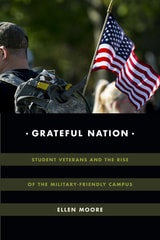
cover of Grateful Nation: Student Veterans and the Rise of the Military-Friendly Campus

Grateful Nation

Student Veterans and the Rise of the Military-Friendly Campus

Ellen Moore

Duke University Press, 2017

In today's volunteer military many recruits enlist for the educational benefits, yet a significant number of veterans struggle in the classroom, and many drop out. The difficulties faced by student veterans have been attributed to various factors: poor academic preparation, PTSD and other postwar ailments, and allegedly antimilitary sentiments on college campuses. In Grateful Nation Ellen Moore challenges these narratives by tracing the experiences of Iraq and Afghanistan war veterans at two California college campuses. Drawing on interviews with dozens of veterans, classroom observations, and assessments of the work of veteran support organizations, Moore finds that veterans' academic struggles result from their military training and combat experience, which complicate their ability to function in civilian schools. While there is little evidence of antimilitary bias on college campuses, Moore demonstrates the ways in which college programs that conflate support for veterans with support for the institutional military lead to suppression of campus debate about the wars, discourage antiwar activism, and encourage a growing militarization.
[more]