Results by title
271 books match the query 'Employment' and 5 start with g
Gender and Family Issues in the Workplace
Francine D. Blau
Russell Sage Foundation, 1997
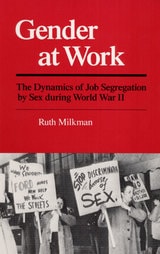
Gender at Work
The Dynamics of Job Segregation by Sex during World War IIRuth Milkman
University of Illinois Press, 1987
Women's entry into so-called men's work during World War II sparked conflicts at the time and when men returned at war's end. Ruth Milkman delves into the issues in play and the prewar origins of traditional patterns of gender segregation in the workplace. Ranging from the dynamics on the shop floor to hiring patterns, Milkman pays particular attention to automobile and electrical manufacturing. She analyzes a number of persistent questions, including management's decision to re-embrace gender segregation after the war; women's lack of protest; the failure of unions to protect women; and how related employer strategies helped control labor by maintaining women's place as workers paid less than men.
Gendering Labor History
Alice Kessler-Harris
University of Illinois Press, 2006
This collection represents the thirty-year intellectual trajectory of one of today’s leading historians of gender and labor in the United States. The seventeen essays are divided into four sections, narrating the evolution and refinement of Alice Kessler-Harris's central project: showing gender’s fundamental importance in the shaping of United States history and working class culture.
The first section considers women and organized labor while the second pushes this analysis toward a gendered labor history as the essays consider the gendering of male as well as female workers and how gender operates with and within the social category of class. Subsequent sections broaden this framework to examine U.S. social policy as a whole, the question of economic citizenship, and wage labor from a global perspective. While each essay represents an important intervention in American historiography in itself, the collection taken as a whole shows Kessler-Harris continuing to push the field of American history to greater levels of inclusion and analysis.
Gendering the Recession
Media and Culture in an Age of AusterityDiane Negra and Yvonne Tasker, eds.
Duke University Press, 2014
Contributors. Sarah Banet-Weiser, Hamilton Carroll, Hannah Hamad, Anikó Imre, Suzanne Leonard, Isabel Molina-Guzmán, Sinéad Molony, Elizabeth Nathanson, Diane Negra, Tim Snelson, Yvonne Tasker, Pamela Thoma

Global Cinderellas
Migrant Domestics and Newly Rich Employers in TaiwanPei-Chia Lan
Duke University Press, 2006
Lan demonstrates how economic disparities, immigration policies, race, ethnicity, and gender intersect in the relationship between the migrant workers and their Taiwanese employers. The employers are eager to flex their recently acquired financial muscle; many are first-generation career women as well as first-generation employers. The domestics are recruited from abroad as contract and “guest” workers; restrictive immigration policies prohibit them from seeking permanent residence or transferring from one employer to another. They care for Taiwanese families’ children, often having left their own behind. Throughout Global Cinderellas, Lan pays particular attention to how the women she studied identify themselves in relation to “others”—whether they be of different classes, nationalities, ethnicities, or education levels. In so doing, she offers a framework for thinking about how migrant workers and their employers understand themselves in the midst of dynamic transnational labor flows.