394 books match the query 'English literature' and 6 start with g
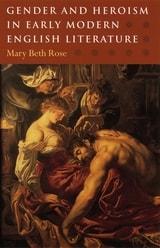
cover of Gender and Heroism in Early Modern English Literature

Gender and Heroism in Early Modern English Literature

Mary Beth Rose

University of Chicago Press, 2001

For most readers and spectators, heroism takes the form of public, idealized masculinity. It calls to mind socially and morally elevated men embarking on active adventures: courageously confronting danger; valiantly rescuing the helpless; exploring and claiming unconquered terrain. But in this book, Mary Beth Rose argues that from the late sixteenth to the late seventeenth centuries, a passive, more female, but equally potent dimension of heroic identity began to dominate English culture. For both men and women, heroism came to be defined in terms of patience, as the ability to endure suffering, catastrophe, and pain.

Interweaving discourses of gender, Rose explores ways in which this heroics of endurance became the dominant model. She examines the glamorous, failed destinies of heroes in plays by Shakespeare, Jonson, and Marlowe; Elizabeth I's creation of a heroic identity in her public speeches; the autobiographies of four ordinary women thrust into the public sphere by civil war; and the seduction of heroes into slavery in works by Milton, Aphra Behn, and Mary Astell. Ultimately, her study demonstrates the importance of the female in the creation of modern heroism, while offering a critique of both idealized action and suffering.

[more]
cover of Gendering Bodies/Performing Art: Dance and Literature in Early Twentieth-Century British Culture

Gendering Bodies/Performing Art

Dance and Literature in Early Twentieth-Century British Culture

Amy Koritz

University of Michigan Press, 1995
Gendering Bodies / Performing Art is the first book that attempts a conceptual integration of dance and literary history in British culture. It attempts to make visible the role of dance in creating, reinforcing, and challenging developments in aesthetic practice and ideology in which both dance and literature participated. Koritz integrates chapters on dance and dancers- from music hall ballet girls of the 1890s to the prestigious season of Diaghilev's Russian Ballet- with discussions on how major literary figures such as Oscar Wilde, W.B. Yeats, George Bernard Shaw, and T.S. Eliot used dance to further their own aesthetic agendas. In doing so, she provides an illuminating analysis of the connections between literature and dance, and explores the ways in which these two arts actively engaged in cultural processes encompassing both. ". . . provocative and stimulating . . . an invaluable addition to the work that is already available on turn-of-century theater/culture. . . ."--Vivien Gardner, Manchester University "Reaching between the poles of popular music hall and the Ballet Russe, Koritz addresses a series of interrelated, mutually informing discourses in which we overhear the language of the literary community in its accolades and in its outcries. Koritz's book will prove useful to a wide variety of readers; many scholars of English literature will undoubtedly use this book to the fullest, turning to it again and again as a contextual primer for performance issues in their field."--Cheryl Herr, University of Iowa Amy Koritz is Co-Director of the Cultural Studies Program and Assistant Professor of English, Tulane University.
[more]
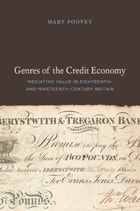
cover of Genres of the Credit Economy: Mediating Value in Eighteenth- and Nineteenth-Century Britain

Genres of the Credit Economy

Mediating Value in Eighteenth- and Nineteenth-Century Britain

Mary Poovey

University of Chicago Press, 2008

How did banking, borrowing, investing, and even losing money—in other words, participating in the modern financial system—come to seem likeroutine activities of everydaylife? Genres of the Credit Economy addressesthis question by examining the history of financial instruments and representations of finance in eighteenth- and nineteenth-century Britain.
Chronicling the process by which some of our most important conceptual categories were naturalized, Mary Poovey explores complex relationships among forms of writing that are not usually viewed together, from bills of exchange and bank checks, to realist novels and Romantic poems, to economic theory and financial journalism. Taking up all early forms of financial and monetarywriting, Poovey argues that these genres mediated for early modern Britons the operations of a market system organized around credit and debt. By arguing that genre is a critical tool for historical and theoretical analysis and an agent in the events that formed the modern world, Poovey offers a new way to appreciate the character of the credit economy and demonstrates the contribution historians and literary scholars can make to understanding its operations.
Much more than an exploration of writing on and around money, Genres of the Credit Economy offers startling insights about the evolution of disciplines and the separation of factual and fictional genres.
[more]
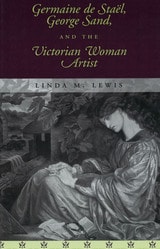
cover of Germaine De Staël, George Sand, and the Victorian Woman Artist

Germaine De Staël, George Sand, and the Victorian Woman Artist

Linda M. Lewis

University of Missouri Press, 2003
By examining literary portraits of the woman as artist, Linda M. Lewis traces the matrilineal inheritance of four Victorian novelists and poets: George Eliot, Elizabeth Barrett Browning, Geraldine Jewsbury, and Mrs. Humphry Ward. She argues that while the male Romantic artist saw himself as god and hero, the woman of genius lacked a guiding myth until Germaine de Staël and George Sand created one. The protagonists of Staël’s Corinne and Sand’s Consuelo combine attributes of the goddess Athena, the Virgin Mary, Virgil’s Sibyl, and Dante’s Beatrice. Lewis illustrates how the resulting Corinne/Consuelo effect is exhibited in scores of English artist-as-heroine narratives, particularly in the works of these four prominent writers who most consciously and elaborately allude to the French literary matriarchs.
            In her initial chapter, Lewis explains Corinne’s gift as “l’enthousiasme” and Consuelo’s as “la flamme sacrée.” Corinne uses her influence as a political Sibyl to enter the debates of the Napoleonic era; Consuelo employs her sacred fire as a divine Sophia to indict injustice throughout Europe. Subsequent chapters examine the public and private voices of the Sibyls and Sophias of Victorian fiction, as well as the degree to which their gift demands service to art, to God, and to humankind. The closing chapter studies the waning influence of Staël and Sand in the fin-de-siècle “New Woman” novel.
The core of Lewis’s book is its treatment of the Victorian author and her feminine aesthetics. In each chapter Lewis uncovers the references to Corinne and Consuelo—subtle or overt, serious or facetious—and reveals the resulting tension when an artist invokes a foremother but avoids merging with the mother whom she emulates. The methodology of this bookincludes myth criticism, feminist commentary, and psychoanalytic theory, but its strength lies in Lewis’s close reading of the intertextuality of ten literary works.
Exploring a connection between French and English literature and providing fresh insight, Germaine de Staël, George Sand, and the Victorian Woman Artist makes a major contribution to our understanding of nineteenth-century feminism.
[more]
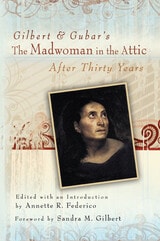
cover of Gilbert and Gubar's The Madwoman in the Attic after Thirty Years

Gilbert and Gubar's The Madwoman in the Attic after Thirty Years

Edited by Annette R. Federico, Foreward by Sandra M. Gilbert

University of Missouri Press, 2011

When it was published in 1979, Sandra M. Gilbert and Susan Gubar's The Madwoman in the Attic: The Woman Writer and the Nineteenth-Century Literary Imaginationwas hailed as a pathbreaking work of criticism, changing the way future scholars would read Jane Austen, Mary Shelley, the Brontës, George Eliot, and Emily Dickinson. This thirtieth-anniversary collection adds both valuable reassessments and new readings and analyses inspired by Gilbert and Gubar’s approach. It includes work by established and up-and-coming scholars, as well as retrospective accounts of the ways in which The Madwoman in the Attic has influenced teaching, feminist activism, and the lives of women in academia.

These contributions represent both the diversity of today’s feminist criticism and the tremendous expansion of the nineteenth-century canon. The authors take as their subjects specific nineteenth- and twentieth-century women writers, the state of feminist theory and pedagogy, genre studies, film, race, and postcolonialism, with approaches ranging from ecofeminism to psychoanalysis. And although each essay opens Madwoman to a different page, all provocatively circle back—with admiration and respect, objections and challenges, questions and arguments—to Gilbert and Gubar's groundbreaking work.
The essays are as diverse as they are provocative. Susan Fraiman describes how Madwoman opened the canon, politicized critical practice, and challenged compulsory heterosexuality, while Marlene Tromp tells how it elegantly embodied many concerns central to second-wave feminism. Other chapters consider Madwoman’s impact on Milton studies, on cinematic adaptations of Wuthering Heights, and on reassessments of Ann Radcliffe as one of the book’s suppressed foremothers.
In the thirty years since its publication, The Madwoman in the Attic has potently informed literary criticism of women’s writing: its strategic analyses of canonical works and its insights into the interconnections between social environment and human creativity have been absorbed by contemporary critical practices. These essays constitute substantive interventions into established debates and ongoing questions among scholars concerned with defining third-wave feminism, showing that, as a feminist symbol, the raging madwoman still has the power to disrupt conventional ideas about gender, myth, sexuality, and the literary imagination.
[more]
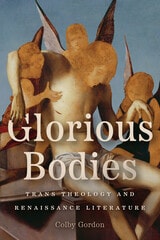
cover of Glorious Bodies: Trans Theology and Renaissance Literature

Glorious Bodies

Trans Theology and Renaissance Literature

Colby Gordon

University of Chicago Press, 2024

A prehistory of transness that recovers early modern theological resources for trans lifeworlds.
 
In this striking contribution to trans history, Colby Gordon challenges the prevailing assumption that trans life is a byproduct of recent medical innovation by locating a cultural imaginary of transition in the religious writing of the English Renaissance. Marking a major intervention in early modern gender studies, Glorious Bodies insists that transition happened, both socially and surgically, hundreds of years before the nineteenth-century advent of sexology. Pairing literary texts by Shakespeare, Webster, Donne, and Milton with a broad range of primary sources, Gordon examines the religious tropes available to early modern subjects for imagining how gender could change. From George Herbert’s invaginated Jesus and Milton’s gestational Adam to the ungendered “glorious body” of the resurrection, early modern theology offers a rich conceptual reservoir of trans imagery.
 
In uncovering early modern trans theology, Glorious Bodies mounts a critique of the broad consensus that secularism is a necessary precondition for trans life, while also combating contemporary transphobia and the right-wing Christian culture war seeking to criminalize transition. Developing a rehabilitative account of theology’s value for positing trans lifeworlds, this book leverages premodern religion to imagine a postsecular transness in the present.
[more]