Results by title
57 books match the query 'Essays & Narratives' and 4 start with g

Gardens
An Essay on the Human ConditionRobert Pogue Harrison
University of Chicago Press, 2008
Humans have long turned to gardens—both real and imaginary—for sanctuary from the frenzy and tumult that surrounds them. Those gardens may be as far away from everyday reality as Gilgamesh’s garden of the gods or as near as our own backyard, but in their very conception and the marks they bear of human care and cultivation, gardens stand as restorative, nourishing, necessary havens.
With Gardens, Robert Pogue Harrison graces readers with a thoughtful, wide-ranging examination of the many ways gardens evoke the human condition. Moving from from the gardens of ancient philosophers to the gardens of homeless people in contemporary New York, he shows how, again and again, the garden has served as a check against the destruction and losses of history. The ancients, explains Harrison, viewed gardens as both a model and a location for the laborious self-cultivation and self-improvement that are essential to serenity and enlightenment, an association that has continued throughout the ages. The Bible and Qur’an; Plato’s Academy and Epicurus’s Garden School; Zen rock and Islamic carpet gardens; Boccaccio, Rihaku, Capek, Cao Xueqin, Italo Calvino, Ariosto, Michel Tournier, and Hannah Arendt—all come into play as this work explores the ways in which the concept and reality of the garden has informed human thinking about mortality, order, and power.
Alive with the echoes and arguments of Western thought, Gardens is a fitting continuation of the intellectual journeys of Harrison’s earlier classics, Forests and The Dominion of the Dead. Voltaire famously urged us to cultivate our gardens; with this compelling volume, Robert Pogue Harrison reminds us of the nature of that responsibility—and its enduring importance to humanity.
"I find myself completely besotted by a new book titled Gardens: An Essay on the Human Condition, by Robert Pogue Harrison. The author . . . is one of the very best cultural critics at work today. He is a man of deep learning, immense generosity of spirit, passionate curiosity and manifold rhetorical gifts."—Julia Keller, Chicago Tribune
"This book is about gardens as a metaphor for the human condition. . . . Harrison draws freely and with brilliance from 5,000 years of Western literature and criticism, including works on philosophy and garden history. . . . He is a careful as well as an inspiring scholar."—Tom Turner, Times Higher Education
"When I was a student, my Cambridge supervisor said, in the Olympian tone characteristic of his kind, that the only living literary critics for whom he would sell his shirt were William Empson and G. Wilson Knight. Having spent the subsequent 30 years in the febrile world of academic Lit. Crit. . . . I’m not sure that I’d sell my shirt for any living critic. But if there had to be one, it would unquestionably be Robert Pogue Harrison, whose study Forests: The Shadow of Civilization, published in 1992, has the true quality of literature, not of criticism—it stays with you, like an amiable ghost, long after you read it.
“Though more modest in scope, this new book is similarly destined to become a classic. It has two principal heroes: the ancient philosopher Epicurus . . . and the wonderfully witty Czech writer Karel Capek, apropos of whom it is remarked that, whereas most people believe gardening to be a subset of life, ‘gardeners, including Capek, understand that life is a subset of gardening.’”—Jonathan Bate, The Spectator
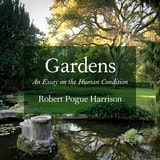
Gardens
An Essay on the Human ConditionRobert Pogue Harrison
University of Chicago Press, 2008
Humans have long turned to gardens—both real and imaginary—for sanctuary from the frenzy and tumult that surrounds them. Those gardens may be as far away from everyday reality as Gilgamesh’s garden of the gods or as near as our own backyard, but in their very conception and the marks they bear of human care and cultivation, gardens stand as restorative, nourishing, necessary havens.
With Gardens, Robert Pogue Harrison graces readers with a thoughtful, wide-ranging examination of the many ways gardens evoke the human condition. Moving from from the gardens of ancient philosophers to the gardens of homeless people in contemporary New York, he shows how, again and again, the garden has served as a check against the destruction and losses of history. The ancients, explains Harrison, viewed gardens as both a model and a location for the laborious self-cultivation and self-improvement that are essential to serenity and enlightenment, an association that has continued throughout the ages. The Bible and Qur’an; Plato’s Academy and Epicurus’s Garden School; Zen rock and Islamic carpet gardens; Boccaccio, Rihaku, Capek, Cao Xueqin, Italo Calvino, Ariosto, Michel Tournier, and Hannah Arendt—all come into play as this work explores the ways in which the concept and reality of the garden has informed human thinking about mortality, order, and power.
Alive with the echoes and arguments of Western thought, Gardens is a fitting continuation of the intellectual journeys of Harrison’s earlier classics, Forests and The Dominion of the Dead. Voltaire famously urged us to cultivate our gardens; with this compelling volume, Robert Pogue Harrison reminds us of the nature of that responsibility—and its enduring importance to humanity.
"I find myself completely besotted by a new book titled Gardens: An Essay on the Human Condition, by Robert Pogue Harrison. The author . . . is one of the very best cultural critics at work today. He is a man of deep learning, immense generosity of spirit, passionate curiosity and manifold rhetorical gifts."—Julia Keller, Chicago Tribune
"This book is about gardens as a metaphor for the human condition. . . . Harrison draws freely and with brilliance from 5,000 years of Western literature and criticism, including works on philosophy and garden history. . . . He is a careful as well as an inspiring scholar."—Tom Turner, Times Higher Education
"When I was a student, my Cambridge supervisor said, in the Olympian tone characteristic of his kind, that the only living literary critics for whom he would sell his shirt were William Empson and G. Wilson Knight. Having spent the subsequent 30 years in the febrile world of academic Lit. Crit. . . . I’m not sure that I’d sell my shirt for any living critic. But if there had to be one, it would unquestionably be Robert Pogue Harrison, whose study Forests: The Shadow of Civilization, published in 1992, has the true quality of literature, not of criticism—it stays with you, like an amiable ghost, long after you read it.
“Though more modest in scope, this new book is similarly destined to become a classic. It has two principal heroes: the ancient philosopher Epicurus . . . and the wonderfully witty Czech writer Karel Capek, apropos of whom it is remarked that, whereas most people believe gardening to be a subset of life, ‘gardeners, including Capek, understand that life is a subset of gardening.’”—Jonathan Bate, The Spectator
Green Chili and Other Impostors
Furstenau, Nina Mukerjee
University of Iowa Press, 2021
Food history is a world heritage story that has all the drama of a tense thriller or maybe a mystery. Whose food is it? Who gets to tell its tale? Respect for food history might tame the accusations of appropriation, but what is at stake as food traditions and biodiversity ebb away is the great, and not always good, story of us.
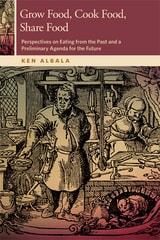
Grow Food, Cook Food, Share Food
Perspectives on Eating from the Past and a Preliminary Agenda for the FutureKen Albala
Oregon State University Press, 2013
Albala considers what the traditions we have needlessly lost have to offer us today: a serious appreciation for the generative power of the earth, the great pleasures of cooking food, and the joy of sharing food with family, friends, and even strangers. In Albala’s compelling book, obscure seventeenth-century Italian farmer-nobles, Roman statesmen, and quirky cheesemakers from the fifteenth and sixteenth centuries all offer lessons about our relationship with the food we eat.
A rare form of historical activism, Grow Food, Cook Food, Share Food is written for anyone who likes to eat, loves to cook, and knows how to throw a great dinner party.
An OSU Press Horning Visiting Scholars Publication.