Results by title
50 books match the query 'Field' and 5 start with g
Gender and Agricultural Development
Surveying the FieldEdited by Helen K. Henderson
University of Arizona Press, 1995
This book is both a resource guide and a review of major issues in gender and agriculture which demonstrates that recognizing the contribution of women to agricultural production is a necessary step in development planning. It presents relevant information and research literature regarding women's roles in agriculture in a consolidated and accessible format, offering insights into how the inclusion or exclusion of appropriate information at the planning stage can have an impact during implementation. It also provides guidelines for locating information on gender-related agricultural issues and incorporating it into development planning, research, and training. The literature reviewed not only calls attention to the work women do in order to improve their access to technology and training but also challenges existing development paradigms. The issues discussed present women's experiences and local knowledge and allude to gender and class inequities that farming women face. Each chapter is intended to help the reader address major gender issues in a specific subject in order to access relevant information and thereby better design and implement appropriate agricultural planning and policies.
By synthesizing twenty years of international research, Gender and Agricultural Development provides an effective tool for development practitioners to use in training programs or surveys in order to ensure the appropriate collection of gender disaggregated data and for educators to integrate gender issues into courses dealing with social aspects of agricultural systems. Its findings are presented in such a way as to allow them to be easily incorporated into innovative planning for more sustainable and equitable agricultural policies.
Gleanings from the Field
Food Security, Resilience, and Experiential LearningEdited by Dan Trudeau, William Moseley, and Paul Schadewald
Lever Press, 2025
This timely essay collection frames our food security challenges as “wicked problems,” puzzles without clear solutions that are characterized by evolving complexities and divergent stakeholder priorities. In classroom settings, they argue for the usage of experiential learning to cultivate “wicked problem-solving skills” among students. Gleanings from the Field exemplifies this approach, offering pedagogical interventions to prepare students for tackling these wicked problems, while advocating for high-impact learning experiences that enable students to grapple with the interconnected systems influencing food security. Through hands-on experiences and reflective practice, students gain a deeper understanding of these systems and their societal implications. Importantly, the contributions outlined in this volume underscore the need for a multidimensional view of food security, thus examining the intersections of economic interests, government policies, and social movements. By contextualizing food security within broader political-economic arrangements, educators can empower students to enact meaningful change.
Gleanings from the Field argues for a holistic approach to food security education, one that acknowledges the fraught nature of wicked problems and equips students with the skills and knowledge needed for effective action. By integrating experiential learning, conceptual frameworks about food security and resilience, and real-world engagement, educators can cultivate a new generation of resilient problem-solvers committed to addressing food insecurity and other wicked problems.
Going Public
Creating Visibility in the Field of ArtEdited by Sigrid Adorf, Sønke Gau, and Basil Rogger
Diaphanes, 2022
There are many ways to go public in art. There’s exhibiting, publishing, or reviewing. It is only through making artworks public that they become accessible to audiences—a performative act that also involves a marketplace of money and attention. Yet reception is an essential aspect of production.
This book looks at why such reception should not be limited to the art public, positing that going public as an aesthetic and political strategy necessitates an emancipatory practice of public communication that allows, and aspires to, uncertainties, questions, and complexities.
Governance Feminism
Notes from the FieldJanet Halley
University of Minnesota Press, 2019
An interdisciplinary, multifaceted look at feminist engagements with governance across the global North and global South
Governance Feminism: Notes from the Field brings together nineteen chapters from leading feminist scholars and activists to critically describe and assess contemporary feminist engagements with state and state-like power. Gathering examples from North America, South America, Europe, Asia, and the Middle East, it complements and expands on the companion volume Governance Feminism: An Introduction. Its chapters argue that governance feminism (GF) is institutionally diverse and globally distributed—emerging from traditional sites of state power as well as from various forms of governance and operating at the grassroots level, in the private sector, in civil society, and in international relations.
The book begins by confronting the key role that crime and punishment play in GFeminist projects. Here, contributors explore the ideological and political conditions under which this branch of GF became so robust and rethink the carceral turn. Other chapters speak to another face of GFeminism: feminists finding, in mundane and seemingly unspectacular bureaucratic tools, leverage to bring about change in policy and governance practices. Several contributions highlight the political, strategic, and ethical challenges that feminists and LGBT activists must negotiate to play on the governmental field. The book concludes with a focus on feminist interventions in postcolonial legal and political orders, looking at new policy spaces opened up by conflict, postconflict, and occupation.
Providing a clear, cross-cutting, critical lens through which to map developments in feminist governance around the world, Governance Feminism: Notes from the Field makes sense of the costs and benefits of current feminist realities to reimagine feminist futures.
Contributors: Libby Adler, Northeastern U; Aziza Ahmed, Northeastern U; Elizabeth Bernstein, Barnard College; Amy J. Cohen, Ohio State U; Karen Engle, U of Texas at Austin; Jacob Gersen, Harvard U; Leigh Goodmark, U of Maryland; Aeyal Gross, Tel Aviv U; Aya Gruber, U of Colorado, Boulder; Janet Halley, Harvard U; Rema Hammami, Birzeit U, Palestine; Vanja Hamzić, U of London; Isabel Cristina Jaramillo-Sierra; Prabha Kotiswaran, King’s College London; Maleiha Malik, King’s College London; Vasuki Nesiah, New York U; Dianne Otto, Melbourne Law School; Helen Reece; Darren Rosenblum, Pace U; Jeannie Suk Gersen, Harvard U; Mariana Valverde, U of Toronto.
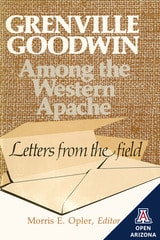
Grenville Goodwin Among the Western Apache
Letters from the FieldEdited by Morris E. Opler
University of Arizona Press, 1973
During this same period, Morris Opler was studying the Chiricahua and Mescalero Apache in New Mexico. In order to exchange information about their studies, Goodwin and Opler began corresponding. Both men were convinced that a long-overdue, systematic comparison of Apachean cultures would yield significant results.